More Joy Ministries
Full Bible Study
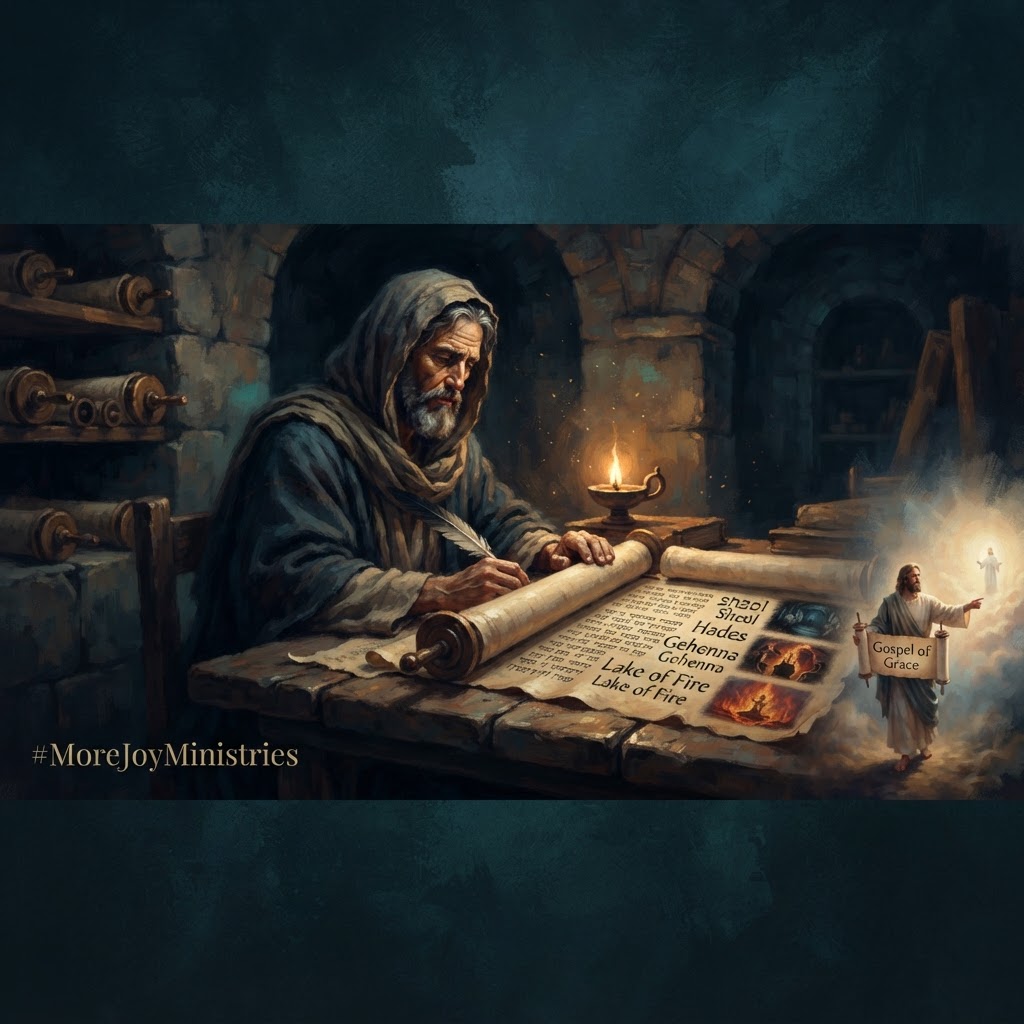
When the Old Testament uses the word hell, it is almost always translating the Hebrew word Sheol. Sheol does not mean a fiery pit of torment.
It refers to the grave, the realm of the dead, or the place where all people go when they die.
Both the righteous and the wicked expected to go there. Jacob said, "I will go down to Sheol to my son mourning" (Gen.
37:35). Job pleaded, "Oh, that You would hide me in Sheol" (Job 14:13).
David recognized God’s presence even there: "If I make my bed in Sheol, You are there" (Ps. 139:8).
Sheol describes a conscious existence rather than annihilation. Scripture notes that in Sheol, the wicked cease from troubling (Job 3:17) and the godly look to God for redemption from its power (Ps.
49:15). The Old Testament offers no picture of eternal fiery torment, but rather a shadowy realm awaiting God’s final judgment.
New Testament writers use three distinct Greek words for hell, and clarity here is essential. Hades is the Greek equivalent of Sheol, functioning as a temporary realm for the dead where the righteous and wicked remain separated.
Jesus describes Hades as a place of consciousness in Luke 16:23, though it is not the final state.
Gehenna is the word Jesus used most frequently for hell. It refers to the Valley of Hinnom, a location outside Jerusalem once associated with idolatry and judgment.
Jesus used this term to describe final judgment, warning people to fear the One who can destroy both soul and body in Gehenna (Matt. 10:28).
It is linked to unquenchable fire (Mark 9:43–48).
Tartarus appears only once in 2 Peter 2:4. It is the place where certain angels are held, distinct from the punishment reserved for humans.
Distinguishing these terms prevents us from confusing temporary conditions with the final reality of Gehenna.
The Bible uses various images to define eternal punishment. These include everlasting fire prepared for the devil and his angels (Matt.
25:41) and everlasting destruction away from the presence of the Lord (2 Thess. 1:9).
Other descriptions include the weeping and gnashing of teeth found in outer darkness (Matt. 8:12) and the lake of fire (Rev.
20:14–15). Hell is the eternal, conscious separation from God expressed through these realities.
Hell is eternal because sin is committed against an infinitely holy God and because the human will may continue in its rejection of Him. God’s justice is both final and irreversible.
Jesus spoke of hell more than anyone else, not to terrify, but to save the lost, for He came to seek and to save that which was lost (Luke 19:10).
Scripture identifies those who experience hell as the unrepentant wicked, those who reject Christ, the devil and his fallen angels, and hypocrites. The biblical descriptions—fire, darkness, and torment—coexist as imagery pointing toward ultimate ruin and exclusion from God’s presence.
Hell is fair because God is a perfect judge (Ps. 98:9).
Punishment fits the offense, yet God desires that none should perish (2 Pet. 3:9).
He paid the ultimate price to save humanity through the cross (Rom. 5:8).
The Bible rejects the idea of a second chance after death. Hebrews 9:27 states that it is appointed for men to die once, and then the judgment.
Luke 16:26 speaks of a great gulf fixed, and Revelation 22:11 implies a state of permanence. Life is the time for mercy, while death leads to judgment.
Jesus spoke about hell to call people to repentance, expose false religion, and reveal the urgency of salvation. He suffered the wrath we deserved so we would not have to bear it ourselves (Isa.
53:5–6).
Hell is real, but so is the cross. Jesus paid the debt, took the punishment, conquered death, and offers eternal life freely to all who believe.
Hell is not God’s desire for anyone, but the gospel is the only escape.
#MoreJoyMinistries