
More Joy Ministries
Full Bible Study
BELIEVERS AND THE FIRSTFRUITS:
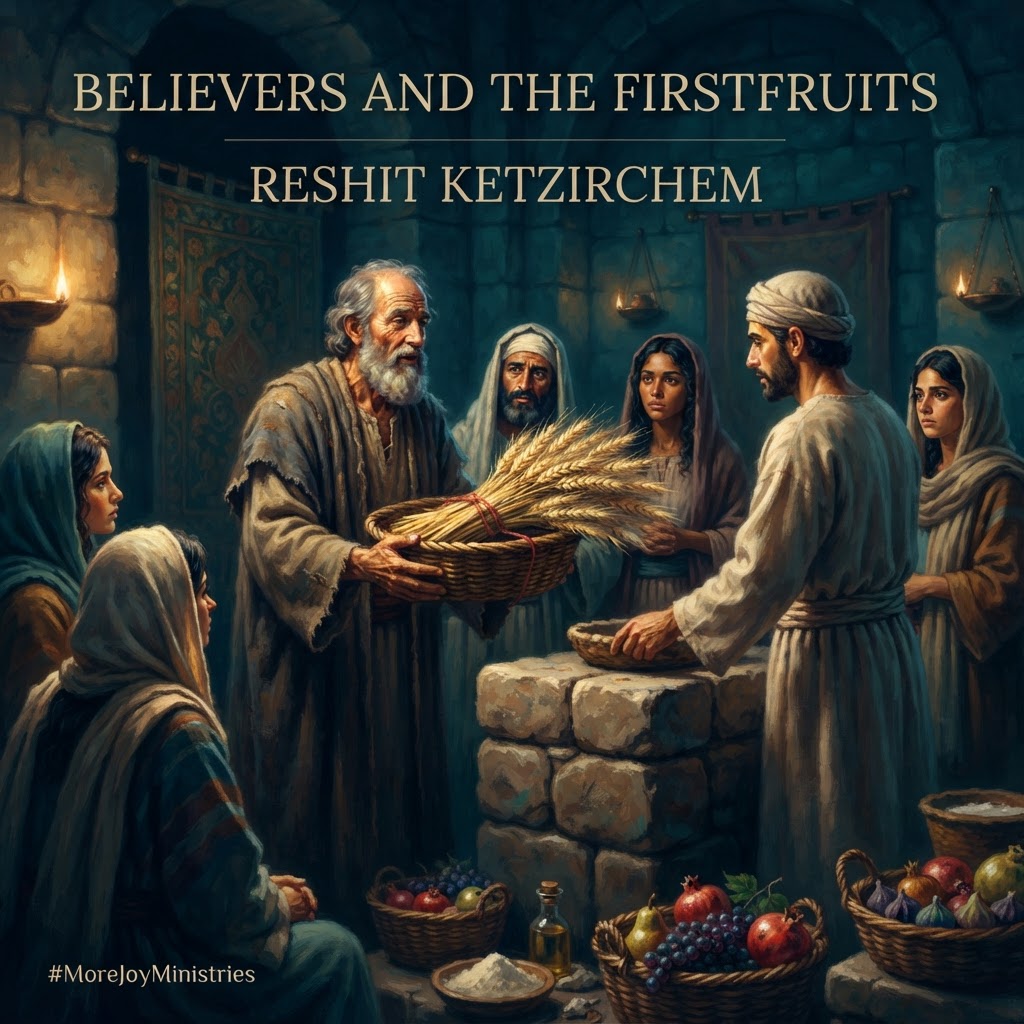
The Feast of Firstfruits has been called by a few different names. Its Hebrew name is Reshit Ketzirchem, which means “the first of your harvest.” It is also known as the Feast of Omer and the Feast of the Wave Sheaf.
In 1 Corinthians 15:20–23, Paul writes:
“But now is Christ risen from the dead, and become the firstfruits of them that slept... But every man in his own order: Christ the firstfruits; afterward they that are Christ’s at his coming.”
That alone shows this is not minor. Christ is called the firstfruits of those who have fallen asleep. His resurrection was not an isolated event. It was the beginning of a coming harvest. He rose first, and those who belong to Him will follow in their order.
Psalm 24:1 says, “The earth is the LORD’S, and the fulness thereof; the world, and they that dwell therein.” So when Scripture talks about firstfruits, it is showing that what is first and best belongs to God and is to be given to Him.
The word firstfruits appears many times in Scripture, and it is an important concept for believers to understand. One of the early mentions is in Exodus 23:16, where God tells His people to celebrate the Feast of Harvest with the firstfruits of their labor. Then Exodus 23:19 says to bring “the first of the firstfruits” into the house of the Lord. The idea is clear: God is to be honored with the first and the best.
Even before that, you can already see this principle in Cain and Abel.
Genesis 4:4–5 says:
“And Abel, he also brought of the firstlings of his flock and of the fat thereof. And the LORD had respect unto Abel and to his offering: But unto Cain and to his offering he had not respect.”
Abel brought the firstlings of his flock. He gave the first and the best. Cain did not approach God the same way, and the Lord did not have respect for his offering.
Then God said to Cain:
“Why art thou wroth? and why is thy countenance fallen? If thou doest well, shalt thou not be accepted?”
Genesis 4:6–7
Cain had the opportunity to do what was right. Instead, he let sin rule him and ended up murdering his brother. The lesson is not complicated. We all have the opportunity to give the Lord our first and our best, but we still have to choose whether we will.
Other passages also speak about firstfruits.
Leviticus 2:12 mentions offering firstfruits to the Lord.
Numbers 28:26 refers to the day of firstfruits during the Feast of Weeks.
Proverbs 3:9 says, “Honour the LORD with thy substance, and with the firstfruits of all thine increase.”
Ezekiel 44:30 says that the best of all the firstfruits belonged to the priests.
Then in the New Testament, Paul writes in Romans 8:23:
“And not only they, but ourselves also, which have the firstfruits of the Spirit, even we ourselves groan within ourselves, waiting for the adoption, to wit, the redemption of our body.”
That verse matters because it shows that believers already have the firstfruits of the Spirit, while still waiting for the redemption of the body. So there is already a present reality and a future hope tied to this idea.
There is also a difference between firstfruits and tithing, even though they are connected. Firstfruits involved giving the first and best. A tithe involved giving a tenth. Both were offerings to God, but firstfruits especially carried the idea of giving to God at the beginning, not after everything else had already taken priority.
In Deuteronomy 26, both firstfruits and tithing are discussed. The firstfruits of the produce were to be offered when the people came into the land. Later in the chapter, the tithe was also set aside, and it served a purpose in caring for others, including the stranger, the fatherless, and the widow. So both giving and obedience were tied to worship, gratitude, and God’s order.
But the part that really stands out is this: believers themselves are spoken of as firstfruits.
2 Thessalonians 2:13 says, “God hath from the beginning chosen you to salvation through sanctification of the Spirit and belief of the truth.”
And James 1:18 says:
“Of his own will begat he us with the word of truth, that we should be a kind of firstfruits of his creatures.”
That is a humbling statement. Believers are described as a kind of firstfruits to God. In other words, those who have been born again through the word of truth are set apart for Him.
That ties in well with Romans 12:1, where Paul says we are to present our bodies as a living sacrifice, holy and acceptable unto God. If Christ is the firstfruits from the dead, and believers are spoken of as firstfruits unto God, then this reaches beyond harvest language and into how we live. It points to a life that is set apart, yielded to God, and no longer treated as our own.
The truth is that because of Christ, believers belong to God. Christ rose as the Firstfruits, and those who belong to Him will follow. Until then, we live as people who have been redeemed, set apart, and called to give the Lord what is first.
#MoreJoyMinistries



