More Joy Ministries
Full Bible Study
THE PENTECOSTAL BRANCH OF CHRISTIANITY:
(WHAT IT IS. WHAT IT TEACHES. WHERE IT STANDS.)
Pentecostalism is one of the fastest-growing branches of Christianity in the modern world. It is not a cult. It is not a fringe sect. It is a Protestant movement that places strong emphasis on the present-day work of the Holy Spirit.
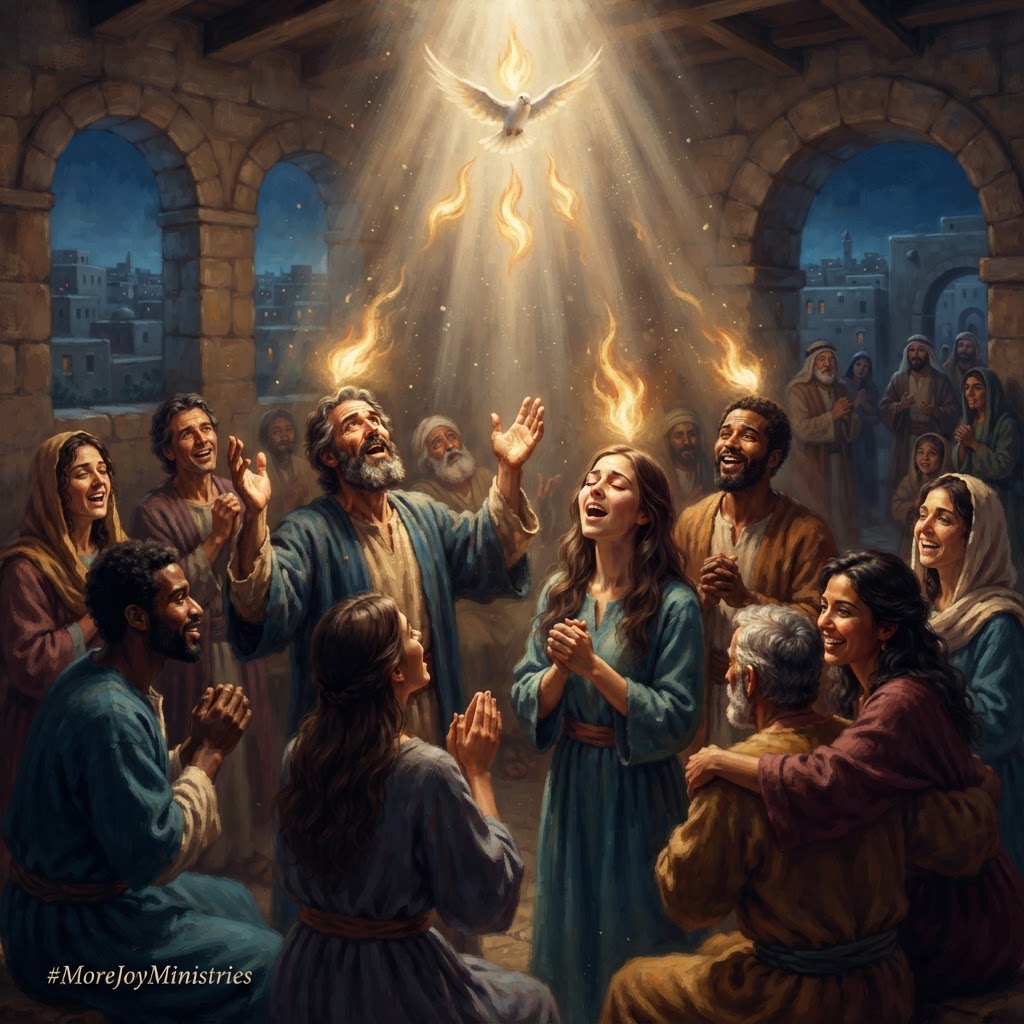
The name comes from Acts 2, the Day of Pentecost. The Greek word is Pentēkostē (Πεντηκοστή), meaning “fiftieth,” referring to the Jewish Feast of Weeks. In Acts 2, the Holy Spirit descends upon the apostles with power. Tongues of fire appear. Languages are spoken. Bold preaching follows. Three thousand are saved.
That chapter becomes the theological foundation for the entire movement.
MODERN ORIGIN:
Modern Pentecostalism traces its roots to the early 1900s, especially the Azusa Street Revival in Los Angeles under William J. Seymour. The meetings were marked by interracial worship, intense prayer, speaking in tongues, and strong emphasis on revival.
From there, Pentecostal denominations formed, including:
Assemblies of God.
Church of God in Christ.
International Church of the Foursquare Gospel.
Today, Pentecostal and Charismatic believers number in the hundreds of millions worldwide.
CORE BELIEFS:
Pentecostals affirm orthodox Christian doctrine:
The Trinity.
The full deity of Jesus Christ.
Salvation by grace through faith.
The authority of Scripture.
The bodily resurrection.
Where they differ from many other Protestants is in their understanding of the gifts of the Holy Spirit.
THE BAPTISM IN THE HOLY SPIRIT:
Pentecostals teach a distinct experience called the “Baptism in the Holy Spirit,” often occurring after conversion.
The Greek word baptizō (βαπτίζω) means to immerse. They argue that believers can be immersed in the Spirit in a powerful, experiential way beyond initial salvation.
They point to Acts 2, Acts 8, Acts 10, and Acts 19.
Many classical Pentecostals teach that speaking in tongues is the “initial physical evidence” of this baptism.
This is a major dividing line between Pentecostals and Baptists, Reformed believers, and many others.
SPEAKING IN TONGUES:
The Greek word glōssa (γλῶσσα) means language or tongue.
In Acts 2, known languages were spoken and understood. In 1 Corinthians 12 to 14, Paul regulates tongues in church worship.
Pentecostals believe tongues continue today.
This leads directly into one of the biggest theological debates in Christianity.
CESSATIONISM VS CONTINUATIONISM:
Cessationists believe miraculous sign gifts ceased with the apostles after the foundation of the church was laid. They often cite 1 Corinthians 13:8–10 and the closing of the canon.
Continuationists believe the gifts continue until Christ returns, pointing to Acts 2:17, “in the last days,” and 1 Corinthians 1:7, which says believers come “behind in no gift” as they await Christ.
Pentecostals are firmly continuationist.
CHARISMATIC VS PENTECOSTAL:
Not all Charismatics are Pentecostal.
Pentecostal churches historically require tongues as initial evidence of Spirit baptism.
Charismatic believers may accept gifts like prophecy and tongues but do not always require tongues as proof of Spirit baptism. Charismatics exist within Baptist, Lutheran, Anglican, and even Catholic churches.
The difference is often doctrinal structure and denominational identity.
ONENESS PENTECOSTALS:
Here we need precision.
Most Pentecostals are Trinitarian and affirm one God in three Persons.
However, Oneness Pentecostals reject the Trinity and teach that God is one Person who manifests in different modes.
Groups like the United Pentecostal Church International hold this view.
This position conflicts with historic Christian orthodoxy and the doctrine of the Trinity. Classical Trinitarian Pentecostals reject Oneness theology.
This distinction matters.
DIVINE HEALING AND MIRACLES:
Pentecostals strongly emphasize healing, citing Isaiah 53:5 and James 5:14–16.
Some teach healing is provided in the atonement. Others are more cautious.
God can heal. Scripture affirms that.
But Scripture also affirms suffering, perseverance, and that not every prayer removes affliction. Balance is critical.
STRENGTHS:
Pentecostal churches are often:
Prayer focused.
Evangelistically bold.
Mission minded.
Passionate in worship.
Expectant that God still moves.
They have experienced explosive growth in Africa, Latin America, and Asia.
WEAKNESSES AND CONCERNS:
In some streams, there can be:
Emotionalism replacing doctrinal depth.
Manipulation under the banner of prophecy.
Prosperity theology influence.
Pressure to manifest gifts publicly.
Lack of theological training.
Paul wrote in 1 Corinthians 14:40, “Let all things be done decently and in order.” The Greek word taxis (τάξις) means structured arrangement.
The Spirit of God does not produce chaos.
FINAL ASSESSMENT:
Pentecostals are Christians if they hold to the Gospel, the Trinity, and the authority of Scripture.
As with every branch of Christianity, there are healthy churches and unhealthy ones.
- More Joy Ministries
#MoreJoyMinistries




