More Joy Ministries
Full Bible Study
WHY ONLY AARON’S ROD BUDDED
Most people remember Numbers 17 as the chapter where Aaron’s dead staff somehow grew almonds overnight. What gets missed is why God did it in the first place.
The rod was God’s final ruling on Korah’s rebellion.
Korah wasn’t some random Israelite complaining from the back of the camp. He was Aaron’s first cousin. Exodus 6 gives the genealogy. Kohath had two sons named Amram and Izhar. Aaron came through Amram, while Korah came through Izhar.
Korah was also a Kohathite, which means he already belonged to one of the most privileged families in the tribe of Levi. The Kohathites were entrusted with carrying the ark, the table, the lampstand, the altars and the sacred furnishings of the tabernacle after Aaron and his sons had prepared and covered them.
Korah already lived his life around holy things.
His problem was that he wanted Aaron’s office.
Moses put his finger directly on it.
“And seek ye the priesthood also?”
Numbers 16:10 KJV
That one sentence explains a huge part of Numbers 16.
Korah’s rebellion wasn’t simply a disagreement over leadership. He was challenging a distinction God had established between the Levites who served the tabernacle and the sons of Aaron who served as priests.
Korah gathered 250 prominent leaders of Israel and accused Moses and Aaron of elevating themselves above the congregation.
“Ye take too much upon you, seeing all the congregation are holy.”
Numbers 16:3 KJV
There was enough truth in the statement to make the lie dangerous. Israel had been set apart by God. The Levites had been set apart for service. None of that meant every Israelite had been appointed to the priesthood.
Korah took equality before God and tried to turn it into equality of office.
Moses answered by putting the question before God. Korah and the 250 men brought censers filled with fire and incense. Incense wasn’t just decoration. They were stepping into priestly territory and presenting themselves before the LORD as though they possessed the same right Aaron possessed.
God consumed the 250 men with fire.
Their censers were then hammered into plates and placed on the altar as a permanent memorial so Israel would remember that the priesthood could not simply be claimed by whoever wanted it.
“That no stranger, which is not of the seed of Aaron, come near to offer incense before the LORD.”
Numbers 16:40 KJV
Then the story gets even heavier.
The next day Israel blamed Moses and Aaron for what happened, and another rebellion broke out. A plague began moving through the congregation.
Aaron grabbed his censer and ran straight into it.
“And he stood between the dead and the living; and the plague was stayed.”
Numbers 16:48 KJV
There is some serious theology in that scene.
The man accused of stealing the priesthood was doing exactly what a priest was supposed to do. Aaron stood between a holy God and guilty men and made atonement for people who had just accused him.
After the plague stopped, God settled the controversy over the priesthood one final time.
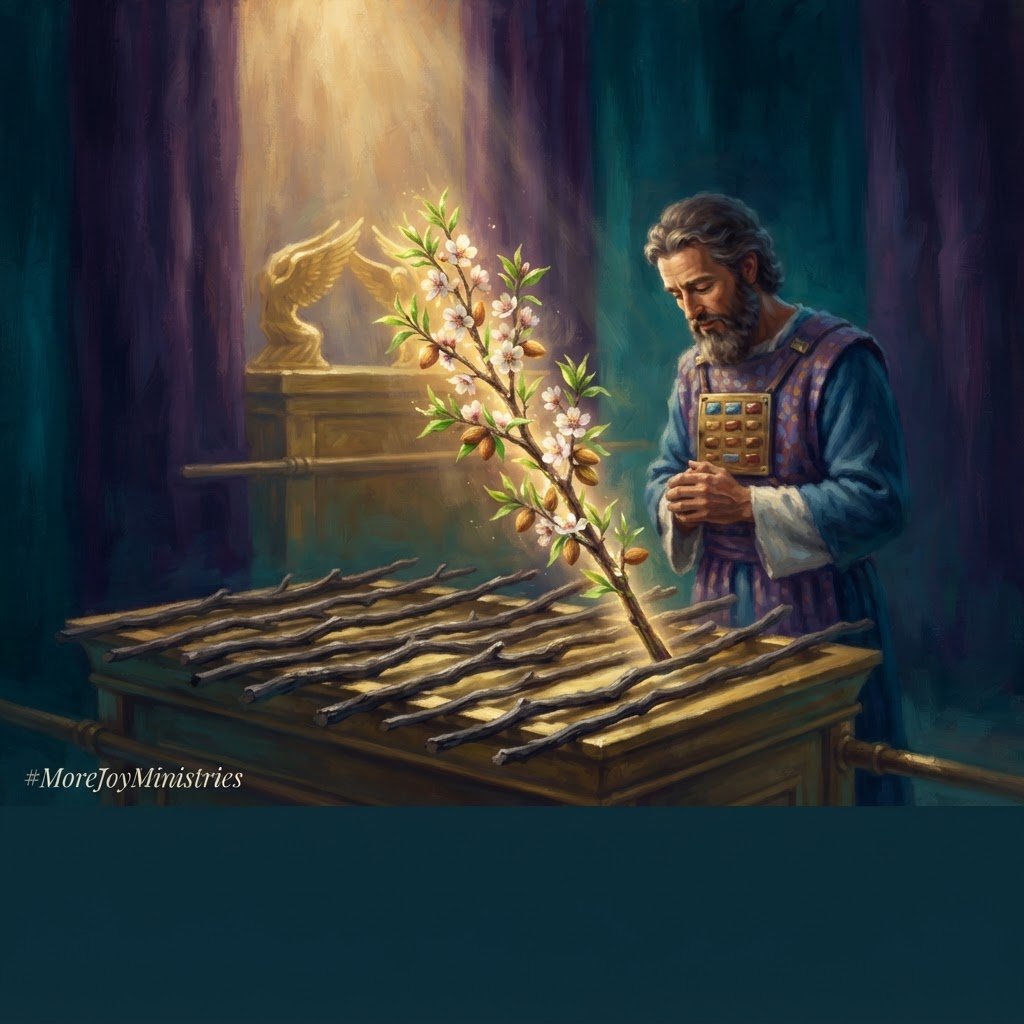
Every tribal leader brought a rod. Twelve rods were placed before the LORD, with each man’s name written on his own. Aaron’s name was written on Levi’s rod.
God said,
“And it shall come to pass, that the man’s rod, whom I shall choose, shall blossom.”
Numbers 17:5 KJV
By morning Aaron’s rod had done far more than sprout.
“And, behold, the rod of Aaron for the house of Levi was budded, and brought forth buds, and bloomed blossoms, and yielded almonds.”
Numbers 17:8 KJV
A staff that had been cut from a tree and had no root system produced buds, open blossoms and mature almonds overnight.
Only Aaron’s.
The Hebrew word for rod is מַטֶּה, matteh, a word that can also be used for a tribe. There is a beautiful precision to the scene. Each tribe stood represented before God by its staff, and the staff belonging to Levi under Aaron’s name was the one God caused to bear life.
God didn’t leave His choice open to interpretation.
Then Aaron’s rod was placed back before the testimony and preserved “for a token against the rebels.”
That is exactly what it was.
A witness.
Korah claimed the priesthood.
God chose Aaron.
The New Testament eventually gives us the theological interpretation in Hebrews.
“And no man taketh this honour unto himself, but he that is called of God, as was Aaron.”
Hebrews 5:4 KJV
That verse could almost be written across the entire story of Numbers 16 and 17.
Priesthood was not something a man seized because he felt qualified. It was received by divine appointment.
Numbers 18 follows immediately afterward and drives it home again when God tells Aaron,
“I have given your priest’s office unto you as a service of gift.”
Numbers 18:7 KJV
A gift is received. It isn’t taken.
Korah reached for something God had not given him, and Jude was still warning the Church about it roughly fifteen hundred years later.
“Woe unto them! ... and perished in the gainsaying of Core.”
Jude 11 KJV
Even Psalm 106 looks back at the rebellion and tells us what was underneath it.
“They envied Moses also in the camp, and Aaron the saint of the LORD.”
Psalm 106:16 KJV
That makes Aaron’s rod much more than a cool Old Testament miracle.
Korah had proximity to holy things, a respected position, an important ministry and an impressive following. None of those things gave him the right to appoint himself to an office God had given someone else.
When the argument was finally laid before the LORD, twelve staffs went into the tabernacle and only one bore fruit.
Aaron never had to manufacture proof that God had called him.
#MoreJoyMinistries




