More Joy Ministries
Full Bible Study
Several men in the Old Testament bear the name Micah, including those mentioned in 1 Chronicles 5:5, 8:34, 24:24, and 2 Chronicles 34:20. The name derives from the Hebrew Micayehû, which means who is like Jehovah.
This title suggests that parents who named their sons Micah were devout followers of Yahweh. This article examines the two most prominent figures with this name.
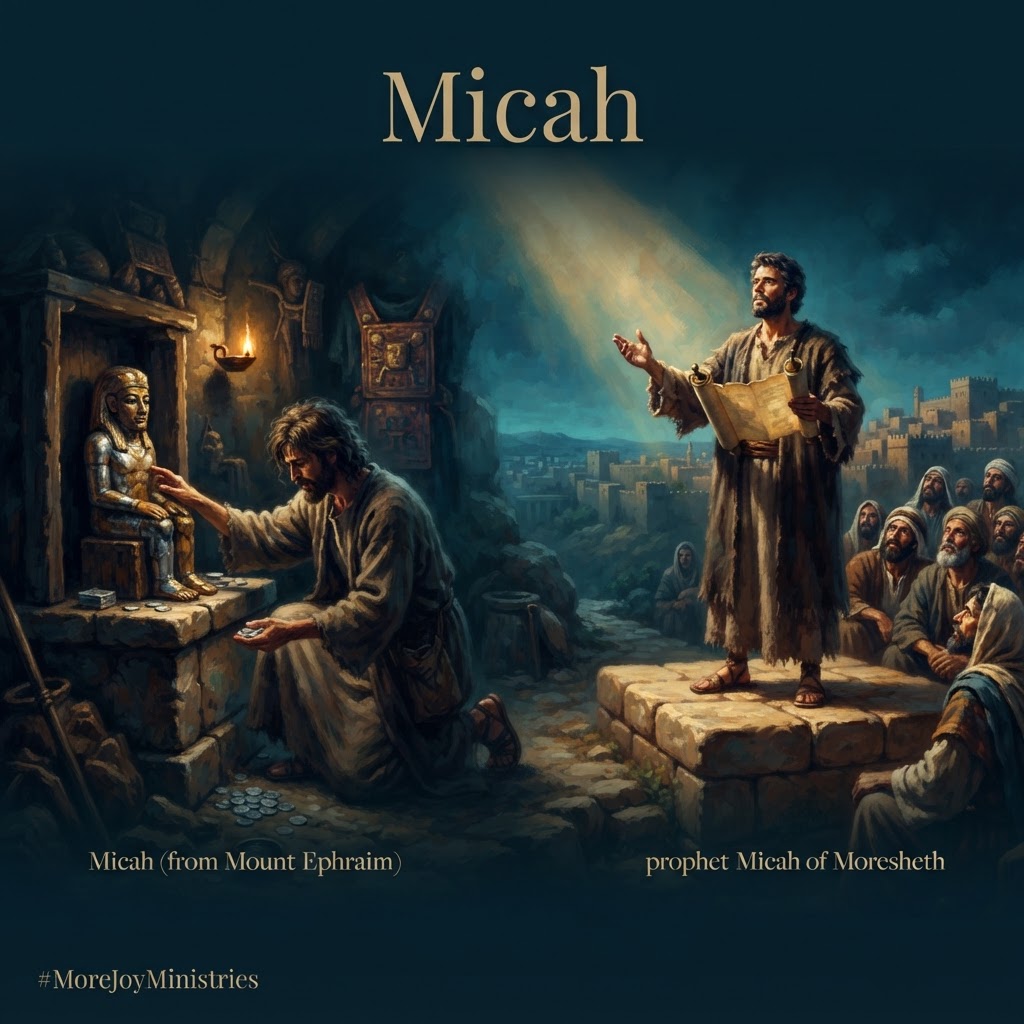
The first Micah appears in Judges 17 and 18. He lived during a time when Israel had no king and every man did what was right in his own eyes.
The second Micah was a prophet in Judah for 59 years under the reigns of Jotham, Ahaz, and Hezekiah. He prophesied alongside Hosea, Amos, and Isaiah.
Judges 17 and 18 detail the life of the first Micah as an example of the lawlessness that plagued Israel. The people had abandoned Yahweh for idols, mixing pagan practices into their worship.
Without a king, the resulting moral chaos led everyone to act according to their own desires. Micah stole silver from his mother, returned it, and saw her dedicate it to the Lord by crafting a physical idol for their home.
Micah later hired a Levite to serve as his personal priest. Both he and his mother were convinced they were right with God, yet they ignored the glaring contradiction of keeping an idol in their home.
They assumed the Lord would bless them for their religious efforts, despite violating the clear command of Exodus 20:4 through 5.
“You shall not make for yourself an idol of any kind or an image of anything in the heavens above, on the earth below, or in the waters beneath. You shall not bow down to them or worship them.”
Many professing Christians today mirror Micah. They view God’s Word as outdated and construct a counterfeit faith that possesses a form of godliness but denies its power.
This lifestyle omits the call to die to self and carry one’s cross. Instead, many build idols of health, wealth, and success while assuming God approves of their self-worship.
The second Micah serves as a sharp contrast to this worldliness. As the author of the book bearing his name, he hailed from Moresheth in Judah.
He received a message from the Lord regarding the future of Samaria and Jerusalem. Micah stands as the sixth of the Minor Prophets, a designation referring to the relative length of their writings.
This prophet foretold the birth of Christ in Bethlehem. His message balances hope and doom, highlighting God’s kindness toward those who repent.
Micah summarized God’s expectations in a familiar passage.
“He has showed you, O man, what is good. And what does the LORD require of you?
To act justly and to love mercy and to walk humbly with your God.” (Micah 6:8)
God maintains zero tolerance for sin, yet He remains ready to forgive those who repent. Micah offered hope even amid strong warnings of judgment.
He concluded his book with the promise of divine compassion.
“He will again have compassion on us; He will vanquish our iniquities. You will cast out all our sins into the depths of the sea.” (Micah 7:19)
We find comfort in these words. Through the Messiah whom Micah foretold, we receive forgiveness when we turn from evil and walk humbly with our God.
#MoreJoyMinistries