
More Joy Ministries
Full Bible Study
Study Of the "Appointment Times" - The Mo'edim
LEARNING GOD'S APPOINTED TIMES
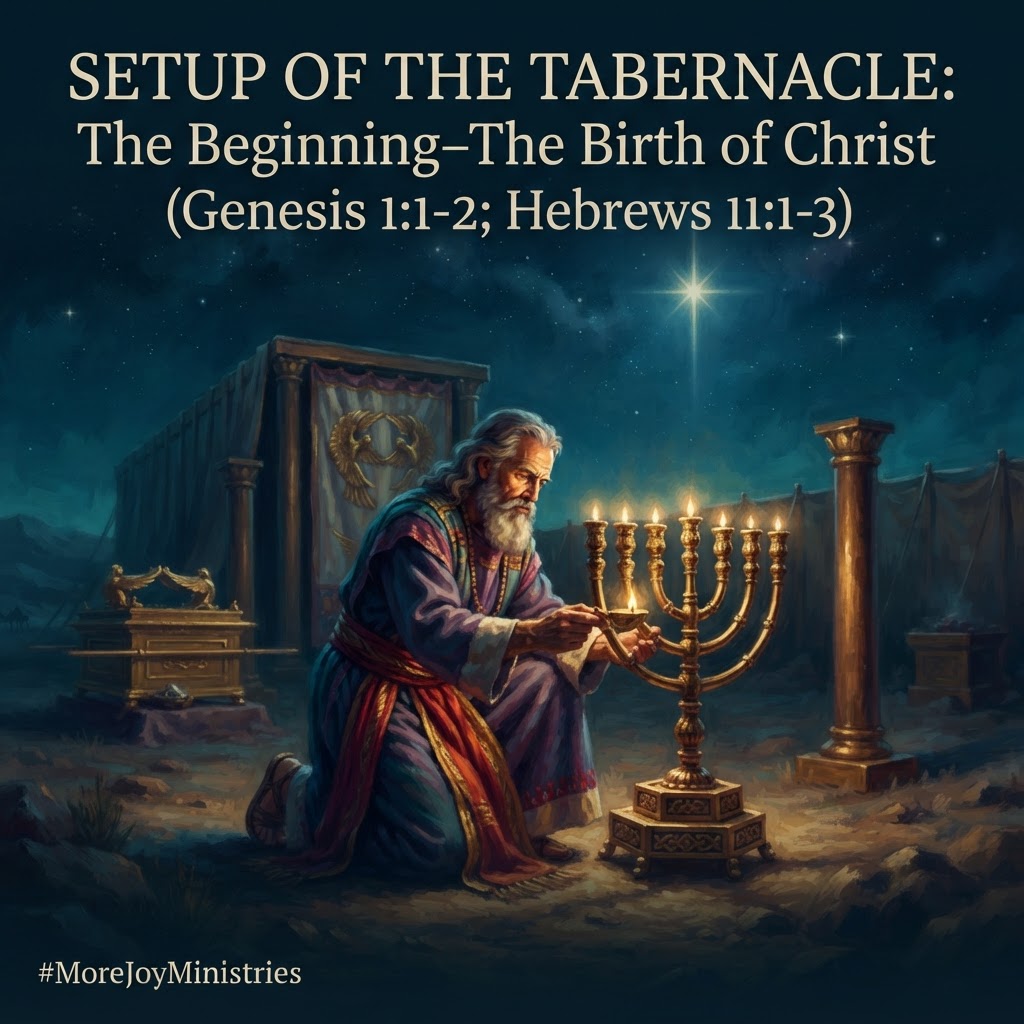
1. SETUP OF THE TABERNACLE:
The Beginning-The Birth of Christ
(Genesis 1:1-2; Hebrews 11:1-3)
In the beginning was the Word, and the Word was with God, and the Word was God. He was with God in the beginning. Through Him all things were made, and without Him nothing was made that has been made. In Him was life, and that life was the light of men. The Light shines in the darkness, and the darkness has not overcome it. (John 1:1-5)
On the first day of the first month, Moses was instructed to set up the temporary tabernacle in the wilderness.
Set up the tabernacle, the tent of meeting, on the first day of the first month. (Exodus 40:1)
This Earthly Tabernacle was to prophetically point the way to God the Father through Jesus. Furthermore, the building of the Tabernacle reveals the ultimate desire of God our Father – to live amongst us His children (Exodus 25:8). Oh, the joy of God when He became flesh on this day and dwelt amongst His people – Emmanuel (i.e., God with us)! (John 1:14)
The setup of the Tabernacle on the first day of the first month was a foreshadow of a day in which Jesus came to temporarily tabernacle among His people offering salvation for mankind through His atoning sacrifice on the cross.
God gave seven feasts that were observed in the Old and New Testaments, yet many Christians know little about them. What can we learn about these feasts?
These seven feasts of the Lord display God’s loving plan for humanity. Observing them every year serves as a needed reminder and encouragement for those resisting this world, Satan and his evil influences.
2. PASSOVER:
The Lord’s Passover begins at twilight on the fourteenth day of the first month. (Leviticus 23:5)
The meaning of Passover is summed up by the apostle Paul: “For indeed Christ, our Passover, was sacrificed for us” (I Corinthians 5:7).
Just as the blood of the lamb saved the Israelites from death in the 10th plague on Egypt, so Christ’s shed blood makes it possible for us to be forgiven of our sins. This is commemorated by following Christ’s example at His last Passover (I Corinthians 11:23-26).
Passover is the starting point of God’s plan of salvation.
It is at 3 pm in which Jesus died, the same hour in which a lamb was slain upon the altar within the Holy of Holies. And thus, Jesus became our Passover Lamb.
3. UNLEAVENED BREAD:
This day represents the day in which our Lord was buried. The day of unleavened bread was to be a sabbath and to fulfill a full three days and three nights in the grave, Jesus would have had to be buried at 6 pm Thursday, three hours later, following his death on
the cross on Wednesday at 3 pm.
Paul also talked about the seven-day festival that comes after Passover. During the Feast of Unleavened Bread, leaven (such as active yeast) represents sin.
Paul warned, “Do you not know that a little leaven leavens the whole lump? Therefore, purge out the old leaven, that you may be a new lump, since you truly are unleavened” (I Corinthians 5:6-7).
Removing leaven reminds Christians to remove sin from their lives with God’s help and to replace it with godly thoughts and actions. Paul continued with a command for Christians to observe the Feast of Unleavened Bread:
“Therefore, let us keep the feast, not with old leaven, nor with the leaven of malice and wickedness, but with the unleavened bread of sincerity and truth” (I Corinthians 5:8).
4. FIRST FRUITS:
The first day of the week began with a resurrection. Jesus rose from the dead after a full 72 hours in the grave.
The first fruits mentioned in Leviticus 23:10 referred to a sheaf of the first barley to be harvested. Barley is harvested in May but in the hill country of Israel it is not concluded until the end of May or beginning of June.
The presentation of the sheaf ‘on the day after the Sabbath’ [during the Feast of Unleavened Bread] symbolized the dedication of the whole year’s crop; and until this was done, none of the new grain was to be eaten.
In the New Testament we find that Jesus spent three days and three nights in the grave, then on the first day of the week during the Feast of Unleavened Bread, He fulfilled this barley sheaf offering. That was the day He ascended to the Father (John 20:17).
5. PENTECOST:
Counting 50 days, starting with the waving of the sheaf (Leviticus 23:11, 16), brings you to the Feast of Weeks or, as it is called in the New Testament, Pentecost. This is the wheat harvest which begins in July and ends in early August according to documentation presented by the agricultural department of Israel. To this day in Israel, wheat is harvested into August to get the proper drying in order to go through the combines that separate the wheat from the chaff.
Peter’s sermon and its results remind us of the wonderful gifts represented by Pentecost. God made it possible for us to repent, be baptized and receive the Holy Spirit (Acts 2:38). Those who have the Holy Spirit then compose the Church of God that Jesus began to build that day (verse 47; Matthew 16:18).
So, the first three festivals remind us of the first three steps in God’s plan of salvation that have already taken place: Christ’s sacrifice, our exodus from slavery to sin, and the launch of the Church.
SHADOWS OF THINGS TO COME:
Paul referred to God’s appointed times as “a shadow of things to come” (Colossians 2:17). Though we would love a full-color brilliant vision of the future steps in God’s plan, for now we may be limited to see “in a mirror dimly” (I Corinthians 13:12). But we can glimpse the shadow that hints at what “eye has not seen, nor ear heard, nor have entered into the heart of man the things which God has prepared for those who love Him” (I Corinthians 2:9).
What are the next steps in God’s plan? Revelation 19 and 20 (among other passages) summarize the events ahead of us in God’s plan of salvation.
6. DAY OF TRUMPETS:
‘On the first day of the seventh month (the first day of winter) you are to have a day of sabbath rest (our going home to be with Jesus), a sacred assembly (for those set apart) commemorated with trumpet blasts. Do no regular work, but present a food offering to the Lord. (represents our good fruit of our salvation and laying our crowns at His feet)’” (Leviticus 23:24-25)
Paul spoke of this day in Corinthians.
"Behold, I shew you a mystery; We shall not all sleep, but we shall all be changed, In a moment, in the twinkling of an eye, at the last trump: for the trumpet shall sound, and the dead shall be raised incorruptible, and we shall be changed." (I Corinthians 15:51-52)
Surely the Sovereign LORD does NOTHING without revealing his plan to his servants the prophets. (Amos 3:7)
Remember Jesus said in John 4:35, "Don’t you have a saying, ‘It’s still four months until harvest?"
We can establish from Jesus' words that there are 4 months to the harvest from the completion of the wheat harvest, which puts us to the first day of winter.
This day is also 6 months from the 1st day of the 1st month and would indicate the day in which John the Baptist was born, that loud voice in the wilderness, "Prepare ye the way for the Lord."
This season would also begin with Jesus' ministry with 3 1/2 years to go until his death.
From the last trump on the 2nd day of the Days of Awe, there are 7 full days to Atonement. These days are known by some as the Time of Jacob's Trouble.
7. DAY OF ATONEMENT:
Yom Kippur (Day of Atonement) is the holiest day of the Biblical year, and provides much prophetic insight regarding the 2nd Coming of the Messiah, the spiritual restoration of the nation of Israel and the final judgment of the world. It is also a day that reveals the High Priestly work of Yeshua as our Kohen Gadol (High Priest) after the order of Malki-Tzedek (Hebrews 5:10, 6:20).
In a Shemitah cycle, such as this year we are presently in, there are 2,550 days from the new moon of the proposed day of Trumpets or any new moon within the season to the same proposed 10th day of the 7th month seven years later.
The day of Atonement is the day of the 2nd Coming, the day in which salvation is brought to the Jews, the day in which God's vengeance is poured out upon all the wicked and the armies are destroyed at Armageddon. It is the day Satan hates most as he is thrown alive in the bottomless pit and his False prophet and the Antichrist into the Lake of Fire.
The Old Testament ceremonies for the Day of Atonement foreshadowed this End-Time Event. The Azazel goat of Leviticus 16 reflected Satan’s influence in leading mankind to sin. The other goat represented the sacrifice of Jesus Christ by which sin can be forgiven.
Revelation 20:1-3 shows the solution:
“Then I saw an angel coming down from heaven, having the key to the bottomless pit and a great chain in his hand. He laid hold of the dragon, that serpent of old, who is the Devil and Satan, and bound him for a thousand years; and he cast him into the bottomless pit, and shut him up, and set a seal on him, so that he should deceive the nations no more till the thousand years were finished.”
After Satan is locked away and unable to influence humanity, the Bible foretells a time of peace and prosperity.
8. FEAST OF TABERNACLES:
On the fifteenth day of the seventh month the Lord’s Festival of Tabernacles begins, and it lasts for seven days. (Leviticus 23:34) after you have gathered the crops of the land (vs. 39)
The final crop to be harvested in Israel is the pomegranate and it is harvested from September to December.
Flavius Josephus spoke of this feast in his Antiquities of the Jews, stating that the temporary dwelling tents were built inside their homes before winter completely set in, in order to stay warm.
Revelation 20:4 tells of the 1,000 years when the resurrected/raptured saints will serve under Jesus Christ. When the long-prophesied Kingdom of God rules the earth, all the utopian prophecies will come to pass.
This is foreshadowed by the Feast of Tabernacles, a seven-day festival of abundance enjoyed in temporary dwellings. Even the 1,000 years will someday seem temporary.
Micah records one of the amazing prophecies:
“Now it shall come to pass in the latter days that the mountain of the LORD’s house shall be established on the top of the mountains, and shall be exalted above the hills; and peoples shall flow to it.
“Many nations shall come and say, ‘Come, and let us go up to the mountain of the LORD, to the house of the God of Jacob; He will teach us His ways, and we shall walk in His paths.’ For out of Zion the law shall go forth, and the word of the LORD from Jerusalem.
“He shall judge between many peoples, and rebuke strong nations afar off; they shall beat their swords into plowshares, and their spears into pruning hooks; nation shall not lift up sword against nation, neither shall they learn war anymore.
“But everyone shall sit under his vine and under his fig tree, and no one shall make them afraid; for the mouth of the LORD of hosts has spoken” (Micah 4:1-4).
The knowledge of God’s way of life will be made known to all. Many people will choose to follow God’s way, leading to peace and plenty and the acceptance of His offer of salvation.
9. HANUKKAH:
Today the Jews celebrate this feast at the close of fall but what does the Bible have to say?
"And it was at Jerusalem the feast of the dedication, and it was winter." (John 10:22)
The feast of dedication, known as Hanukkah, will one day be fulfilled as the 1335th day prophesied by Daniel the prophet.
Blessed is the one who waits for and reaches the end of the 1,335 days. (Daniel 12:12)
From the time the Antichrist begins his reign to the dedication of the Millennial Temple, there are 1335 days. Hanukkah falls 75 days after the Day of Atonement. Establishing that the season is winter, based on Scripture and historical data, we can expect to see these last remaining feasts to be fulfilled at the beginning of winter and the next appointed time to be fulfilled is the day of Trumpets, as the season is changing for the cold of winter. That cold continues into the 9th month. It is believed that the Biblical calendar and the Day of Trumpets was marked by the new moon and the last trump is at the last hour of that day at the sighting of the new moon...after a very long day. Two witnesses would blow the last trump at the sighting of this new moon, a day known as the day or hour no man knows, as the time of the last trump was relative to the time the moon appeared and could be for a time obscured by clouds.
The story of Hanukkah reveals to us God's future appointed time, a time of joy in that winter (tribulation) is past and a time to celebrate that God has renewed His Earth and brought to man 1000 years of peace for all those who trusted in Him. His name will be great as Prince of Peace, Almighty God, Wonderful Counselor.
A Hanukkah menorah, or hanukkiah, is a nine-branched candelabrum lit during the eight-day Jewish holiday. Eight of the nine branches hold lights (candles or oil lamps) that symbolize the eight nights of the holiday; on each night, one more light is lit than the previous night, until on the final night all eight branches are ignited. The ninth branch holds a candle, called the shamash ("helper" or "servant"), which is used to light the other eight.
The Hanukkah menorah commemorates, but is distinct from, the seven-branched menorah used in the ancient Temple in Jerusalem, but within both, we can see and understand God's appointed times and explain the full gospel plan of Jesus Christ in that He was born to die on Passover, was buried, rose again the third day and that He is appearing to catch us away on a specific appointed day for His bride, the church, and coming again to wage war against a wicked and rebellious world, restore Israel back to Himself and set up His kingdom for 1000 years.
I am the Alpha and the Omega, the First and the Last, the Beginning and the End. Revelation 22:13




