
More Joy Ministries
Full Bible Study
Passover or Pesach commemorates the Israelites' liberation from Egyptian slavery. The historical account of this event is found primarily in Exodus chapters 12 through 14.
This festival begins at sunset on the 14th of Nisan and marks the start of a seven-day period that includes the Feast of Unleavened Bread.
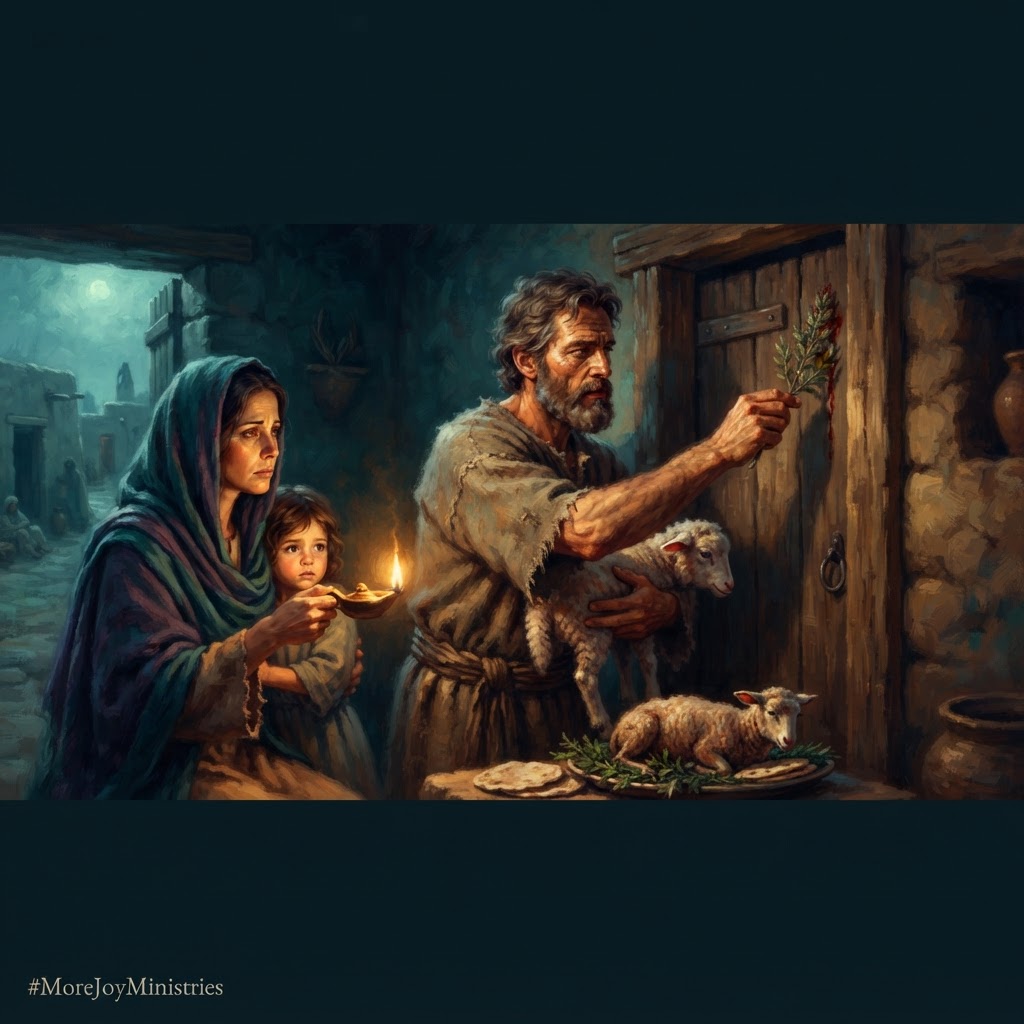
The central observance is the Seder, a meal conducted in a specific order to recount God's deliverance of His people. During the first Passover, God commanded the Israelites to sacrifice a lamb and mark their doorframes with its blood.
The angel of death passed over every home marked by this blood, sparing the firstborn inside.
This celebration features the Haggadah, matzah, bitter herbs, and four cups of wine. These symbols remind participants of both the suffering of slavery and the joy of liberation.
The festival has remained a cornerstone of Jewish faith for thousands of years, rooted in themes of redemption.
Passover gains deeper theological meaning in the New Testament as it points directly to the death and resurrection of Jesus. During the Last Supper, recorded in the Synoptic Gospels, Jesus transformed the elements of the meal into symbols of the new covenant.
He identified His own body and blood with the bread and the wine.
In Luke 22:15-20, Jesus explains this transition:
I have eagerly desired to eat this Passover with you before I suffer. For I tell you, I will not eat it again until it finds fulfillment in the kingdom of God.
Then He took bread, and when He had given thanks, He broke it and gave it to them, saying, This is my body given for you; do this in remembrance of me. In the same way, after the supper He took the cup, saying, This cup is the new covenant in my blood, which is poured out for you.
Jesus is the Lamb of God. His sacrifice achieves a final deliverance, saving believers from the bondage of sin.
The Gospel of John underscores this by timing the crucifixion of Jesus with the preparation of the Passover lambs.
Consider the testimony of Scripture regarding this feast:
1 Corinthians 5:7: Cleanse out the old leaven that you may be a new lump, as you really are unleavened. For Christ, our Passover lamb, has been sacrificed.
Leviticus 23:4-8: These are the appointed feasts of the Lord, the holy convocations, which you shall proclaim at the time appointed for them. In the first month, on the fourteenth day of the month at twilight, is the Lord's Passover.
And on the fifteenth day of the same month is the Feast of Unleavened Bread to the Lord; for seven days you shall eat unleavened bread. On the first day you shall have a holy convocation; you shall not do any ordinary work.
But you shall present a food offering to the Lord for seven days. On the seventh day is a holy convocation; you shall not do any ordinary work.
Exodus 12:21-28: Then Moses called all the elders of Israel and said to them, Go and select lambs for yourselves according to your clans, and kill the Passover lamb. Take a bunch of hyssop and dip it in the blood that is in the basin, and touch the lintel and the two doorposts with the blood that is in the basin.
None of you shall go out of the door of his house until the morning. For the Lord will pass through to strike the Egyptians, and when he sees the blood on the lintel and on the two doorposts, the Lord will pass over the door and will not allow the destroyer to enter your houses to strike you.
Matthew 26:26-28: Now as they were eating, Jesus took bread, and after blessing it broke it and gave it to the disciples, and said, Take, eat; this is my body. And he took a cup, and when he had given thanks he gave it to them, saying, Drink of it, all of you, for this is my blood of the covenant, which is poured out for many for the forgiveness of sins.
#MoreJoyMinistries




