More Joy Ministries
Full Bible Study
TEN OF THE GREATEST BIBLICAL ARCHAEOLOGICAL FINDS:
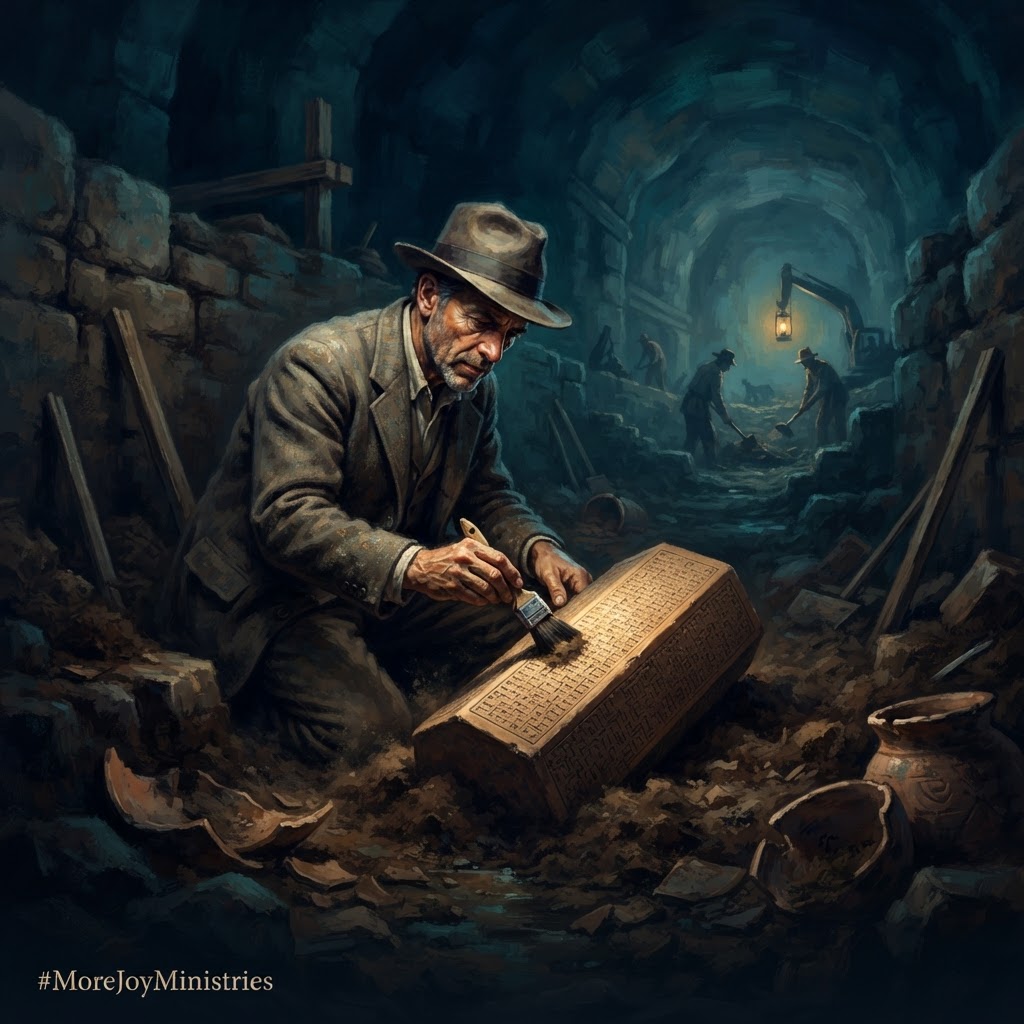
A lot of people talk like the Bible floats in some religious fog, detached from real history. It does not. The Bible names kings, cities, empires, roads, gates, pools, tunnels, battles, governors, priests, and places you can still put a shovel into.
Archaeology does not “prove” the Gospel by itself. A stone cannot repent for you. A tunnel cannot save your soul. A scroll cannot replace the Holy Ghost. But archaeology can do something powerful: it keeps reminding the skeptic that the Bible was written in the real world.
Real geography. Real rulers. Real languages. Real cities. Real judgment. Real fulfillment.
Here are ten of the greatest finds connected to the world of Scripture.
THE DEAD SEA SCROLLS:
The Dead Sea Scrolls are probably the most famous biblical discovery ever made. Found near Qumran beginning in the late 1940s, these scrolls and fragments include some of the oldest known copies of biblical texts.
Before this discovery, critics loved to act like the Old Testament text had been hopelessly changed over time. Then the scrolls came out of the caves.
Isaiah. Psalms. Deuteronomy. Habakkuk. Daniel. And more.
The Great Isaiah Scroll was especially massive because it showed that the book of Isaiah was not some late invention conveniently edited after the fact. The text had been preserved with remarkable care. So when Isaiah 53 speaks of the suffering servant, wounded for our transgressions and bruised for our iniquities, we are not dealing with medieval imagination. We are dealing with an ancient prophetic text.
THE KETEF HINNOM SILVER SCROLLS:
These tiny silver scrolls were found near Jerusalem and contain language from the priestly blessing in Numbers 6:
“The LORD bless thee, and keep thee…”
That means one of the oldest known biblical texts we have is not some dry political document. It is a blessing from the Lord.
Think about that.
Before many of the famous manuscripts people talk about, there was already Scripture being written, carried, and treasured by God’s people.
The blessing given through Moses and Aaron was not just sitting in a later religious tradition. It was already embedded in the life of Israel during the First Temple period.
THE TEL DAN STELE:
The Tel Dan Stele is a big one because it mentions the “House of David.”
For years, skeptics treated David like a Bible legend. A nice religious story. A tribal hero inflated by later writers. Then this broken stone inscription showed up from the ninth century BC with language pointing to the dynasty of David.
Not just David as a character.
The House of David.
That is royal language. Dynastic language. Historical language.
The Bible presents David as the king whose line would lead to Messiah. The prophets keep pointing back to David’s house. Then archaeology steps in and says, yes, ancient people outside the Bible knew about this Davidic house too.
THE MESHA STELE:
The Mesha Stele, also called the Moabite Stone, comes from Moab and tells the story from Moab’s side.
That is what makes it interesting.
The Bible talks about Mesha king of Moab in 2 Kings 3. The Mesha Stele gives us a hostile witness from the other side of the conflict. It mentions Israel, Omri, Moab, Chemosh, and the kind of political and military tension we see in the Old Testament world.
This is not a Christian devotional artifact. It is not trying to help your faith. It is Moab bragging in stone.
And even there, the world of the Bible shows up.
Sometimes the best witnesses are not friendly witnesses. They are enemies who accidentally confirm the neighborhood.
SENNACHERIB’S PRISM:
Sennacherib, king of Assyria, came against Judah during the reign of Hezekiah. The Bible records the Assyrian threat in 2 Kings 18 through 19, 2 Chronicles 32, and Isaiah 36 through 37.
The Taylor Prism, also called Sennacherib’s Prism, gives the Assyrian version of the campaign.
Of course Sennacherib brags. Ancient kings did that. But what is fascinating is what he does and does not say.
He talks about Hezekiah. He talks about Judah. He talks about shutting Hezekiah up in Jerusalem “like a bird in a cage.” But he never claims to have conquered Jerusalem.
That silence is loud.
The Bible says the Assyrian army did not take the city. Sennacherib’s own royal record talks big, but it stops short of claiming the victory that would have mattered most.
HEZEKIAH’S TUNNEL AND THE SILOAM INSCRIPTION:
Hezekiah’s Tunnel is one of those finds that makes you feel the pressure of the biblical story.
Second Kings 20:20 says Hezekiah made a pool and a conduit and brought water into the city. Second Chronicles 32 says he prepared Jerusalem because Assyria was coming.
Jerusalem needed water secured inside the city walls before the Assyrians arrived. Hezekiah’s Tunnel carried water from the Gihon Spring toward the Pool of Siloam. The Siloam Inscription describes workers cutting through the rock from opposite directions until they met in the middle.
That is not just archaeology. That is biblical engineering under wartime pressure.
Faith does not mean sitting around while an army marches toward you. Hezekiah prayed, yes. But he also prepared.
THE POOL OF SILOAM:
John 9 says Jesus healed a man born blind and told him:
“Go, wash in the pool of Siloam.”
For a long time, some treated John like he was too theological to be historically grounded. Then the Pool of Siloam began coming back out of the dirt.
That is one of the things I love about John’s Gospel. It is deep enough to drown in, but it is also rooted in real places.
Jesus did not heal a symbol walking through a metaphor.
He healed a real blind man and sent him to a real pool in a real city.
The Word became flesh, and He walked on actual stone.
THE CYRUS CYLINDER:
The Bible says Cyrus king of Persia issued a decree connected to the return of the Jews and the rebuilding of the temple after Babylonian captivity.
The Cyrus Cylinder does not quote Ezra for us, but it does show the kind of imperial policy Cyrus was known for: restoring peoples, temples, and worship centers after Babylon fell.
That fits the world of Ezra.
Isaiah even names Cyrus long before the Persian king rises to power:
“That saith of Cyrus, He is my shepherd, and shall perform all my pleasure…” Isaiah 44:28
God can call a pagan king His shepherd when He decides to use him. Cyrus did not need to understand the God of Israel fully for the God of Israel to move him like a piece on the board.
THE LACHISH LETTERS:
The Lachish Letters are written on pottery fragments from the final days before Babylon crushed Judah.
They give us a window into the panic, military communication, and collapse happening right before Jerusalem fell.
Jeremiah was preaching while the nation was breaking apart. Babylon was closing in. The political and spiritual disaster was no abstraction. Men were writing desperate messages while watchfires disappeared and cities fell.
That is the world Jeremiah lived in.
When you read Jeremiah, you are not reading a man making dramatic religious speeches in a vacuum. You are reading a prophet standing in a dying nation, warning people who did not want to listen.
THE PILATE STONE:
Pontius Pilate is not just a name in a creed.
He was a real Roman official.
The Pilate Stone was found at Caesarea Maritima and contains an inscription naming Pontius Pilate, prefect of Judea. That connects directly to the Roman authority involved in the trial and crucifixion of Jesus.
The Gospels are not embarrassed to name names.
Caiaphas. Herod. Pilate. Caesar. Jerusalem. Galilee. Golgotha.
Christianity is not built on “once upon a time.” It is built on events that happened under named rulers, in named places, during real history.
Jesus Christ was not crucified in myth.
He was crucified under Pontius Pilate.
THE BIGGER POINT:
None of these finds replace Scripture. Scripture does not need a museum label to become true.
But these discoveries keep doing the same thing.
They drag the conversation back into history.
David was not imaginary. Moab was not imaginary. Hezekiah was not imaginary. Sennacherib was not imaginary. Cyrus was not imaginary. Pilate was not imaginary. Jerusalem was not imaginary. Siloam was not imaginary.
Every time the ground opens, it keeps reminding the world that the Book they mock has been standing in history the whole time.
The stones are still crying out.
#MoreJoyMinistries
Research receipts: The Dead Sea Scrolls Digital Library describes the scrolls as preserving thousands of fragments, including some of the oldest known copies of biblical texts. The Israel Museum identifies the Ketef Hinnom silver amulets as the oldest known copies of biblical text, older than the Dead Sea Scrolls. The Tel Dan inscription is widely discussed because of its “House of David” reference, discovered at Tel Dan in 1993. The Mesha Stele is a ninth-century BC Moabite inscription tied to King Mesha of Moab and events comparable to 2 Kings 3. The British Museum describes the Taylor Prism as Sennacherib’s campaign record, including tribute from Hezekiah king of Judah in 701 BC. The Siloam Inscription describes the cutting of Hezekiah’s Tunnel from two ends until the workers met in the middle. The Pool of Siloam is tied to John 9 and late Second Temple Jerusalem. The British Museum identifies the Cyrus Cylinder as a Babylonian account of Cyrus’s conquest of Babylon in 539 BC and restoration of temples. The Lachish Letters date to the final years before Nebuchadnezzar’s destruction of Lachish and Jerusalem. The Israel Museum notes a Latin inscription from Caesarea mentioning Pontius Pilate, the Roman governor connected to Jesus’ trial and crucifixion.