More Joy Ministries
Full Bible Study
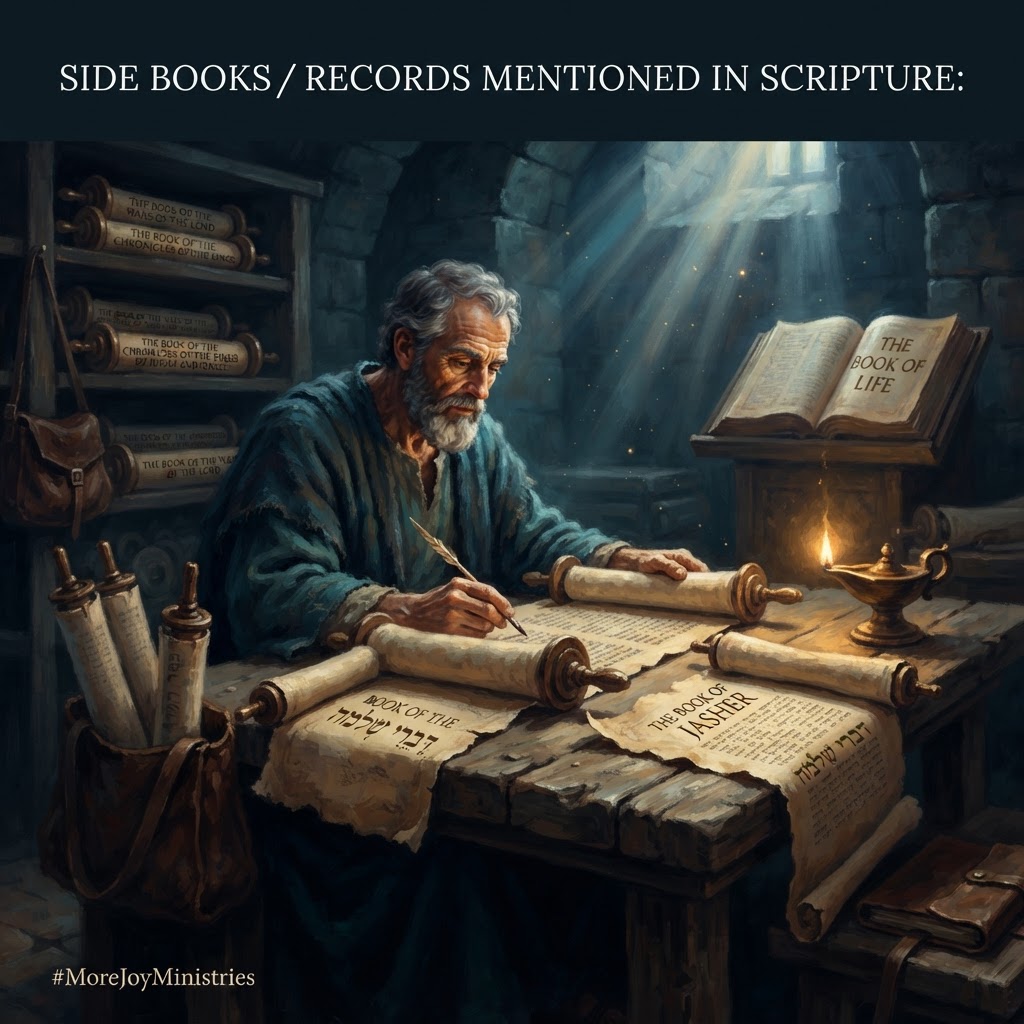
SIDE BOOKS / RECORDS MENTIONED IN SCRIPTURE:
The Bible mentions several “books” outside the main flow of Scripture. Some were literal historical records. Some were prophetic writings. Some are heavenly records kept by God Himself. The point is not that all of these belong in the Bible. The point is that Scripture shows God keeps records, Israel kept records, prophets wrote records, and some historical sources existed that are no longer preserved for us.
The Book of Life:
This is the most important “book” mentioned in Scripture because it concerns eternal life.
Exodus 32:32 through 33 says:
“Yet now, if thou wilt forgive their sin-; and if not, blot me, I pray thee, out of thy book which thou hast written. And the LORD said unto Moses, Whosoever hath sinned against me, him will I blot out of my book.”
Psalm 69:28 says:
“Let them be blotted out of the book of the living, and not be written with the righteous.”
Daniel 12:1 says:
“And at that time thy people shall be delivered, every one that shall be found written in the book.”
Luke 10:20 says:
“Rather rejoice, because your names are written in heaven.”
Philippians 4:3 mentions fellow labourers “whose names are in the book of life.”
Revelation 20:15 gives the final warning:
“And whosoever was not found written in the book of life was cast into the lake of fire.”
The Book of Life is not mythology. It is God’s record of those who belong to Him.
The Books Opened at the Great White Throne:
Revelation 20:12 says:
“And I saw the dead, small and great, stand before God; and the books were opened: and another book was opened, which is the book of life…”
Notice there are “books” plural, and then “another book,” which is the Book of Life.
The dead are judged “out of those things which were written in the books, according to their works.”
So Scripture presents two categories here: the Book of Life, and the books of record used in judgment. Nobody escapes God’s accounting.
The Book of Remembrance:
Malachi 3:16 says:
“Then they that feared the LORD spake often one to another: and the LORD hearkened, and heard it, and a book of remembrance was written before him…”
This is a powerful verse. God records the fear of the LORD, the faithful conversations of His people, and those who think upon His name.
Men forget. God does not.
The Book of the Wars of the LORD:
Numbers 21:14 says:
“Wherefore it is said in the book of the wars of the LORD…”
This appears to be an ancient record connected to the mighty acts and battles of the LORD. We do not have this book today, and Scripture does not tell us to go find it. The Holy Spirit preserved the part He wanted quoted in Numbers.
The Book of Jasher:
Joshua 10:13 says:
“Is not this written in the book of Jasher?”
Second Samuel 1:18 also mentions it:
“Also he bade them teach the children of Judah the use of the bow: behold, it is written in the book of Jasher.”
Jasher means “upright” or “just.” It seems to have been an ancient Hebrew record or collection containing songs, heroic accounts, or national history. The modern books floating around today under the name “Jasher” should not automatically be treated as the same original book mentioned in Joshua and Samuel.
The Bible quotes the real ancient source. That does not mean the modern copies sold online are inspired Scripture.
The Book of the Acts of Solomon
First Kings 11:41 says:
“And the rest of the acts of Solomon… are they not written in the book of the acts of Solomon?”
This was likely a royal record of Solomon’s reign. Kings had official chronicles. Scripture mentions them, but they are not part of the canon.
The Book of the Chronicles of the Kings of Israel
This phrase appears many times in Kings.
Example: First Kings 14:19 says:
“And the rest of the acts of Jeroboam… are they not written in the book of the chronicles of the kings of Israel?”
This was not the biblical book of Chronicles as we know it. It was likely an official northern kingdom royal record.
The Book of the Chronicles of the Kings of Judah:
First Kings 14:29 says:
“Are they not written in the book of the chronicles of the kings of Judah?”
Again, this refers to royal records from the kingdom of Judah. The biblical writer used historical records, but the Holy Spirit guided what became Scripture.
The Book of Samuel the Seer, Nathan the Prophet, and Gad the Seer:
First Chronicles 29:29 says:
“Now the acts of David the king, first and last, behold, they are written in the book of Samuel the seer, and in the book of Nathan the prophet, and in the book of Gad the seer.”
This shows that prophets and seers recorded history. Some of their writings may overlap with what we now have in Samuel, but Scripture also speaks of records by Nathan and Gad.
The Book of Nathan, the Prophecy of Ahijah, and the Visions of Iddo:
Second Chronicles 9:29 says:
“Are they not written in the book of Nathan the prophet, and in the prophecy of Ahijah the Shilonite, and in the visions of Iddo the seer…”
These were prophetic/historical writings connected to Solomon’s reign.
The Book of Shemaiah and Iddo:
Second Chronicles 12:15 says:
“Are they not written in the book of Shemaiah the prophet, and of Iddo the seer concerning genealogies?”
More prophetic records. More genealogy records. More evidence that Israel preserved written testimony.
The Story / Commentary of the Prophet Iddo:
Second Chronicles 13:22 says:
“And the rest of the acts of Abijah… are written in the story of the prophet Iddo.”
The word “story” here carries the idea of a written account or record.
The Book of Jehu:
Second Chronicles 20:34 says:
“Behold, they are written in the book of Jehu the son of Hanani…”
Jehu son of Hanani was a prophet, and his writings are mentioned as a source concerning Jehoshaphat.
The Sayings of the Seers:
Second Chronicles 33:19 says:
“His prayer also, and how God was intreated of him… behold, they are written among the sayings of the seers.”
This concerns Manasseh. Again, Scripture points to other records, but the preserved biblical account is what God gave us as Scripture.
The Writing of Hezekiah:
Second Chronicles 32:32 says:
“Now the rest of the acts of Hezekiah… are written in the vision of Isaiah the prophet…”
Isaiah did not only prophesy. He also recorded historical material connected to Hezekiah.
The Writing of Isaiah:
Second Chronicles 26:22 says:
“Now the rest of the acts of Uzziah… did Isaiah the prophet… write.”
This shows Isaiah wrote historical records beyond what many people think of when they only picture “prophecy.”
The Book of the Covenant:
Exodus 24:7 says:
“And he took the book of the covenant, and read in the audience of the people…”
This one is different. This is not a lost side book. This is connected to the covenant law God gave Israel. Moses wrote the words of the LORD and read them to the people.
The Book of the Law:
Joshua 1:8 says:
“This book of the law shall not depart out of thy mouth…”
Second Kings 22:8 says:
“I have found the book of the law in the house of the LORD.”
This refers to the written law of Moses. This is Scripture, not some extra-biblical source.
The Book of the LORD:
Isaiah 34:16 says:
“Seek ye out of the book of the LORD, and read…”
This is a strong statement about the certainty of God’s written word. What God declares will stand.
The Little Book:
Revelation 10 mentions a “little book” open in the hand of the mighty angel.
Revelation 10:9 says:
“Give me the little book. And he said unto me, Take it, and eat it up…”
This is prophetic imagery tied to John receiving and internalizing the message of judgment and prophecy, similar in feel to Ezekiel eating the scroll.
The Scroll / Roll of the Book:
Ezekiel 2 through 3 shows Ezekiel being given a roll written within and without.
Ezekiel 2:10 says:
“And he spread it before me; and it was written within and without…”
Ezekiel 3:1 says:
“Son of man, eat that thou findest; eat this roll, and go speak unto the house of Israel.”
Again, this is not a lost book people need to chase. It is prophetic imagery showing that the prophet must receive God’s message before speaking it.
The Point of This Post..
The Bible mentions many books and records, but not every book mentioned in the Bible is part of the Bible.
Some were royal records.
Some were prophetic records.
Some were historical sources.
Some were covenant writings.
Some were heavenly books kept by God Himself.
The existence of these books does not weaken the Bible. It actually shows the opposite. Scripture is rooted in real history, real records, real prophets, real kings, real events, and a real God who keeps perfect account.
We do not need every ancient record to have the Word of God.
We have what God preserved.
Deuteronomy 29:29 says:
“The secret things belong unto the LORD our God: but those things which are revealed belong unto us and to our children for ever…”
That is the balance. Some things were written and lost to history. Some things are written in heaven. Some things God preserved for us in Scripture.
And what He preserved is enough.
#MoreJoyMinistries