More Joy Ministries
Full Bible Study
WHAT DOES GOD LOOK LIKE?
A lot of people ask that question, but they usually ask it with assumptions already loaded into it.
They imagine God like a bigger version of man sitting somewhere in the sky with white hair, bright light around Him, and maybe a throne under Him. Then they go looking for one verse that gives them a neat physical description.
Here's how the Bible handles it.
Scripture does speak about God being seen. Scripture also speaks about God not being seen. It describes His glory, His manifestations, His throne, His presence, and the Son who reveals Him. So if we are going to answer this honestly, we have to let the whole Bible speak, not just one image people like to isolate.
The first thing that has to be settled is this:
God in His essence is spirit.
Jesus said in John 4:24, “God is a Spirit: and they that worship him must worship him in spirit and in truth.”
That means God is not a created flesh-and-blood being like us. He is not limited by a body the way man is. He is not a material creature inside creation. He is the eternal Creator over it.
So right away, if somebody asks, “What does God look like?” the answer cannot be reduced to physical shape the way we describe a man, an animal, or an angel.
God is spirit.
That already puts us on different ground.
Then Scripture presses the point even further by telling us that no man has seen God in His fullness.
John 1:18 says, “No man hath seen God at any time; the only begotten Son, which is in the bosom of the Father, he hath declared him.”
1 Timothy 6:16 says God is the One “who only hath immortality, dwelling in the light which no man can approach unto; whom no man hath seen, nor can see.”
1 John 4:12 says, “No man hath seen God at any time.”
That matters because some people read a throne vision in the prophets and think they now have a full literal portrait of God’s essence. No. What men saw were revelations, manifestations, visions of glory, not the exhaustive sight of God as He is in His infinite being.
So we need to make a distinction.
There is God as He is in Himself, beyond creaturely limitation
Then there is God as He reveals Himself.
And that is how Scripture speaks.
God reveals Himself in ways man can bear.
Sometimes through glory. Sometimes through fire. Sometimes through cloud. Sometimes through a human-like appearance in vision. Sometimes through “the angel of the LORD.” And supremely through Jesus Christ.
That last one is where the study has to land.
Because if somebody wants to know what God is like, the fullest visible revelation is not a guess, and it is not merely Ezekiel’s wheels or Daniel’s vision.
It is Jesus Christ.
Colossians 1:15 calls Christ “the image of the invisible God.”
Hebrews 1:3 says the Son is “the brightness of his glory, and the express image of his person.”
Jesus said in John 14:9, “he that hath seen me hath seen the Father.”
That does not mean the Father is the Son and the Son is the Father as the same Person. Scripture keeps that distinction clear. But it does mean the Son perfectly reveals the Father. If you want to know the character of God, the holiness of God, the mercy of God, the authority of God, the heart of God, look at Christ.
So in one sense, the answer to “What does God look like?” is this: Look at Jesus.
Not because the Father is a physical duplicate of the incarnate Son in a simplistic sense, but because the Son is the perfect revelation of the invisible God.
Now with that foundation in place, we can look at the main ways Scripture describes God being seen.
First, God is often revealed in glory and unapproachable light.
When Moses asked in Exodus 33 to see God’s glory, the Lord answered in a very controlled way. God said in Exodus 33:20, “Thou canst not see my face: for there shall no man see me, and live.”
That is massive..
Moses was not dealing with a mild religious experience. He was dealing with the problem of finite sinful man trying to behold infinite holiness directly.
God then places Moses in the cleft of the rock, covers him, and allows him to see something described as His “back parts,” meaning not a full unveiled sight of the divine essence, but a partial passing manifestation suited to what Moses could endure.
That passage alone should kill casual ideas about God being just another being.
The issue is not eyesight.
The issue is holiness.
The second thing Scripture shows is that God often manifests His presence in forms that communicate majesty, purity, and judgment.
Think about Sinai.
Exodus 19 shows thunderings, lightnings, thick cloud, trumpet blast, smoke, fire, quaking mountain. God’s presence is not described there with soft sentimentalism. It is terrifying. Holy. Untouchable.
That is what sinners keep forgetting when they talk about God too lightly.
The living God is not cute. He is not manageable. He is not somebody man strolls up to on equal terms.
His presence shakes mountains.
Then you have the throne visions.
Isaiah 6 says, “I saw also the Lord sitting upon a throne, high and lifted up, and his train filled the temple.” Seraphim cry, “Holy, holy, holy, is the LORD of hosts.” The whole place shakes and fills with smoke. Isaiah’s response is not casual curiosity. He says, “Woe is me! for I am undone.”
That is what happens when a sinner gets near the reality of divine holiness.
He is not impressed with himself anymore.
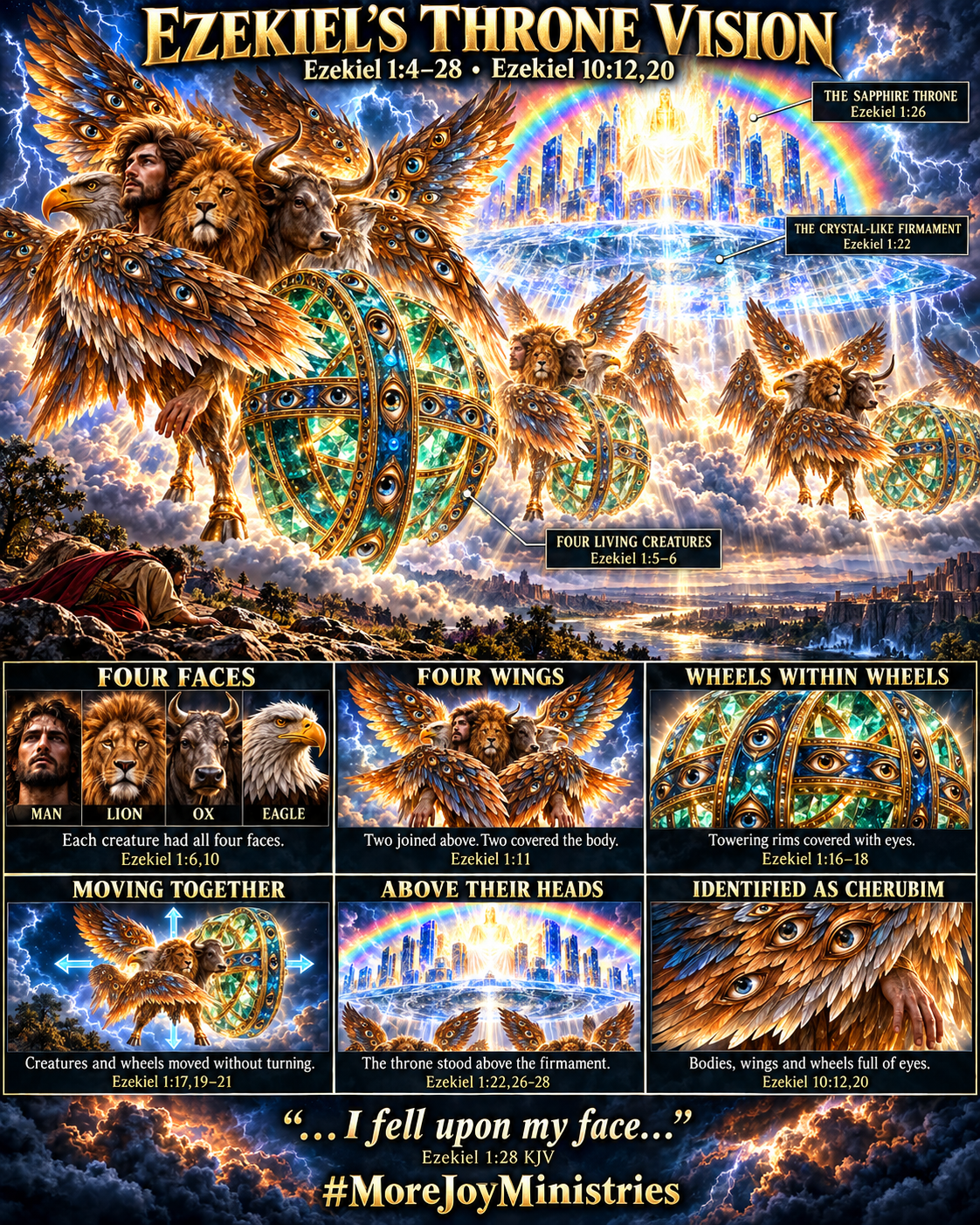
In Ezekiel 1, the language becomes even more intense. Ezekiel describes living creatures, wheels within wheels, fire, lightning, crystal, a throne, and above the throne “the appearance of a man.” Then he says there was brightness like amber and fire from the loins upward and downward, with radiance round about, “as the appearance of the bow that is in the cloud in the day of rain.” Then Ezekiel says, “This was the appearance of the likeness of the glory of the LORD.”
Notice the wording.
“The appearance.” “The likeness.” “The glory.”
Ezekiel is reaching for language because he is seeing a revelation of divine glory, not giving you a simple anatomy sketch.
Daniel 7 gives another throne scene and speaks of the Ancient of Days: “his garment was white as snow, and the hair of his head like the pure wool: his throne was like the fiery flame, and his wheels as burning fire.”
Again, this is not there to make God look like an old man in the creaturely sense.
The white garment and white hair communicate purity, eternal dignity, glory, and majesty. This is symbolic visionary language revealing truth about God, not reducing Him to a literal aged human body.
Then Revelation 4 shows the One seated on the throne described in terms of jasper, sardine stone, rainbow, lightning, thunderings, lamps of fire, crystal sea. John does not say, “Here is the facial structure.” He describes radiance, glory, brilliance, and awe.
Why?
Because the biblical emphasis is not on giving you a portrait to hang on a wall.
It is on overwhelming you with holiness, splendor, sovereignty, and glory.
That is what man needs to grasp.
Now this raises a question.
If no man has seen God, then what about the passages where men did see God?
Good question.
The answer is that Scripture sometimes speaks of visible manifestations of God, often called theophanies. These are appearances in which God reveals Himself in a form man can perceive.
For example, Genesis 18 describes the LORD appearing to Abraham in a form Abraham could interact with. Jacob in Genesis 32 says, “I have seen God face to face, and my life is preserved.” Exodus 24 says Moses, Aaron, Nadab, Abihu, and seventy elders of Israel “saw the God of Israel.” Yet John still says no man has seen God at any time.
That is not a contradiction.
It means no man has seen God in the fullness of His unseen essence, but men have seen God as He chose to reveal Himself.
That is a huge difference.
Many of those Old Testament appearances are best understood as manifestations of God, and many believers have argued that some of them are appearances of the preincarnate Son, because the Son is the revealer of God.
That brings us again to Christ.
Jesus is not merely one more messenger showing us something about God.
He is God the Son become flesh.
John 1:1 says, “the Word was God.”
John 1:14 says, “the Word was made flesh, and dwelt among us, and we beheld his glory.”
So when Christ walked among men, God was not being reduced. God was being revealed through the incarnation.
That is why Jesus is central to this question.
You want to know what God looks like in revealed form?
Look at Christ in the Gospels.
Watch Him cleanse the temple. Watch Him stop storms. Watch Him forgive sins. Watch Him receive worship. Watch Him speak with authority no mere prophet ever had. Watch Him go to the cross. Watch Him rise again.
That is what the invisible God looks like when He is made known in the Son.
And Scripture even gives us a glorified vision of Christ in Revelation 1.
John describes Him clothed with a garment down to the foot, girt with a golden band, head and hairs white like wool, eyes like a flame of fire, feet like fine brass burned in a furnace, voice like many waters, countenance like the sun shining in full strength.
That is royal, terrifying, glorious, and divine.
And it echoes Daniel’s throne visions on purpose.
The Son shares the glory of God.
Now another important point.
The Bible forbids man from making carved images of God.
Why?
Because every image lies.
Every image shrinks Him.
Every image makes Him manageable.
Deuteronomy 4 is especially strong here. Moses reminds Israel that when the Lord spoke at Horeb, they heard a voice, “but saw no similitude.” Therefore they were not to corrupt themselves with graven images.
That is important for this study because fallen man always wants to drag God down into visible manageable representation. Something he can shape. Something he can control. Something he can stare at without repentance.
God will not be reduced like that.
So the Bible gives enough revelation for truth, but not the kind of visual reduction men crave for idolatry.
That is not an accident.
That is protection.
Now let’s tighten this up.
What does God look like?
In His essence, God is spirit and cannot be reduced to creaturely form.
In His holiness, He dwells in unapproachable light.
In His manifestations, He reveals Himself through fire, cloud, glory, throne visions, and forms suited to human weakness.
In His self-disclosure, He is seen truly and perfectly in Jesus Christ, the image of the invisible God.
So the deepest answer is not, “God looks like an old man with white hair.”
That is far too shallow.
The biblical answer is that God reveals Himself in overwhelming holiness, blazing glory, consuming purity, kingly majesty, and perfect self-expression in the Son.
And that should do more than satisfy curiosity.
It should humble us.
Because the real problem is not that man lacks enough data to sketch God.
The real problem is that sinners want sight without holiness.
They want a visual before they want repentance.
They want a description before they want surrender.
But when men in Scripture truly encountered the glory of God, the response was not casual fascination.
It was collapse.
Isaiah said, “Woe is me.” Ezekiel fell on his face. Daniel lost his strength. John fell at His feet as dead.
That is what the presence of divine glory does to human pride.
So this question should end with more than a definition.
It should end with worship.
God is not like the gods of the nations. He is not a carved object. He is not a manageable religious mascot. He is the living God, holy, eternal, invisible in essence, blazing in glory, and perfectly revealed in Jesus Christ.
And one day, for the redeemed, there is an even greater promise.
Revelation 22:4 says, “And they shall see his face.”
That is where this is going.
The same God no sinner can approach on his own will be beheld by the redeemed in eternal fellowship because of the Lamb.
Not because man forced his way in.
Because Christ opened the way.
That is the hope.
#MoreJoyMinistries