More Joy Ministries
Full Bible Study
ISHMAEL: (THE SON OF THE FLESH, NOT THE SON OF PROMISE)
Ishmael is one of those men in the Bible people know by name, but usually do not understand in context.
And context is everything.
Because Ishmael was not just Abraham’s son. He became a living picture of what happens when man tries to help God fulfill what only God can fulfill.
God had promised Abraham a son. Not just any son, but a covenant son. A promised seed. One through whom the covenant line would continue. But Abraham and Sarah got tired of waiting, and instead of resting in what God said, they reached for a human solution.
That is where Ishmael comes in.
Genesis 16 tells us that Sarah gave Hagar, her Egyptian handmaid, to Abraham so she could obtain children by her. Abraham listened, Hagar conceived, and Ishmael was born. So Ishmael came into the world through impatience, unbelief, and fleshly planning. He was real, loved, and blessed in a temporal sense, but he was never the covenant child.
That distinction matters because God did not say, “I will establish my covenant with Ishmael.”
He said, “My covenant will I establish with Isaac” (Genesis 17:21).
That means Ishmael was Abraham’s son by natural means, but Isaac was the son of promise. Ishmael came by human effort. Isaac came by divine intervention. Ishmael was what flesh could produce. Isaac was what only God could bring to life.
And that turns Ishmael into more than a historical figure. He becomes a theological picture.
Paul makes that exact point in Galatians 4.
He says Abraham had two sons: one by a bondmaid, the other by a freewoman. Then he explains that the one born of the bondwoman was born “after the flesh,” while the one born of the freewoman was “by promise” (Galatians 4:23). Paul is not insulting Ishmael as a human being. He is explaining what Ishmael represents. Ishmael stands for the system of human effort, legal bondage, and fleshly striving. Isaac stands for promise, grace, liberty, and what God does by His own power.
That is a massive lesson.
A lot of people are still trying to produce spiritual results the Ishmael way.
They want righteousness by effort. Favor by performance. Standing with God by works. They want to manufacture what can only be received by faith. They want the blessing without the waiting, the promise without the surrender, and the calling without trusting God’s timing.
That road always produces Ishmael.
It produces something real, but not what God promised.
It produces movement, but not covenant fulfillment.
It produces labor, strain, jealousy, conflict, and confusion.
And that conflict showed up immediately in the text.
After Hagar conceived, her relationship with Sarah became tense. Pride entered. Contention followed. Later, after Isaac was born, Ishmael mocked him. Genesis 21 and Galatians 4 both show the same pattern: flesh persecutes promise. What is born merely of the flesh does not peacefully coexist with what is born of the Spirit.
That pattern still has not changed.
The flesh still fights what God is doing.
Religious pride still mocks grace.
Human effort still resents divine promise.
That is why Ishmael’s story is not just ancient history. It is a mirror.
Now none of this means Ishmael was ignored by God.
That part needs to be said clearly.
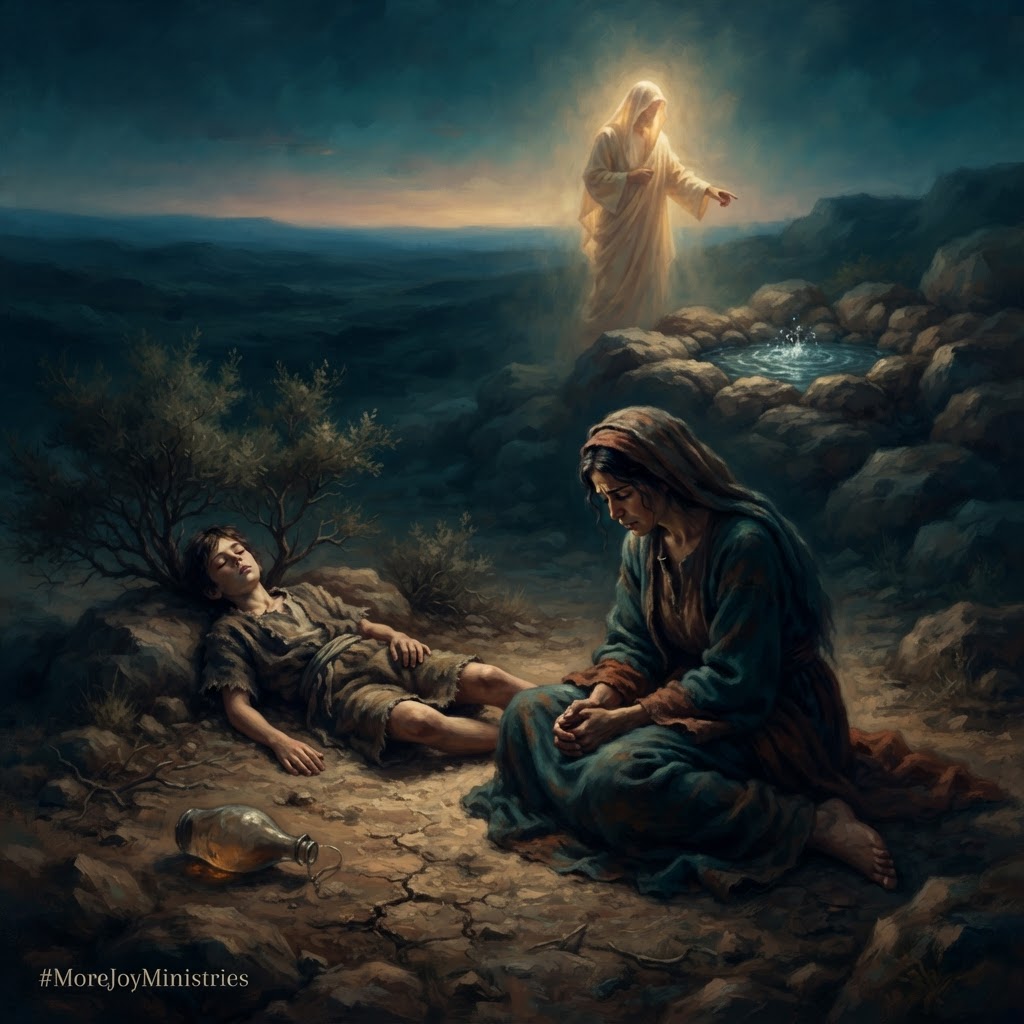
God heard Hagar in her affliction. In fact, the name Ishmael means “God hears.” The Hebrew is connected to shama‘, meaning “to hear.” That alone is powerful. Even in a situation born out of sin, disorder, and unbelief, God still heard. He saw Hagar in the wilderness. He preserved Ishmael. He promised to make him a great nation. Genesis 17:20 says God would bless him, make him fruitful, and multiply him exceedingly.
So Ishmael was not cursed in the sense of being discarded as worthless.
He was blessed in providence, but not chosen for the covenant line.
That is the key distinction.
People constantly blur categories in the Bible and then wonder why their doctrine gets messy. Blessing is not the same thing as covenant election. Being used in history is not the same thing as being the promised seed. Nearness to Abraham is not the same thing as inheriting the covenant.
Isaac was the line of promise.
Not Ishmael.
And the Bible is deliberate about that because ultimately the whole line is moving toward Christ.
The promised seed theme does not stop with Isaac. It runs through Abraham, Isaac, Jacob, Judah, David, and finally to Jesus Christ. That is why the issue was never simply, “Who is Abraham’s biological son?” The issue was, “Through whom will God carry the promise that leads to the Messiah?”
The answer was never Ishmael.
It was Isaac.
So what should we learn from Ishmael?
First, waiting on God is not wasted time. Abraham and Sarah tried to force open a door God had not opened yet, and the result brought long-term pain. Flesh hates waiting. Faith knows God is not late.
Second, not everything born out of activity is born out of promise. Some things look productive but were never authored by God. A man can create a mess in the name of solving a problem.
Third, the flesh and the promise do not come from the same source. One is produced by man. The other is received from God.
Fourth, God can still show mercy in messy situations. Hagar and Ishmael were not outside His sight. He heard. He saw. He acted. That should encourage anyone who has lived through the consequences of someone else’s sin or their own.
And fifth, proximity to truth is not the same thing as inheritance. Ishmael grew up around Abraham, but the covenant was not his. Being around godly things is not the same as belonging to God by faith.
That hits hard because many people today are near biblical language, near church culture, near Christian content, near truth, and still strangers to the promise.
Ishmael is a warning against trying to produce with the flesh what God said He would do by promise.
And he is also a reminder that God hears the afflicted, even in the wilderness.
That is Ishmael.
A real man in history.
A son of Abraham.
A child connected to failure, striving, and conflict.
Yet also a living biblical picture of the difference between flesh and promise, works and grace, human effort and divine fulfillment.
#MoreJoyMinistries