More Joy Ministries
Full Bible Study
WHERE WAS JESUS FOR THE THREE DAYS BETWEEN THE CROSS AND THE RESURRECTION?
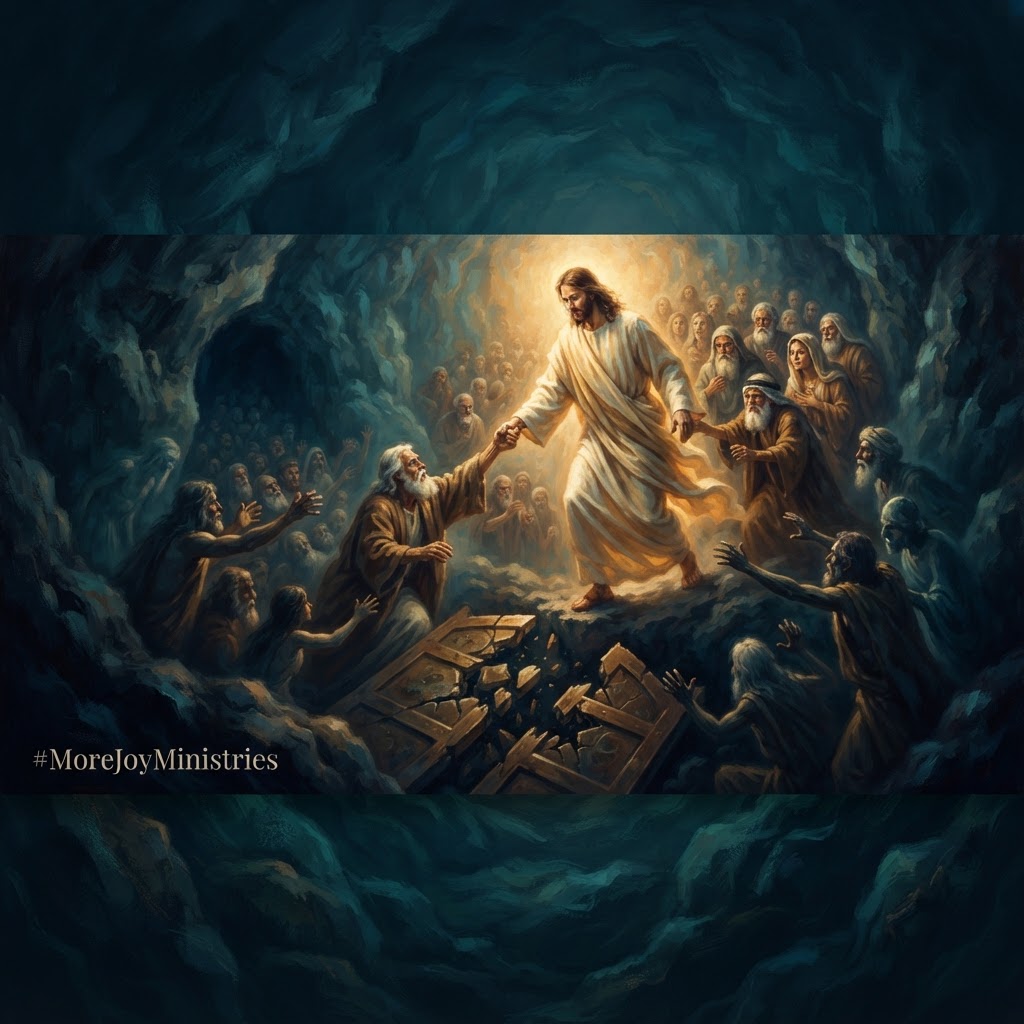
A lot of people ask where Jesus was between His death and resurrection.
Did He go to hell to suffer? Did He go to Abraham’s bosom? Did He preach to the dead? Did He descend somewhere to finish something that was not completed on the cross?
Let’s stay with Scripture.
When Jesus died, His body was laid in Joseph’s tomb.
Luke 23:53 says He was taken down, wrapped in linen, and laid in a sepulchre “wherein never man before was laid.”
So His body was in the grave.
But His spirit was not.
Jesus told the repentant thief, “Verily I say unto thee, To day shalt thou be with me in paradise” (Luke 23:43).
He did not say He was going to suffer in hell. He did not say more atoning work remained. He said, “Today... thou shalt be with me in paradise.”
That shows Christ went to paradise after death, not to a place of torment.
Luke 23:46 says, “Father, into thy hands I commend my spirit.”
He committed His spirit to the Father.
John 19:30 says, “It is finished.”
The work of redemption was complete at the cross. Jesus did not go somewhere else to keep paying for sin. Hebrews 10:10–14 says that by one offering He perfected forever them that are sanctified. One sacrifice. Once for all.
Some people go to 1 Peter 3:18–20 and say Jesus spent those three days preaching in hell.
But that text does not say He went there to suffer.
Peter says Christ was “put to death in the flesh, but quickened by the Spirit: By which also he went and preached unto the spirits in prison” (1 Peter 3:18–19).
There are two main ways this is understood.
One is that Christ proclaimed His victory to imprisoned spirits, likely fallen angels connected with Noah’s day. That fits with 1 Peter 3:22, where angels, authorities, and powers are made subject to Him.
The other is that Christ, by the Spirit, preached long ago through Noah to the people who are now in prison because they rejected that message. In that reading, Peter is not describing something Jesus did between the cross and resurrection, but something Christ did through Noah before the flood.
Either way, the passage does not teach that Jesus went to hell to keep suffering.
Acts 2:27, quoting Psalm 16, says, “Because thou wilt not leave my soul in hell, neither wilt thou suffer thine Holy One to see corruption.”
That does not mean Jesus was being tormented. It means He truly entered death, but was not abandoned there. Acts 2:31 says again, “His soul was not left in hell, neither his flesh did see corruption.”
He died. He entered the state of death. But death could not hold Him.
Then there is Ephesians 4:8–10, where Paul says Christ “descended first into the lower parts of the earth.”
Some take that as a reference to the grave. Some connect it to His coming down from heaven in incarnation and death. Either way, the passage is about His humiliation and triumph, not Jesus being tortured by demons after the cross.
Colossians 2:15 says He “spoiled principalities and powers, he made a shew of them openly, triumphing over them in it.”
That is victory language.
So what can we say with confidence?
His body was in the tomb. His spirit was in paradise with the Father. His redemptive work was already finished. He was not in hell being punished. And on the third day He rose bodily from the dead.
The cross was enough because His sacrifice was enough.
When Jesus said, “It is finished,” He meant it.
John 10:17–18 says, “I lay down my life, that I might take it again. No man taketh it from me, but I lay it down of myself.”
His body rested in the tomb. His spirit was with the Father. The payment for sin was complete. The resurrection was the open declaration of His victory.
Jesus did not spend those three days continuing His suffering.
He had already finished the work.
#MoreJoyMinistries