More Joy Ministries
Full Bible Study
DISPENSATIONALISM:
(WHAT IT IS, WHY IT MATTERS, AND WHY PEOPLE KEEP MISREPRESENTING IT)
One of the quickest ways to tell whether somebody actually understands dispensationalism is whether they describe it honestly.
A lot of people attack dispensationalism without ever defining it correctly. They talk like it means there are different ways of salvation, or that it teaches two different peoples of God in the sense of two different gospels, or that it was invented to prop up modern politics. That is not a serious treatment. That is a caricature.
So let us slow it down and deal with it plainly.
Dispensationalism is not the belief that people were saved by works in the Old Testament and are now saved by grace in the New Testament. That is false.
Dispensationalism is not the belief that Israel can be saved apart from Jesus Christ. That is false.
Dispensationalism is not the belief that the Church is an afterthought because God made a mistake. That is false.
Dispensationalism is the view that God has administered His dealings with mankind in distinguishable stewardships throughout history, while salvation in every age has always been by grace through faith based on the redemptive work of Christ.
That is the actual issue.
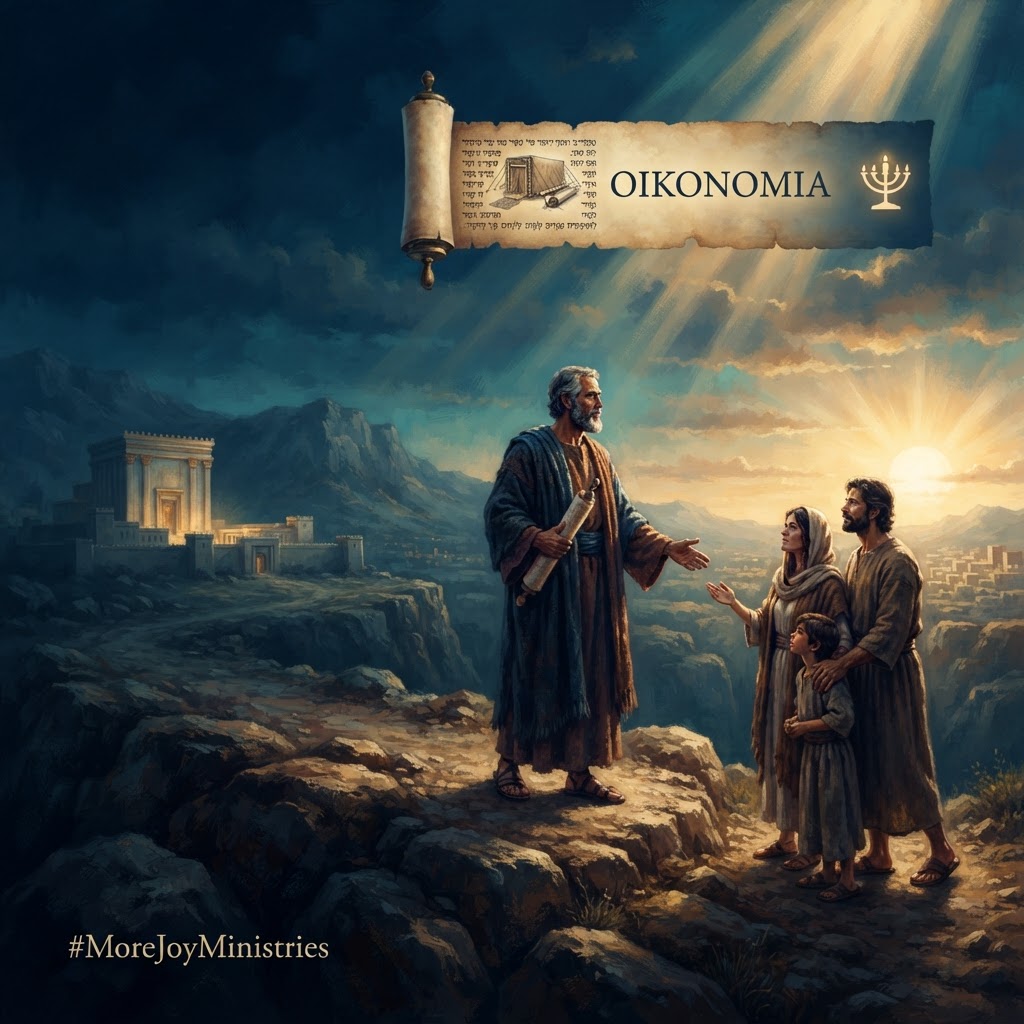
The word “dispensation” comes from the Greek word οἰκονομία (oikonomia), which carries the idea of stewardship, administration, or management of a household. Paul uses it in places like Ephesians 1:10, Ephesians 3:2, and Colossians 1:25. So right away, this is not some made up category with no biblical footing. Scripture itself uses the language of administration and stewardship in describing how God unfolds His plan.
Now, that does not mean God changes in His character. He does not.
It does not mean truth changes. It does not.
It means God’s dealings with man in history have progressive stages, and man’s responsibility under revelation is not identical in every era.
Adam in Eden was not living under the same revealed arrangement as Israel at Sinai.
Israel under the Mosaic Law was not living under the same revealed arrangement as the Church under the New Covenant.
And the Church right now is not living in the same kingdom conditions described for Christ’s millennial reign.
That should not be controversial. That should be obvious.
The Bible itself marks distinctions in administration, covenant structure, priesthood, temple function, sacrifice, national calling, and kingdom expectation. The real question is not whether distinctions exist. The real question is whether we will honor them or flatten them.
And that is where dispensationalism is often stronger than its critics.
It lets the Bible say what it says.
When God makes promises to Abraham about land, seed, and blessing in Genesis 12, 15, and 17, dispensationalism does not rush in and “spiritualize” the land into heaven or the seed into a vague religious abstraction. It takes God at His word.
When God promises David a throne and kingdom in 2 Samuel 7, dispensationalism does not dissolve that into a purely symbolic reign in the heart. It recognizes that yes, Christ reigns now in the highest sense, but the Davidic kingdom promises also point to a real earthly fulfillment.
When the prophets describe Israel’s national restoration, Jerusalem’s centrality, the nations going up to worship, the temple, the tribal allotments, and Messiah reigning on earth, dispensationalism does not panic and turn it all into “the Church.” It lets Israel mean Israel and Jerusalem mean Jerusalem.
That right there is one of the biggest dividing lines.
Dispensationalism insists that words should retain their normal meaning unless the text clearly signals symbolism. It does not deny symbols. The Bible obviously contains symbols. The issue is whether symbols cancel the reality being symbolized, and the answer is no.
If the twelve tribes are named, if the land boundaries are described, if the throne of David is referenced, if Jerusalem is centered, and if the nations are distinguished from Israel, then the burden is on the person trying to erase those distinctions, not on the person who simply reads the text as written.
A lot of this comes down to hermeneutics.
That is a big word, but the idea is simple. It means the method you use to interpret Scripture.
Dispensationalism tries to apply a consistent grammatical historical method. That means reading words in their normal sense according to grammar, context, history, and genre. Poetry is poetry. Symbol is symbol. Narrative is narrative. Prophecy is prophecy. But in every case, language still means something definite.
If you abandon that when you get to prophecy, you can make the text say almost anything.
That is exactly why so many anti dispensational arguments collapse. They begin by accusing dispensationalists of forcing the Bible into a system, while they themselves are quietly redefining Israel, land, kingdom, throne, temple, and tribulation to make the text fit theirs.
Now let us deal with a major misunderstanding.
Does dispensationalism teach two peoples of God?
That depends on what someone means.
If they mean two redeemed communities with two different saviors, absolutely not. There is one Savior, one cross, one ultimate basis of redemption. No Jew has ever been saved apart from Christ, and no Gentile has ever been saved apart from Christ. Romans 3:22 through 26 makes that clear. So does Acts 4:12.
But if they mean that Israel and the Church are not the same entity in Scripture, then yes, dispensationalism does maintain that distinction, and for good reason.
Israel is an ethnic, national, covenant people descended from Abraham, Isaac, and Jacob, with specific promises tied to land, nationhood, kingdom, and future restoration.
The Church is the body of Christ, a mystery not revealed in the same way in prior ages, composed of Jew and Gentile united in one body by the Spirit.
That is not confusion. That is Bible.
Paul in Romans 11 does not say Israel became the Church. He says Israel has experienced a partial hardening until the fullness of the Gentiles comes in, and then “all Israel shall be saved.” That only makes sense if Israel still means Israel. Otherwise Paul’s entire argument falls apart.
In 1 Corinthians 10:32, Paul distinguishes between the Jews, the Gentiles, and the church of God. That is a remarkable verse, because it shows categories still being maintained in the apostolic era.
In Ephesians 3, Paul calls the Church a mystery. The Greek word is μυστήριον (mystērion), meaning something once hidden and now revealed. If the Church is just Israel under another name, then calling it a mystery in that sense becomes very strange.
The Church participates in spiritual blessings promised in Christ, yes. The Church is saved by the Jewish Messiah, yes. The Church is grafted into blessing, yes. But none of that requires the cancellation of Israel’s national promises.
In fact, Romans 11 warns Gentile believers against arrogance on that exact point.
Another major issue is the law.
One of the reasons dispensational distinctions matter is because the Bible itself distinguishes between life under the Mosaic economy and life under the present administration of grace.
Israel was brought under the Law at Sinai.
The Church is not under the Law as a covenantal code.
That does not mean the Law was bad. Romans 7:12 says the Law is holy, just, and good.
It means the Law had a specific role.
Galatians 3 describes it as a schoolmaster. The Greek word is παιδαγωγός (paidagōgos), a guardian or tutor. It was never given as the final means of righteousness. It exposed sin, restrained, instructed, and pointed forward. It was temporary in function until the coming of Christ.
So when people mock dispensationalism for saying the Church is not Israel and grace is not Sinai, what they are often really mocking is the plain distinction the New Testament itself makes.
Read Acts carefully and you will see transition.
Read Hebrews carefully and you will see transition.
Read Galatians carefully and you will see transition.
Read the Jerusalem Council in Acts 15 carefully and you will see that the apostles did not put Gentile believers under the Mosaic covenant structure.
Now let us move into prophecy, because this is where the fight usually starts.
Dispensationalism is strongly connected to a futurist reading of prophecy, especially Daniel 9, Matthew 24, 2 Thessalonians 2, and Revelation 4 through 19.
Why?
Because it recognizes that the seventieth week of Daniel has not yet been fulfilled in the way the text describes.
Daniel 9:24 through 27 gives seventy weeks determined upon Daniel’s people and Daniel’s holy city. That means Israel and Jerusalem are at the center of the prophecy. The goals include finishing transgression, making an end of sins, making reconciliation for iniquity, bringing in everlasting righteousness, sealing up vision and prophecy, and anointing the most holy.
That full package has not been historically completed in the national and prophetic sense the text describes.
Yes, Messiah was cut off. Absolutely. That is central.
But the seventieth week includes more than Messiah’s death. It includes a coming prince, a covenant, a midweek desecration, and desolations that run until decreed judgment is poured out. Jesus in Matthew 24 still points forward to the abomination of desolation as a future event from His standpoint, and Paul in 2 Thessalonians 2 does the same with the man of sin. Revelation then unfolds a future period of unprecedented judgment tied to that same framework.
That is one reason dispensationalists reject the claim that the seventieth week was fully exhausted in Christ’s earthly ministry or the years immediately after.
The text pushes farther.
And once you see that, the larger prophetic structure starts to hold together.
Israel is central in Daniel’s seventieth week.
The nations rage.
The Beast rises.
The false prophet deceives.
Judgments fall.
And Christ returns bodily to establish His kingdom.
Dispensationalism does not create that framework. It simply refuses to blur the lines the text preserves.
Now, let us be fair.
Are there bad dispensationalists? Of course.
Are there shallow versions of it? Yes.
Have some people turned it into newspaper sensationalism instead of careful exegesis? Absolutely.
But that is not an argument against the system itself. Every theological camp has sloppy representatives. That proves human weakness, not doctrinal falsity.
The real test is whether the system helps make sense of the whole counsel of God without forcing contradictions.
And here is where dispensationalism has real strength.
It explains why there is a real difference between Israel and the Church without inventing two ways of salvation.
It explains why Old Testament kingdom promises have not been canceled.
It explains why the New Testament still speaks of a future for Israel.
It explains why the present Church age has features described as a mystery.
It explains why Revelation after chapter 3 shifts so heavily into judgment, Israelite imagery, temple language, and worldwide tribulation.
It explains why the Bible ends not with souls floating forever, but with a King reigning, nations being ordered, evil judged, and creation restored.
It is not a perfect system because no system built by men is perfect.
But it is far more biblically serious than its critics often admit.
And honestly, a lot of the hatred toward dispensationalism comes from what it refuses to surrender.
It refuses to dissolve Israel into the Church.
It refuses to reduce prophecy to vague spiritual metaphors.
It refuses to pretend the kingdom promises are already fulfilled in their plain sense.
It refuses to erase the future tribulation, future antichrist, future national restoration of Israel, future bodily return of Christ to earth, and future millennial reign.
That is why it gets attacked.
Not because it is weak, but because it is stubbornly literal where others prefer flexibility.
Now let me say something important.
Dispensationalism does not save anybody.
Jesus Christ saves.
A man can use the term dispensational and still be lost.
A man can reject the label and still love the Lord.
So this is not about worshiping a system.
It is about whether our theology is letting Scripture keep its own categories.
It is about whether we believe God means what He says.
It is about whether unconditional promises remain unconditional.
It is about whether prophetic texts still have prophetic value.
And it is about whether God’s faithfulness to Israel says something massive about His faithfulness to all of us.
Because if God can just redefine or cancel what He plainly promised to Israel, then what exactly stops someone from saying He can do the same thing with promises made to the Church?
That is one reason this matters more than people think.
Dispensationalism is not just about charts.
It is about the character of God.
It is about whether He keeps covenant.
It is about whether prophecy means what it says.
It is about whether the Bible can be read consistently from Genesis to Revelation without collapsing distinctions God Himself put there.
So no, dispensationalism is not the cartoon version critics love to attack.
It is a serious attempt to honor the progress of revelation, the distinction between Israel and the Church, the plain sense of prophecy, and the faithfulness of God to every word He has spoken.
People can disagree with it. Fine.
But they should at least have enough honesty to argue against the real thing.
Not a straw man.
Not a meme.
Not some lazy rant about Scofield, Darby, or “Zionists” from people who have not done the work.
If you are going to attack dispensationalism, first define it correctly.
Then explain why God’s promises to Israel do not mean what they say.
Then explain why Paul still distinguishes Israel in Romans 11.
Then explain why the Church is called a mystery.
Then explain why the kingdom prophecies read like kingdom prophecies.
Then explain why the Book of Revelation still sounds future.
Until then, a lot of these anti dispensational arguments are just noise dressed up as confidence.
And a lot of Christians would do well to stop letting loud people shame them out of taking the Bible plainly.
Tony Campbell
Key Scriptures: Genesis 12:1 through 3, Genesis 15, Genesis 17, 2 Samuel 7:12 through 16, Jeremiah 31:31 through 37, Ezekiel 36:22 through 28, Daniel 9:24 through 27, Matthew 24:15 through 21, Luke 21:24, Acts 1:6 through 7, Romans 11:1 through 29, 1 Corinthians 10:32, Galatians 3:19 through 25, Ephesians 1:10, Ephesians 3:1 through 11, Colossians 1:24 through 27, 1 Thessalonians 4:13 through 18, 2 Thessalonians 2:1 through 12, Revelation 6 through 19, Revelation 20:1 through 6
#MoreJoyMinistries #Dispensationalism #BibleStudy #Prophecy #IsraelAndTheChurch #RightlyDividingTheWord #KJV