More Joy Ministries
Full Bible Study
PURIM: THE DAY A GENOCIDE WAS SCHEDULED, AND GOD OVERTURNED IT.
Purim is called in Scripture a “day of feasting and joy” (Esther 9:18).
But that joy was born out of a signed death warrant.
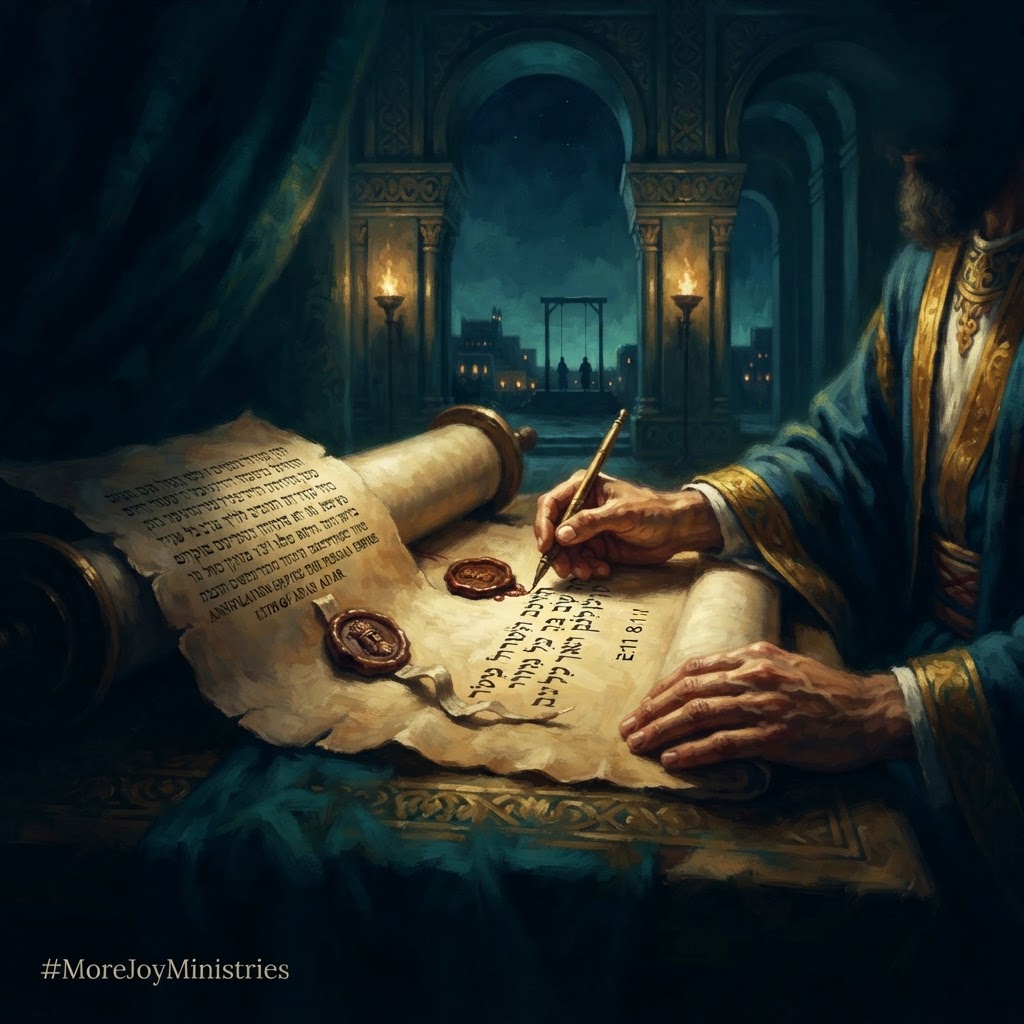
In the Persian Empire under King Xerxes, an official decree was sealed to annihilate every Jew in the empire on a single day: the 13th of Adar. Men. Women. Children. Wiped out.
The man behind it was Haman, identified in Esther 3 as an Agagite. That detail is not random. Agag was king of the Amalekites in 1 Samuel 15. Amalek had attacked Israel in Exodus 17 after the Red Sea crossing. God declared that He would be at war with Amalek from generation to generation.
Saul failed to eliminate Agag. Samuel finished it. But generations later, an Agagite rises again in Persia with genocidal intent.
History is colliding with covenant.
Haman’s rage began when Mordecai, a Jew from the tribe of Benjamin, refused to bow. Pride turned into hatred. Hatred turned into extermination. Haman cast “pur”, lots, to determine the day of destruction. The lot fell nearly a year away. The decree was sealed with the king’s signet ring and sent across 127 provinces.
The date was set.
In all 5,633 Hebrew words of Esther, the name of God is never mentioned.
Not once.
No miracles. No prophets. No burning bush moments.
And yet God is everywhere in the story.
Esther calls for a three-day fast. She approaches the king without invitation, which could mean death. The king extends the golden scepter. She invites him and Haman to a banquet. Then another banquet.
In between, the king cannot sleep. The royal records are read. Mordecai’s past loyalty is discovered. Haman is forced to publicly honor the man he hates. The gallows he builds for Mordecai become his own execution stake.
At the second banquet, Esther reveals her identity and exposes the plot. Haman is executed. The original decree cannot legally be revoked, but a second decree is issued allowing the Jews to defend themselves.
On the very day meant for their destruction, their enemies fall instead.
Esther 9 says the following day became a “day of feasting and joy.” Mourning turned into celebration.
Purim means “lots,” because lots were cast to decide the day of annihilation.
But the lot does not control history.
God does.
During Purim, the Scroll of Esther is read publicly. When Haman’s name is spoken, noise is made to drown it out. This reflects Deuteronomy 25:19 “blot out the remembrance of Amalek.” Covenant memory is louder than hatred.
If Haman had succeeded, the Jewish people in Persia would have been destroyed.
No preserved line of Judah. No continuation toward David. No Messiah born in Bethlehem. No fulfillment of Genesis 22:18. No Gospel.
Purim is not a minor Jewish holiday tucked into the Old Testament.
It is a preservation event in the redemptive timeline.
God promised Abraham that through his seed all nations would be blessed. That line runs through Isaac, Jacob, Judah, David, and ultimately to Jesus Christ. God does not let His word fail (Romans 9:6). Even when He is not named, He is active. Even when heaven seems silent, providence is moving.
Purim teaches that God works behind sleepless nights, political decrees, human courage, and hidden timing.
The enemy casts lots.
God writes outcomes.
Happy Purim.
More Joy Ministries
#MoreJoyMinistries