More Joy Ministries
Full Bible Study
The story of Noah’s Flood is one of the most iconic narratives in the Bible. Whether you learned it in Sunday school or heard it in cultural references, it carries weight across religious and secular lines.
Beneath the surface familiarity lies a profound theological and historical depth that people often overlook or misunderstand. Genesis 6 through 9 recounts a world steeped in total corruption.
Humanity’s wickedness had reached a tipping point where every inclination of the thoughts of the human heart was only evil all the time. God’s response was not impulsive wrath, but rather grief.
The Hebrew word naham, translated as regret or sorry, conveys deep sorrow rather than a change of mind. God’s heart was troubled, and He chose to act based on divine justice and mercy.
Genesis 6:1–4 introduces a mysterious subplot involving the union of the sons of God and the daughters of men, which produced the Nephilim. Some interpret this as a merging of the lines of Seth and Cain.
Others, drawing from Job and 1 Enoch, see these sons as fallen angels who corrupted humanity through forbidden unions and knowledge. Jude 1:6 and 2 Peter 2:4 support the idea that these beings faced divine punishment for their actions.
Their influence likely accelerated human depravity and prompted divine intervention.
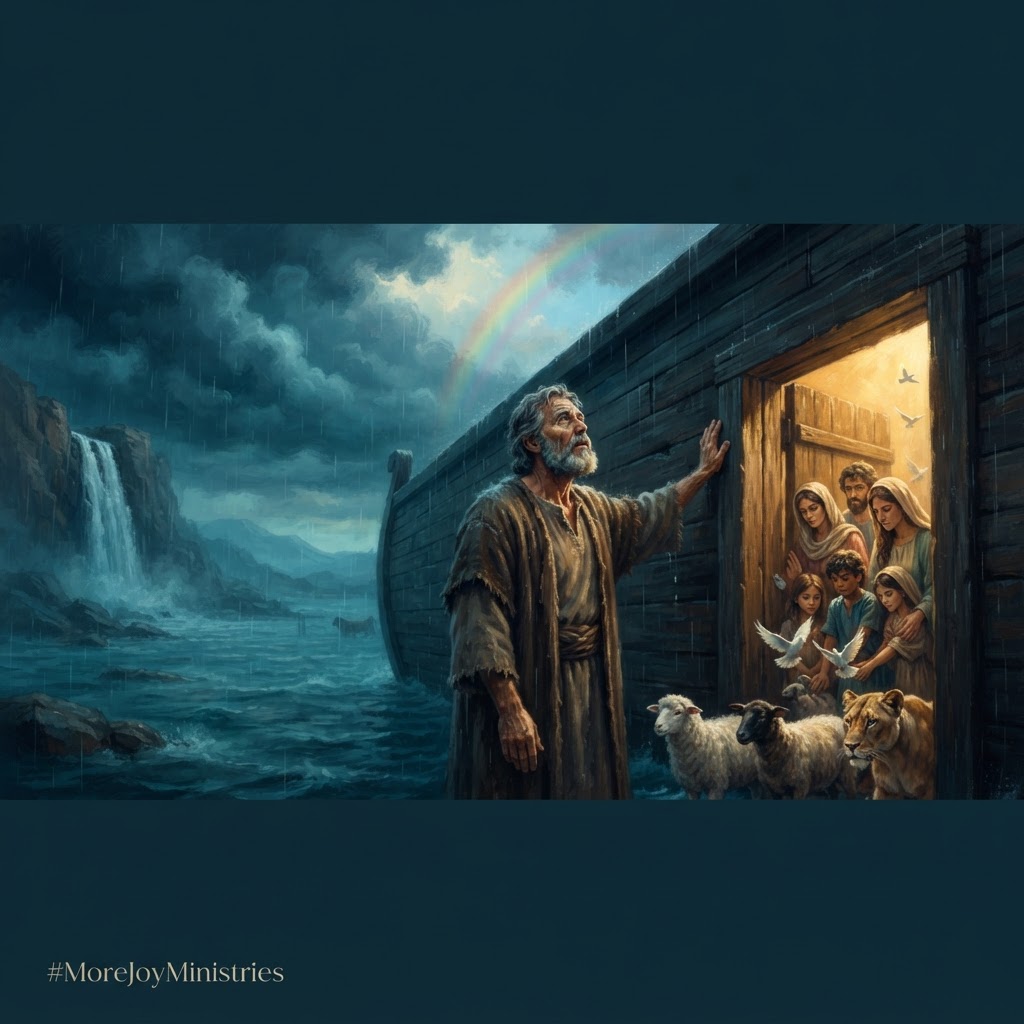
Popular depictions of the Ark often misrepresent its scale and cargo. Noah did not bring two of every species, but rather kinds, which were representative pairs of animals within broader categories like the cat kind or horse kind.
Genesis 7:2–3 clarifies that seven pairs of clean animals and birds were also included. The Ark was not a floating zoo, but a vessel of preservation and divine order.
The floodwaters rose for 40 days, prevailed for 150, and receded over a year. Eventually, the Ark rested on the mountains of Ararat, and Noah’s family emerged into a renewed world.
God then made a covenant, symbolized by the rainbow, promising He would never again destroy the earth by flood.
The flood narrative is not unique to the Bible. The Quran recounts a similar story, and ancient Mesopotamian epics like Gilgamesh and Atrahasis also describe massive floods.
These parallels suggest a shared memory of a cataclysmic event, though they are interpreted through different theological lenses. The flood was not just punishment, as it served as a warning and a reset.
2 Peter 2:4–6 and 1 Corinthians 10:1–11 frame it as a precedent for future judgment. The parable of Lazarus and the rich man in Luke 16:19–31 reinforces this point by showing we have the testimony of Moses, the Prophets, and the New Testament to guide us.
The flood teaches that God is patient but not indifferent, and that sin carries real consequences. The story shows us that while God grieves over human sin, He acts to preserve righteousness and offer redemption.
It is not merely a tale of destruction, but a call to reflection, repentance, and hope.
#MoreJoyMinistries