More Joy Ministries
Full Bible Study
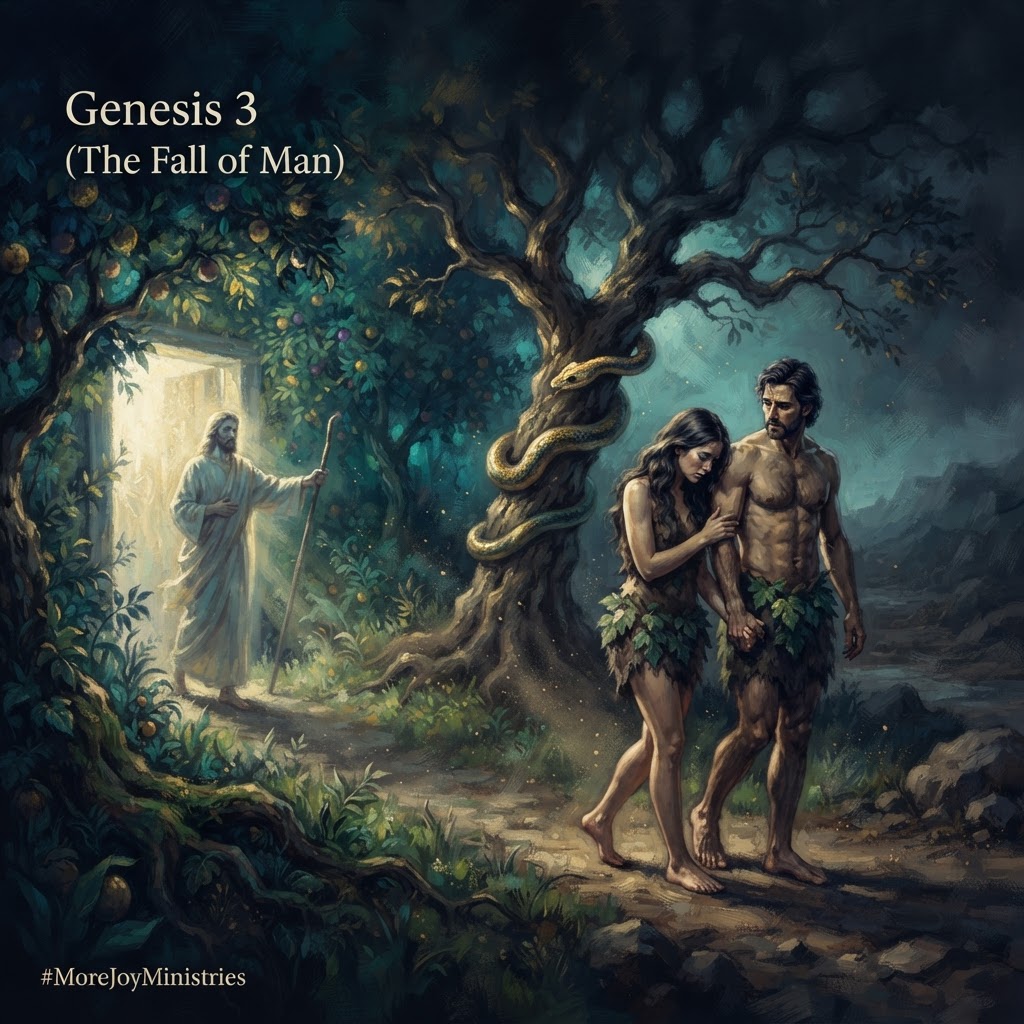
Genesis 3 (The Fall of Man)
This chapter is one of the most consequential in the entire Bible. It explains the origin of sin, death, suffering, the curse, and—crucially—the first promise of redemption (the Protoevangelium in 3:15).
1–5 The Serpent’s Temptation of Eve:
1: “Now the serpent was more crafty than any other beast of the field that the LORD God had made.”
- Hebrew nachash (שָׁנָח) = serpent, but also carries connotations of “shining one” or “diviner.” Many ancient Jewish and early Christian interpreters (and Chuck Missler) believed this was Satan appearing in or possessing a serpent-like creature (see Rev 12:9; 20:2).
- The text deliberately contrasts the serpent with the other “beasts of the field” to show he is not just an animal; he speaks with intelligence and malice.
- v.1b “Did God actually say, ‘You shall not eat of any tree in the garden’?”
- First recorded words of Satan in Scripture = a lie wrapped in a half-truth.
- He exaggerates and misquotes God’s command (God said “from every tree you may freely eat, but…” – Gen 2:16–17). Satan turns abundance into apparent deprivation.
- Goal: sow doubt about God’s goodness and truthfulness.
- v.2–3 Eve’s response:
- Eve adds to God’s command: “neither shall you touch it” (not in 2:17). Even a small addition distorts the Word.
- She weakens the certainty of death: “lest you die” instead of “you shall surely die.”
- v.4–5 “You will not surely die… your eyes will be opened, and you will be like God, knowing good and evil.”
- Direct contradiction of God’s Word.
- Partial truth: their eyes were opened (v.7), and they did “know good and evil” experientially (v.22).
The lie: they would become “like God” autonomously, independent of Him—classic satanic promise of self-deification. Isa 14:13–14; Ezek 28:2).
6 -The Sin Itself:
Threefold temptation mirroring 1 John 2:16 and Jesus’ temptation:
- “good for food” → lust of the flesh
- “a delight to the eyes” → lust of the eyes
- “desired to make one wise” → pride of life
- “She took… and ate… and he ate.” Adam was “with her” (v.6) – he was not deceived (1 Tim 2:14), yet he passively followed. Sin enters through the man (Rom 5:12–19).
7–8 Immediate Consequences:
- Eyes opened → shame and self-awareness of guilt.
- Fig-leaf aprons → first human attempt at self-atonement (always inadequate).
- Hiding from God → broken fellowship; fear replaces love.
9–13 The Confrontation and Blame-Shifting:
- God asks questions not for information but to force confession.
- Adam: blames Eve (and indirectly God – “the woman you gave me”).
- Eve: blames the serpent.
- No one says, “I was wrong.”
14–19 The Curse:
- v.14–15 Curse on the Serpent (two levels)
1. Literal: crawls on belly, eats dust (possible devolution of the creature).
2. Spiritual (v.15 – Protoevangelium, the first gospel promise):
- Enmity between the serpent’s seed and the woman’s seed.
- “He (masculine singular) shall bruise your head” → fatal blow to Satan.
- “You shall bruise his heel” → Satan wounds Christ at the cross, but Christ crushes Satan’s authority (Col 2:15; Heb 2:14; Rom 16:20).
- Virgin birth implied: “seed of the woman” (normally seed is of the man).
- v.16 Curse on the Woman:
- Multiplied pain in childbearing (Hebrew עִצָּבוֹן, “painful toil”).
- “Your desire shall be for your husband, and he shall rule over you.”
- Same phrasing as 4:7 (sin’s “desire” to master Cain). Many scholars see this as a desire to dominate the husband, met with harsh rule → broken harmony in marriage.
- v.17–19 Curse on the Man: (and the ground)
- Because he “listened to the voice of your wife” instead of God.
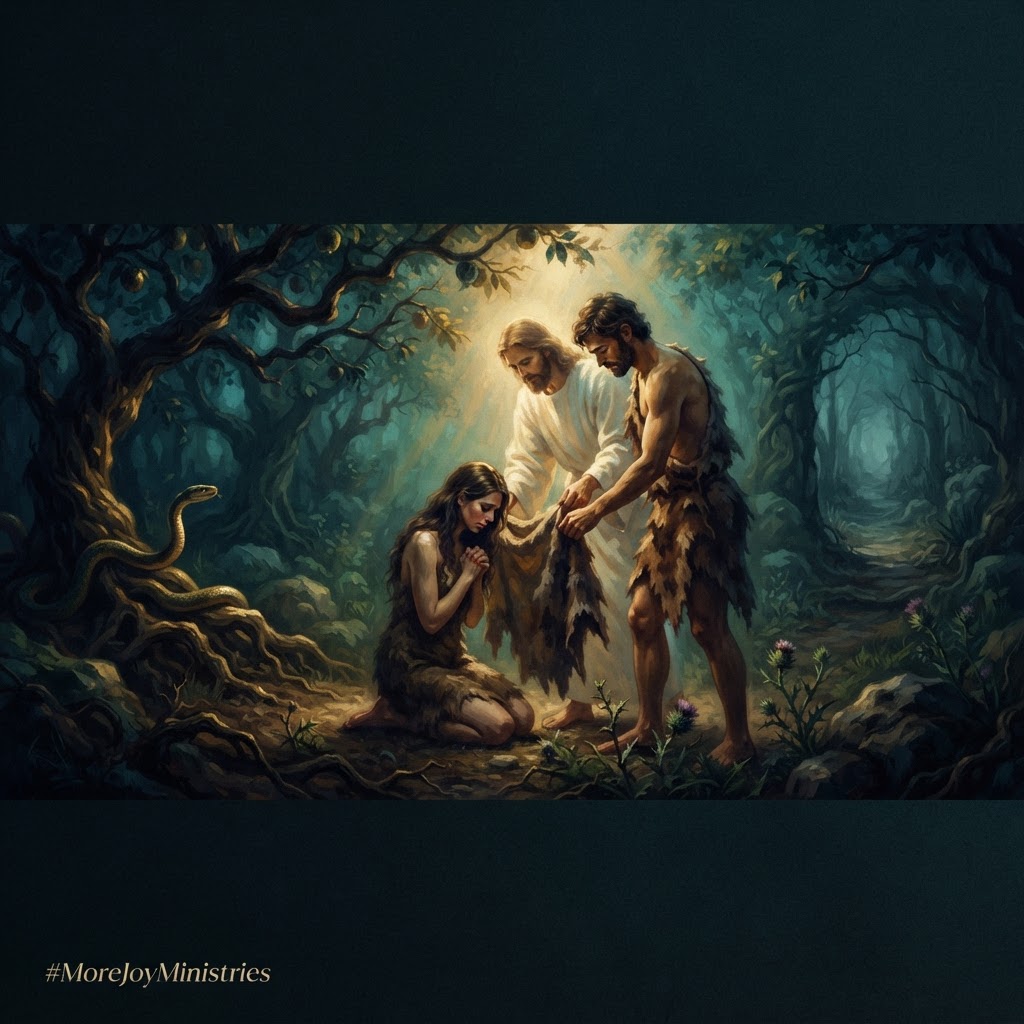
- Ground cursed → thorns, thistles, sweat, toil.
- “By the sweat of your face you shall eat bread till you return to the ground… for you are dust.”
- Death introduced: physical (return to dust) and spiritual (separation from God).
20–21 Grace in the Midst of Judgment:
- v.20 Adam names her “Eve” (Hebrew חַוָּה, “living”) – an act of faith looking forward to life despite the death sentence.
- v.21 God makes garments of animal skins → first blood shed in Scripture. Foreshadows substitutionary atonement (an innocent dies to cover the guilty).
22–24 Expulsion from the Garden:
- “Lest he reach out his hand and take also of the tree of life and eat, and live forever” – mercy, not cruelty. Eternal life in a fallen state would be hell.
- Cherubim and flaming sword → guard the way back. Access to the tree of life is restored only in Christ (Rev 2:7; 22:2, 14).
Major Theological Takeaways:
1. Sin is fundamentally rebellion against God’s Word and authority.
2. Satan’s strategy has never changed: question God’s Word, deny consequences, promise divinity.
3. Both Adam and Eve sinned differently (Eve deceived, Adam willful), but sin entered through Adam as the head.
4. The curse affects every area: serpent, woman (childbearing & marriage), man (work & death), creation itself (Rom 8:20–22).
5. God’s grace appears immediately: animal sacrifice, promise of the coming Seed (Christ), and prevention of eternal life in fallenness.
Genesis 3 is not just “how sin entered”; it is the foundation for understanding the entire redemptive story of the Bible. Every major doctrine—sin, salvation, atonement, Satan, marriage, work, death—finds its origin here.