
More Joy Ministries
Full Bible Study
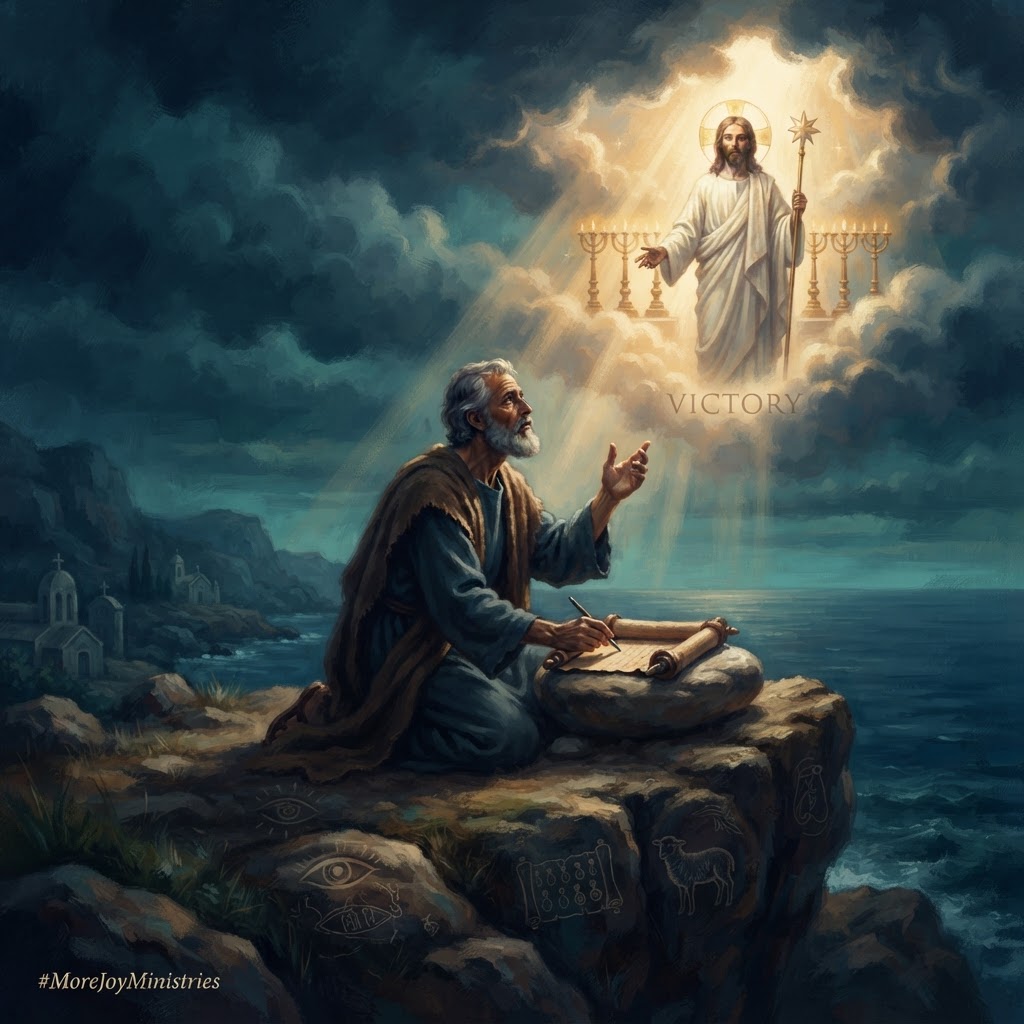
The title Revelation comes from the Greek word apokalypsis, which means an unveiling. This is not a secret hidden away, but a curtain ripped open for the church to see reality.
John expects his readers to recognize that nearly every image in the book draws from the Old Testament. With over 800 allusions in about 400 verses, these symbols serve as spotlights that point us back to the writings of Isaiah, Ezekiel, Daniel, Zechariah, and Exodus to understand what God is accomplishing.
Blessed is the one who reads aloud the words of this prophecy, and blessed are those who hear it and take to heart what is written in it, because the time is near. (Rev 1:3)
This is the only book in the Bible that pronounces a specific blessing on those who read it aloud and listen. God wants His servants to grasp this message.
Jesus Himself provides the divine outline in Revelation 1:19: Write, therefore, what you have seen, what is now, and what will take place later.
The first section describes the vision of the glorified Christ. The second covers the seven churches, representing the entire present church age.
The third section, beginning with the Greek phrase meta tauta, covers everything from Revelation 4:1 to the end. The phrase appears twice in 4:1 right after the letters to the churches conclude.
Following this, an open door appears in heaven and a voice sounds like a trumpet, saying, Come up here. Whether or not you view this as the rapture, the structure shows the church on earth in the first three chapters and in heaven from chapter 4 through 19, before returning with Christ in chapter 19.
Regarding the timing, Revelation 3:10 gives a clear promise to the faithful church: Because you have kept my command to endure patiently, I will also keep you from the hour of trial that is going to come on the whole world to test the inhabitants of the earth. The Greek phrase tereo ek means to keep you out of the hour itself, not simply to keep you safe through it.
Paul confirms this in 1 Thessalonians 5:9, stating that believers are not appointed to wrath. The church is absent during the outpouring of wrath described in Revelation 6 through 19.
John’s original readers understood the historical context perfectly. The seven heads represented the seven hills of Rome, and the harlot drunk with the blood of saints described the city’s luxurious persecution under Nero and Domitian.
In Hebrew gematria, 666 was a common calculation for Neron Kaisar. John’s message was that Rome was merely the current Babylon, continuing a pattern of empires that demand absolute allegiance and persecute the people of the Lamb.
This pattern repeats until Jesus ends it.
The heart of the book is the Slain Lamb who wins by losing. John hears that the Lion of Judah is coming to conquer, yet he turns to see a Lamb standing as though slaughtered.
This image shatters human expectations of power. The Lion wins because He is the Lamb.
The Kingdom advances not through believers killing enemies, but through believers willing to die for their faith while loving and forgiving those who oppose them.
John provides a 360-degree prophetic vision rather than a flat timeline. The seven seals, trumpets, and bowls are overlapping cycles that illustrate the drama of history.
The seals represent the big-picture scroll of history, the trumpets serve as Exodus-style warnings, and the bowls represent the final justice against a hardened humanity. Armageddon, mentioned in Revelation 16:16, refers to the mountain of Megiddo, a site of historic conflict.
It is not a literal nuclear war, but the final gathering of every anti-God system to make war on the Lamb. Jesus wins this conflict effortlessly with a word from His mouth.
Revelation 20 mentions the thousand-year reign where Satan is bound, martyrs are vindicated, and Christ reigns. After this, a final rebellion is crushed, death is destroyed, and the old creation passes away.
Chapters 21 and 22 reveal the new heaven and new earth, the final goal of the entire Bible. The city is presented as a bride in perfect union with God, where the river of life flows and the tree of life heals the nations.
The Spirit and the Bride issue the final invitation for all who are thirsty to come.
John wrote this to suffering churches facing an empire that demanded worship or death. His message remains the same today: every Babylon will fall, the Lamb has already won, and faithfulness unto death is how we conquer.
Jesus is coming back to make every wrong right and to dwell with His people. Hold fast, wash your robes, and keep the words of this prophecy.
Behold, I am coming soon. Even so, come, Lord Jesus.
#MoreJoyMinistries



