More Joy Ministries
Full Bible Study
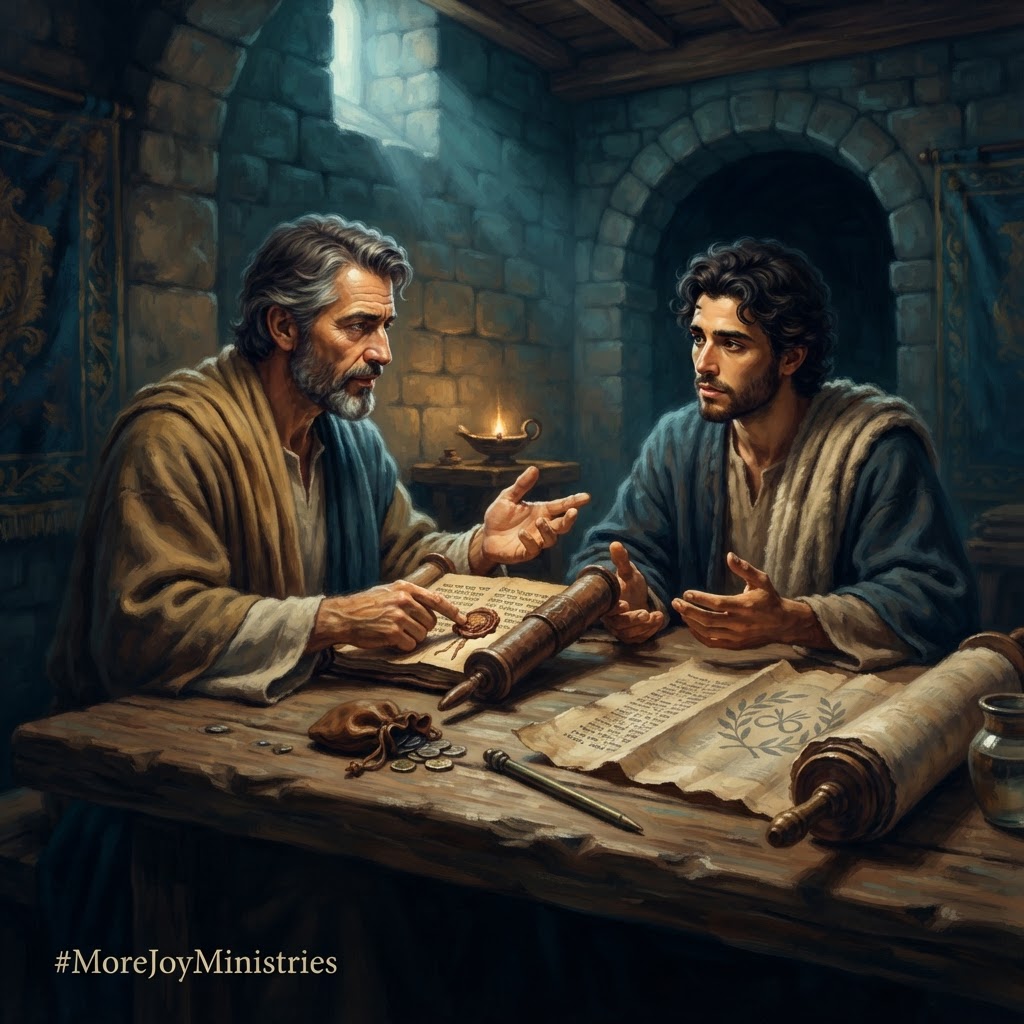
Genesis 9:11 says, "Thus, I establish My covenant with you." We read often that God keeps His covenants, but we must understand what a covenant is.
Technically, two parties form a covenant to make binding promises to one another to achieve a common goal. It is essentially a contract.
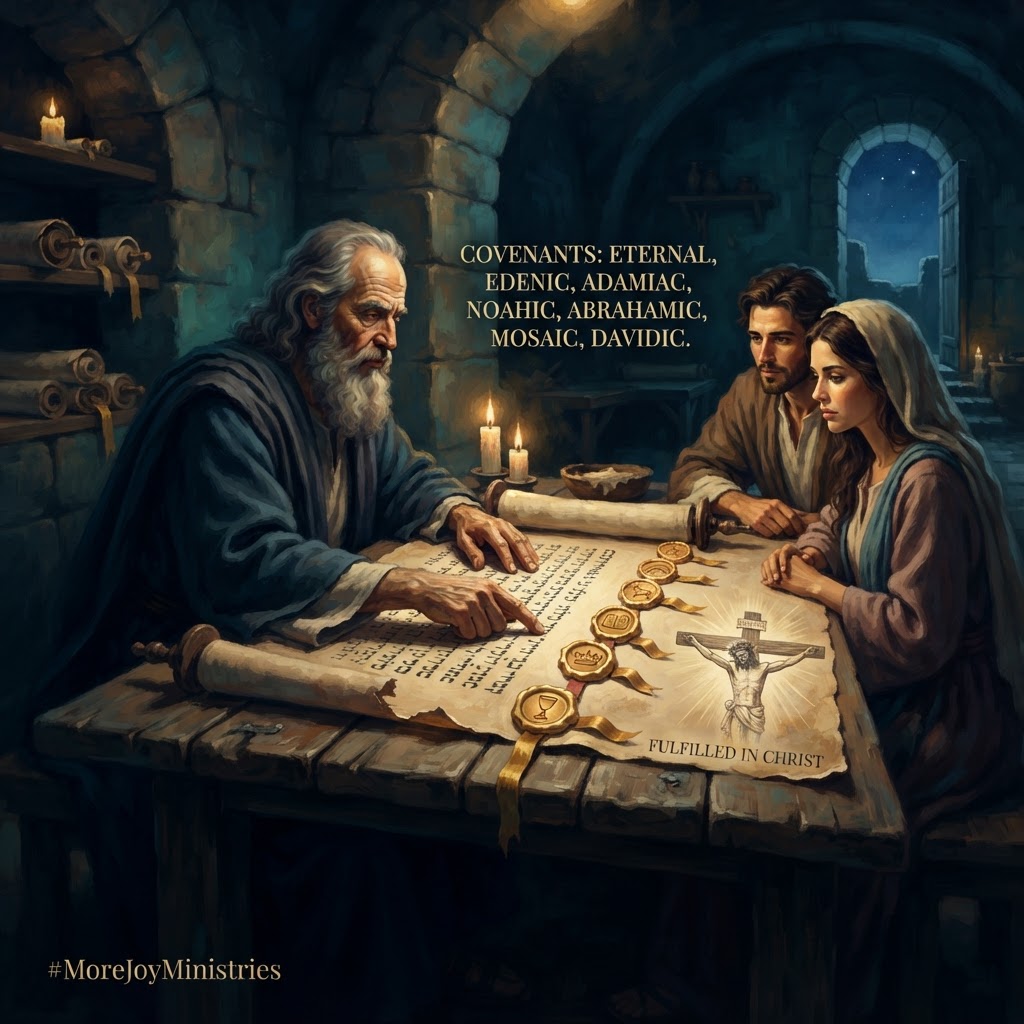
The Bible details seven covenants God made to restore mankind to salvation and his divine calling following the fall in the Garden of Eden. Four of these are specific to Israel, while three pertain to all of mankind.
We will walk through these in order as they appear in Scripture. The Adamic Covenant is the first agreement God made with man.
It contains three distinct parts known as the Edenic, Adamic, and the restoration of man. Genesis 1:26–30 details the Edenic portion where God creates man in His image and defines his responsibilities toward nature.
"And God said to them, ‘Be fruitful and multiply. Fill the earth and subdue it.
Have dominion over the fish of the sea, over the birds of the air, and over every living thing that moves on the earth.’” (v28). Stewardship of nature included the Tree of the Knowledge of Good and Evil.
"And the LORD GOD commanded the man, saying, ‘Of every tree of the garden you may freely eat. But of the Tree of the Knowledge of Good and Evil you shall not eat, for in the day that you eat of it, you shall surely die.’” (Genesis 2:16–17).
Adam and Eve failed to keep their side of the agreement. In Genesis 3, the serpent deceived the couple, leading them to eat the forbidden fruit.
This sin triggered the Adamic Covenant, where God pronounced eternal consequences for disobedience. Women would face extreme pain in childbirth and struggles with their husbands, while men would endure hard labor to coax food from the ground.
God did not leave mankind without hope. He promised restoration in the third part of the covenant.
"And I will put enmity between you and the woman and between your seed and her Seed. He shall bruise your head, and you shall bruise His heel.” (v15).
The capitalization of "Seed" points directly to the coming Messiah. Though believers and unbelievers will always be at odds, God promised a full restoration of man.
God then implemented the Noahic Covenant. By the time of Noah, sin was rampant.
God saw that Noah was a just man and instructed him to build an ark to protect his family from the coming flood. Once they were aboard, God brought rain for forty days and nights.
After the waters receded, God promised never to destroy the earth with a flood again. "Thus, I establish My covenant with you.
Never again shall all flesh be cut off by the waters of the flood. Never again shall there be a flood to destroy the earth.” (Genesis 9:11).
God placed a rainbow in the clouds as a sign of this eternal faithfulness. The Abrahamic Covenant appears in Genesis 12.
"I will make you a great nation. I will bless you and make your name great.
And you shall be a blessing. I will bless those who bless you, and I will curse those who curse you.
And in you, all the families of the earth shall be blessed.” (v1–3). God promised Abraham many descendants and the land of Canaan as an everlasting possession.
God required circumcision as a sign of this covenant. Abraham demonstrated his faith when God commanded him to sacrifice his only son, Isaac.
God stopped him, but this act of obedience mirrored the Father’s later sacrifice of His own Son. The Mosaic Covenant followed the exodus from Egypt.
At Mount Sinai, God defined how the Israelites should conduct themselves to be a kingdom of priests and a holy nation. This required adherence to hundreds of statutes, including the Ten Commandments.
"Therefore, be careful to observe [the covenant], for this is your wisdom and your understanding in the sight of the peoples who will hear all these statutes and say, ‘Surely this great nation is a wise and understanding people.’” (Deuteronomy 4:6). Disobedience brought curses upon the people.
The Davidic Covenant established a royal bloodline through King David, leading directly to Jesus Christ. "He will be great and will be called the Son of the Highest.
And the Lord God will give Him the throne of His father, David. And He will reign over the house of Jacob forever, and of His kingdom, there will be no end.” (Luke 1:32–33).
Psalm 72:17 echoes this promise of an eternal King. Finally, the New Covenant fulfills the previous promises.
Though God established this primarily with Israel, it extends to all mankind. It offers forgiveness and restored fellowship through faith in Jesus Christ rather than the legalistic observance of the law.
"For God so loved the world that He gave His only begotten Son, that whoever believes in Him should not perish but have everlasting life.” (John 3:16). Jesus succeeded where humanity failed.
He is the mediator of this new and better covenant. He paid our debt of rebellion, and through His death and resurrection, our relationship with the Father is restored.
#MoreJoyMinistries