More Joy Ministries
Full Bible Study
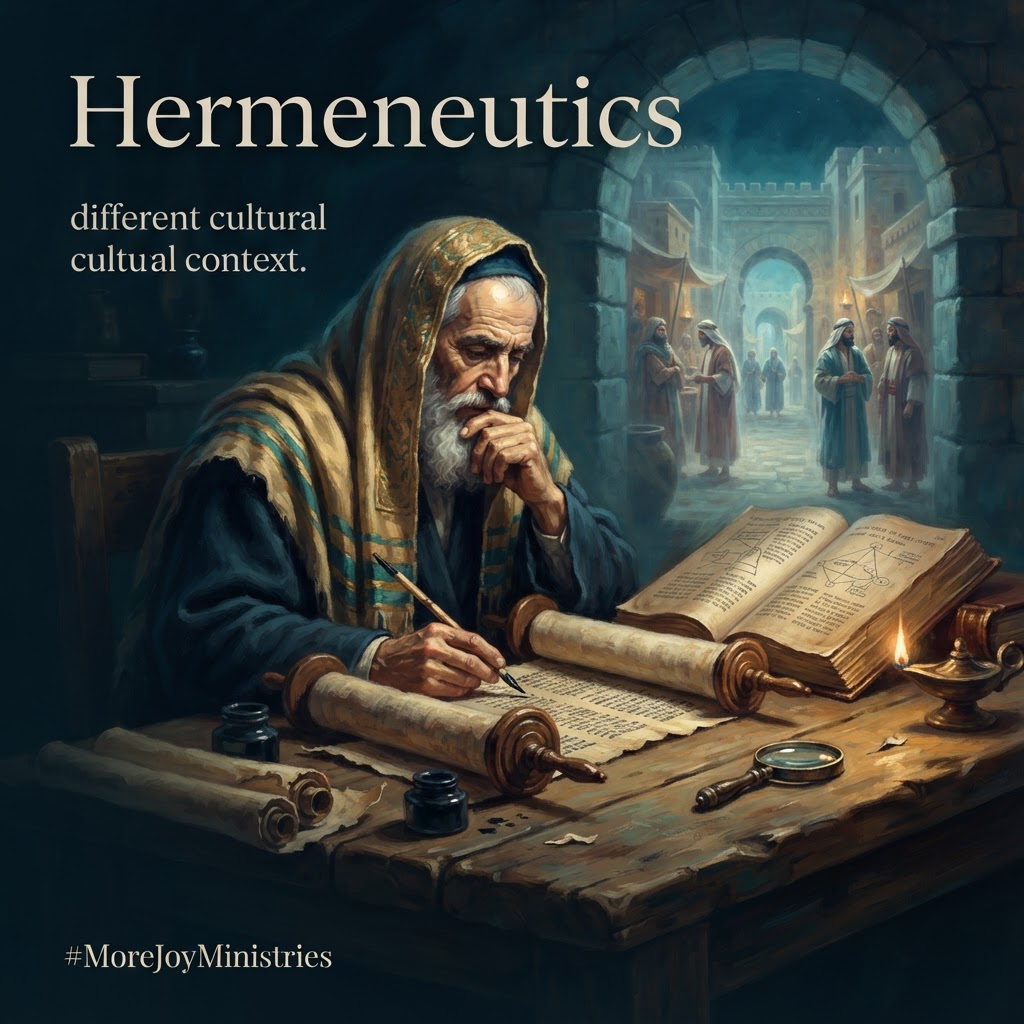
Hermeneutics:
Hermeneutics is any effort to interpret the meaning of communication, particularly communication that is being interpreted in a different cultural context.
In the Anchor Yale Bible Dictionary, Bernard C. Lategan says about hermeneutics: “Although language presupposes shared conventions between persons, the unique experience of the individual cannot be expressed adequately through this medium. The receiver therefore needs help to reproduce the meaning of the sender in his or her own consciousness. The task of hermeneutics is to provide this help.”
In other words, every time we read or hear something, we absorb the info using language. But even when we’re speaking the same language, we can misunderstand what someone means because their context is different from ours. That’s what hermeneutics does—it helps us understand what the original speaker/writer means by what they say.
Biblical hermeneutics is the method of interpreting Scripture so we can bridge the gaps between modern-day readers of the Bible, its original audiences, and God as its ultimate author.
Hermeneutics is foundational to theological study. Whether or not they know it, every biblical reader interprets the Bible through their own hermeneutic. Developing a clearly communicated biblical hermeneutic helps Bible students to understand the biases they bring into their interpretive work. Without effective (and faithful) methods of interpretation, we can’t understand the meaning of the text and therefore build cohesive biblical theologies, and therefore, a Christ-honoring, mission-driven Christian life.
Steve Bond, in his article on hermeneutics for the Holman Illustrated Bible Dictionary, notes that how we interpret the Bible has much in common with how we interpret other texts, but “the difference between biblical texts and texts from law, literature, and the sciences is that despite the 66 biblical books having been written by many people over a period of 1,500 years, the Bible claims God as its ultimate author.”
Why is biblical hermeneutics important?
The church today faces many important issues as technological innovation transforms everything from communications to family structures to social relationships. We need the wisdom from God himself to properly engage and understand the world we live in. Yet the primary way we learn what God has to say is the Bible—a book written between 2,000 to 3,500 years ago.
How we interpret the timeless Word of God shapes how we answer the important questions we face as we pursue God’s mission in the world today.
In this article, I’ll help you to think through issues of biblical hermeneutics so you can better interpret God’s Word. Through this article, you’ll discover:
How biblical interpretation has changed from the biblical period to the modern age
Which key issues to consider when interpreting the Bible
Why hermeneutics strategies are used differently in different biblical genres
4 eras of biblical hermeneutics
Biblical Era
Patristic Era
Medieval Era
Reformation Era
5 key components of biblical hermeneutics
1. Context
As you try to interpret the meaning of the text, start by considering its context. Usually interpreters consider two aspects of context.
First, you have the historical context. You want to ask the question, “What did the text mean in its original situation?” Commentaries (or even book summaries at the beginning of a study Bible) can help shed light on the historical situation. Bible dictionaries with articles on specific biblical books can also help.
In The Hermeneutical Spiral, Grant Osborne suggests four specific questions to consider when looking at the historical context.
Who wrote the book?
When was the book written?
What group was the book addressing?
What is the purpose or theme of the book?
Another important area of context to consider is a passage’s logical context. What comes before and after the passage you’re studying? The closer a section of text is to whatever you’re studying, the more important it is to interpreting the passage. Osborne describes eight concentric circles of context that help unlock the meaning of the text. Those circles include: passage, immediate context, major section, book, writer, testament, Bible, and genre.1
2. Grammar
Next, it’s important to consider the basic laws of language. Although knowing the original languages helps considerably with this step, students without that background can still benefit from looking at how the biblical writers structured their sentences.
Commentaries will help you understand the grammar, but you don’t want to depend upon the exegesis of others. Comparing multiple Bible versions with varying translation strategies will help to make sure you aren’t leveraging a particular commentary writer’s grammatical approach.
Digital Bible tools can be extremely helpful as well. With apps like Logos, you can tap on a word in most English translations and see the word in its original language, along with information about the grammatical construction. At that point, you’re only a few taps away from grammar textbooks that can fill in the gaps about what the particular verb tense or noun declination means.
Readers trying to make a proper interpretation of a verse don’t need to note the grammatical construction of every single word but can focus on the key words in each verse, particularly the subject, verb, and important clauses.
3. Semantics
Word studies have become one of the most popular lay exegetical activities in recent years. One reason is that digital tools make word studies really easy. In The Hermeneutical Spiral, Osborne notes that semantics (determining word meanings) is a relatively young field in biblical studies. It dates back to the 19th century and didn’t move to the forefront until the 1950s.
Again, original language background (along with an expanding original language vocabulary) helps with semantics but many of the important skills aren’t dependent upon language knowledge. Mark Ward provides a great three-step guide that helps any Bible student dig into the words of Scripture:
Look for a promising word. Find a word that if it’s better defined you’ll have a better sense of the passage—and can more effectively apply it to your life and the lives of those with whom you’re in community.
Identify the underlying Greek or Hebrew lemma. Greek and Hebrew words often have multiple English meanings. Try to identify the meaning particular to your passage.
Find every instance of a particular Greek or Hebrew word. Digital tools can do this with a simple search function, but a good original language concordance will also do this.
All of this can be done without extensive original language knowledge. Once you’ve discovered the usage of a word, you can then begin to look at it in context and get a better grasp of the meaning. Digital tools that allow you to review verses using a word’s various senses help with this as well.
4. Syntax
When you look at the grammar of a verse or passage of the Bible, you’re focusing on the rules of how words relate with one another. The syntax relates to how the words are actually used. Syntax is about the relationship between words.
Sometimes studying the syntax of a verse simply means you look at a specific word and its place in the sentence. Is the noun being used as a subject or an object? How is the verb understood when it has God for the subject? How is it understood when the word has God for its object?
You can make these observations by looking through a concordance or with the help of digital tools, like Logos.
Other times studying the syntax of a verse is looking deeper into the figures of speech used. In The Hermeneutical Spiral, Osborne defines six types of figures of speech to consider:
figures of comparison
figures of addition or fullness of expression
incomplete figures of speech
figures involving contrast or understatement
figures centering on association or relation
figures stressing the personal dimension
Understanding which, if any, of these figures of speech are being used in the verse helps you to unlock its meaning.
5. Historical or cultural backgrounds
Understanding the background of a particular Scripture helps it come alive for Bible students. Osborne writes: “The stories and discourses of the Bible were never meant to be merely two-dimensional treatises divorced from real life. Every one was written within a concrete cultural milieu and written to a concrete situation. It is socio-scientific background studies that unlock the original situation that otherwise would be lost to the modern reader.”
A number of resources can help you understand a passage’s historical and cultural background. The IVP Bible Dictionaries can be particularly helpful because they include extensive articles on most important background topics. Commentaries can be helpful as well.