More Joy Ministries
Full Bible Study
The Book of Ezekiel:
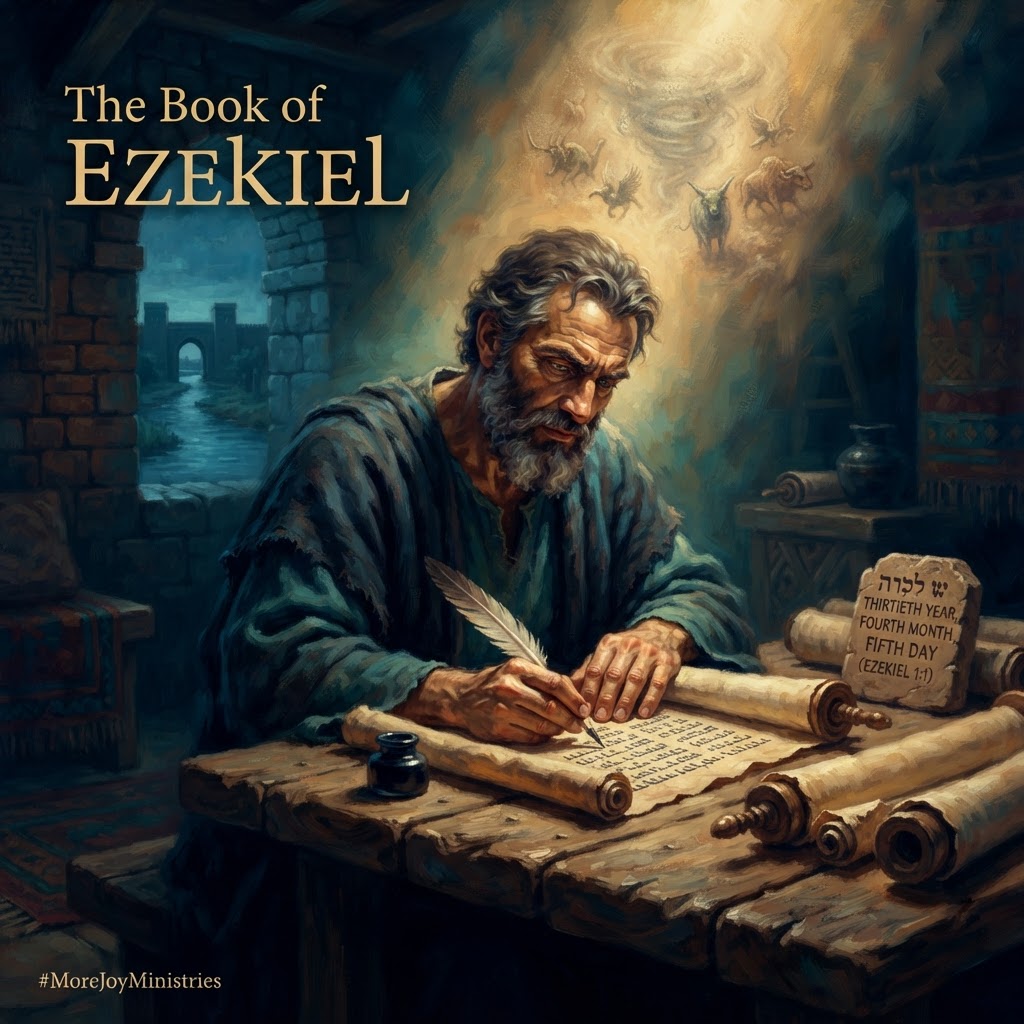
Ezekiel's book features more specific dates than any other prophetic text in the Old Testament, allowing for a high degree of accuracy in dating its prophecies. Contemporary research, utilizing archaeological findings (such as Babylonian records on cuneiform tablets) and astronomical data (like the precise dating of eclipses mentioned in historical documents), offers exact modern calendar equivalents.
Out of the 13 dates mentioned, twelve indicate moments when Ezekiel received a divine message, while the remaining date marks the arrival of the messenger who informed him of Jerusalem's fall (33:21).
Ezekiel's life and work are primarily known through the book that carries his name. He was one of the Jews taken to Babylon by Nebuchadnezzar in 597 B.C. where he received his prophetic calling among the exiles (refer to 1:1 through 3). Ezekiel was married (see 24:15 through 18) and owned a house (see 3:24; 8:1). Despite being in Babylon, he and his fellow exiles enjoyed a relatively unrestricted life.
Coming from a priestly lineage (see 1:3), Ezekiel was qualified to serve as a priest. As a priest-prophet tasked with ministering to the exiles, who were distanced from the temple and its rituals, his messages often focused on the temple and its practices (notably in chapters 8-11 and 40-48).
Ezekiel demonstrated extensive knowledge, not only of his own cultural heritage but also of global events and history. His understanding of various cultural aspects, from shipbuilding to literature, is impressive. He possessed a sharp intellect, capable of addressing significant issues with grand and vivid imagery. While his writing can be detached at times, it also displays moments of passion and raw emotion (see chapters 16 and 23).
Ezekiel began his prophetic ministry in July 593 B.C. and continued for 22 years, with his final recorded oracle occurring in April 571 (refer to 29:17). If the "thirtieth year" mentioned in 1:1 pertains to Ezekiel's age at the time of his calling, then his prophetic service extended two years beyond the typical priestly term (see Nu 4:3). His active years aligned with a particularly bleak period for Jerusalem, occurring seven years before the city's destruction in 586 and fifteen years afterward.
The Old Testament, particularly through the prophets, emphasizes God's authority over all creation, including individuals, nations, and the unfolding of history. The book of Ezekiel illustrates this divine sovereignty more vividly than any other scripture. From the very first chapter, which powerfully depicts the divine presence invading Ezekiel's reality, to the concluding statement of his vision ("the Lord is there"), the theme of God's sovereignty resonates throughout.
This sovereign God has determined that He will be recognized and acknowledged. The phrase "Then they will know that I am the Lord" appears around 65 times, highlighting His desire for recognition (refer to 6:7). Chapters 1 to 24 convey that God will reveal Himself through the fall of Jerusalem and the destruction of the temple; chapters 25 to 32 indicate that the nations will also come to know God through His judgments; and chapters 33 to 48 promise that God will be recognized through the restoration and spiritual renewal of Israel.
God possesses the freedom to judge and to show grace. His severe judgments on Israel ultimately reflect His grace, as He allows the complete dismantling of Israel's political and religious structures so that their renewed existence and His presence will be recognized as a gift from the Lord of all creation.
Additionally, Ezekiel's role as God's messenger, identified as "son of man" (see 2:1), underscores the sovereign God he was chosen to serve.
The three principal prophets, Isaiah, Jeremiah, and Ezekiel, along with Zephaniah, share a similar sequence in their messages: (1) oracles directed at Israel, (2) oracles aimed at the nations, and (3) words of comfort for Israel. This pattern is most evident in the book of Ezekiel.
In addition to its clear structure, Ezekiel's book exhibits symmetry. The vision of the defiled temple, destined for destruction (chapters 8-11), is counterbalanced by the vision of the restored and sanctified temple (chapters 40-48). The portrayal of God in a state of intense anger (chapter 1) is complemented by the depiction of Him as a source of comfort ("the Lord is there," 48:35). Ezekiel's role as a watchman delivering messages of divine judgment (chapter 3) is mirrored by his role in announcing the forthcoming new era (chapter 33). In one instance (chapter 6), the mountains of Israel receive a prophetic reprimand, while in another (chapter 36), they are offered consolation.
While prophetic literature is often poetic, with prophets using imaginative and rhythmic language, much of Ezekiel is written in prose, likely reflecting his priestly background. His use of repetition creates a powerful impact, and his priestly perspective is evident in his legalistic phrasing (for example, 3:19, "If you do warn the wicked... " compared to Exodus 21:2, "If you buy a Hebrew servant...").
The book features four significant visions (chapters 1-3; 8-11; 37:1 through 14; 40-48) and twelve symbolic actions (3:22 through 26; 4:1 through 3; 4:4 through 8; 4:9 through 11; 4:12 through 14; 5:1 through 3; 12:1 through 16; 12:17 through 20; 21:6 through 7; 21:18 through 24; 24:15 through 24; 37:15 through 28). Additionally, five messages are conveyed through parables (chapters 15-17; 19; 23).
Ezekiel lived during a period of significant global turmoil. The Assyrian Empire, which had previously dominated the Syro-Palestinian region and destroyed the northern kingdom of Israel around 722-721 B.C. began to weaken due to the rise of Babylon. In 612, the major Assyrian city of Nineveh fell to a coalition of Babylonians and Medes. Three years later, Pharaoh Neco II of Egypt advanced north to support the Assyrians and reestablish Egypt's historical influence over Canaan and Aram (Syria). At Megiddo, King Josiah of Judah, possibly allied with Babylon like his predecessor Hezekiah, tried to confront the Egyptian forces but was defeated and killed in the battle (refer to 2 Kings 23:29 through 30; 2 Chronicles 35:20 through 24).
Josiah's son Jehoahaz ruled Judah for just three months before Neco appointed another son, Jehoiakim, as his puppet king in Jerusalem in 609 B.C. In 605, the Babylonians defeated the Egyptian army at Carchemish (see Jeremiah 46:2) and advanced south into the Philistine territory. That same year, Nebuchadnezzar ascended to the Babylonian throne, prompting Jehoiakim to switch his loyalty to him. However, when Egyptian and Babylonian forces faced off in a standoff battle a few years later, Jehoiakim revolted against his new master.
Nebuchadnezzar quickly retaliated by sending troops to Jerusalem, which he captured in 597 B.C. Jehoiakim's son Jehoiachin and around 10,000 Jews (see 2 Kings 24:14), including Ezekiel, were taken to Babylon, joining those exiled during Jehoiakim's "third year" (see Daniel 1:1). Nebuchadnezzar appointed Jehoiachin's uncle, Zedekiah, as king in Jerusalem, but within five or six years, Zedekiah also rebelled. The Babylonians besieged Jerusalem in 588, and by July 586, they breached the walls and looted the city. On August 14, 586, both the city and the temple were set ablaze.
Babylon, under Nebuchadnezzar and his successors, held a prominent position in international affairs until Cyrus the Persian defeated it in 539 B.C. This marked the end of the Davidic dynasty, the loss of Judah's independence, and the destruction of Jerusalem and the temple.