More Joy Ministries
Full Bible Study
Elijah:
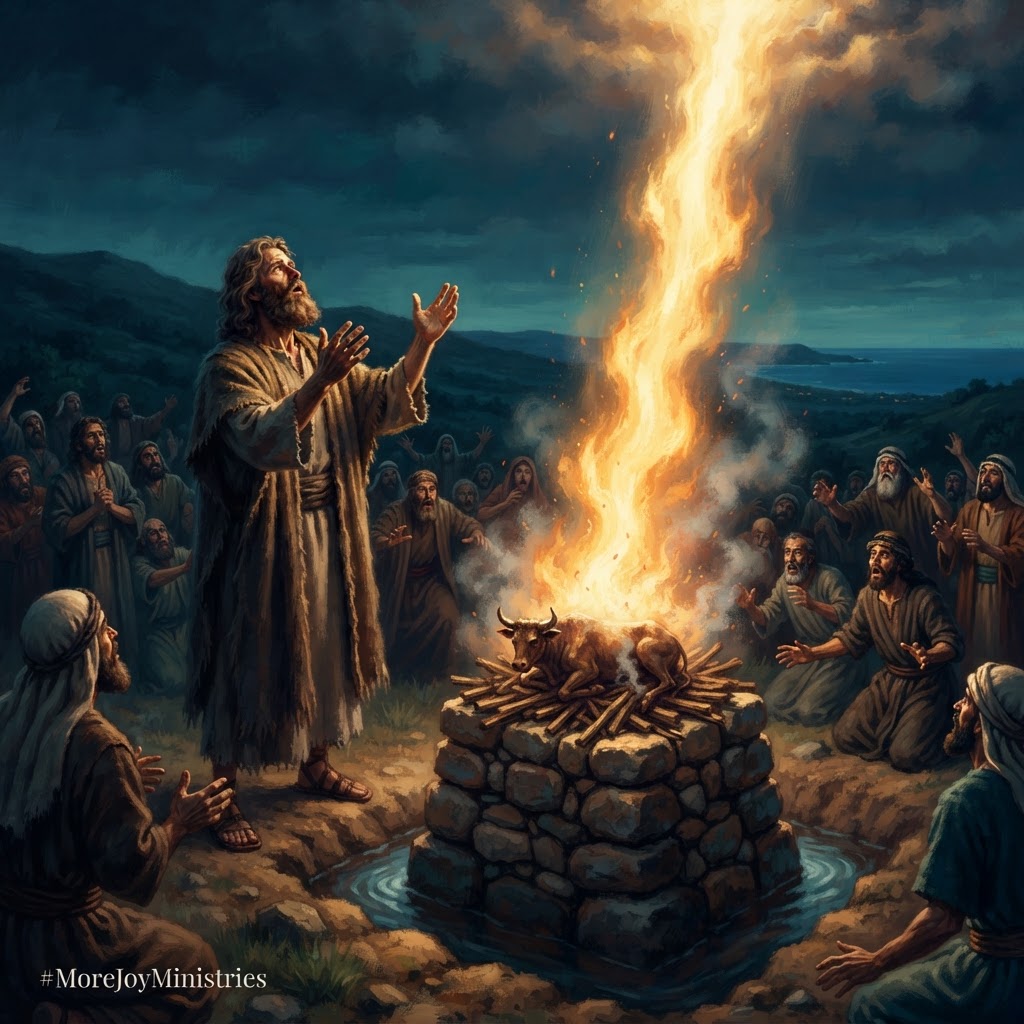
This man was on fire for God! Literally, at his request, the Lord answered with a consuming fire from heaven (1 Kings 18:36-38). Elijah was sent on a mission from God to turn the Israelites' hearts back to their One True God. When we first read of Elijah, the Israelites have been worshiping both the God of their ancestors, who is the One True Living God and the false God Baal. Enough was enough. God sent Elijah to confront their wavering faith and lead them to make a decision.
Elijah, who thrived in the 9th century BCE, is a prominent Hebrew prophet, esteemed alongside Moses for his efforts to preserve the worship of Yahweh against the encroachment of Baal's nature worship. His name translates to "Yahweh is my God," and in certain biblical translations, he is referred to as Elias. The narrative of his prophetic mission in the northern kingdom of Israel during the reigns of Kings Ahab and Ahaziah is chronicled in 1 Kings 17–19 and 2 Kings 1–2. Elijah asserted the exclusivity of the God of Israel, advocating for monotheism with a level of fervor that may have been unparalleled. Christians honor his memory on July 20, and he is acknowledged as a prophet within Islam.
The historical context shows that King Omri of Israel formed an alliance with the coastal Phoenician cities, and his son Ahab married Jezebel, the daughter of Ethbaal, the king of Tyre and Sidon. Jezebel brought her Tyrian followers and a significant number of pagan priests and prophets to promote her religion in a temple dedicated to Baal in Samaria, the royal city. This led the Israelites to accept both Baal and Yahweh, equating Yahweh with a nature deity whose main aspects were the elements and fertility, often celebrated through wild rituals. Jezebel’s actions further blurred the lines between the worship of Yahweh and the Canaanite religion of Baal, a shift made easier by the weakening faith of the Israelites in Yahweh.
Elijah came from Tishbe in Gilead. In the story from 1 Kings, he suddenly shows up during King Ahab's rule to announce a drought as a punishment for the worship of Baal that Jezebel was encouraging in Israel, which was disrespecting Yahweh. Later, Elijah faces off against 450 prophets of Baal on Mount Carmel in a showdown to see which god is the real one. They set up altars, one for Baal and one for Yahweh, and the prophets of Baal try desperately to get their god to light the fire on his altar, but nothing happens. In contrast, when Elijah prays to Yahweh, fire comes down and consumes his offering. This convinces the Israelites, who then follow Elijah's lead and execute the prophets of Baal. After this, the drought finally ends with the arrival of rain.
Elijah flees the wrath of the vengeful Jezebel by undertaking a pilgrimage to Mount Horeb (Sinai), where he is at first disheartened in his struggle and then miraculously renewed. In a further narrative, King Ahab has a man named Naboth condemned to death in order to gain possession of his vineyard. Ahab’s judicial murder of Naboth and confiscation of his vineyard arouse Elijah as the upholder of the moral law, as before he had come forward as the champion of monotheism. Elijah denounces Ahab for his crimes, asserting that all men are subject to the law of God and are therefore equals. Later Ahab’s son, King Ahaziah, appeals to Baal to heal him of an injury, and Elijah once more upholds the exclusive rights of Yahweh by bringing down “fire from heaven.” After bestowing his mantle on his successor, Elisha, the prophet Elijah is taken up to heaven in a whirlwind.
Theological significance:
One of the most important moments in the history of monotheism is the climax of Elijah’s struggle with Baalism. His momentous words, “If Yahweh is God, follow him, but if Baal, then follow him”—especially when taken with the prayer “Hear me, Yahweh, that this people may know that you, Yahweh, are God”—show that more is at stake than simply allotting to divinities their particular spheres of influence. The true question is whether Yahweh or Baal is God, simply and universally. Elijah’s words proclaim that there is no reality except the God of Israel, there are no other beings entitled to the name of divinity. The acclamation of the people, “Yahweh, he is God” expresses a fully conscious monotheism, never before perhaps brought home to them so clearly.
Elijah’s deepest prophetic experience takes place on his pilgrimage to Horeb, where he learns that God is not in the storm, the earthquake, or the lightning. Nature, so far from being God’s embodiment, is not even an adequate symbol. God is invisible and spiritual and is best known in the intellectual word of revelation, “the still, small voice.” The transcendence of God receives here one of its earliest expressions. Elijah’s story also expresses for the first time a thought that was to dominate Hebrew prophecy: in contrast to the bland hopes of the people, salvation is bestowed only on a “remnant,” those purified by God’s judgment. The theme of the later prophets, that morality must be at the heart of ritual worship, is also taught by Elijah, who upholds the unity of law and religion against the despotic cruelty of a king influenced by a pagan wife. Elijah’s work may also be regarded as a protest against every effort to find religious experience in self-induced ecstasy and sensual frenzy rather than in a faith linked with reason and morality.
Elijah reminds us any life that trusts in God through prayer will make a significant impact in the Kingdom of God despite our history, who we are, or how we feel. If there is anything we learn from Elijah it's that prayer is truly powerful.
Video Resources:
https://youtube.com/playlist?list=PLwdWLzUmCnsa5bvR5s0MXh3taWq0fSdcN&feature=shared