More Joy Ministries
Full Bible Study
Zechariah 14: The Day of The Lord
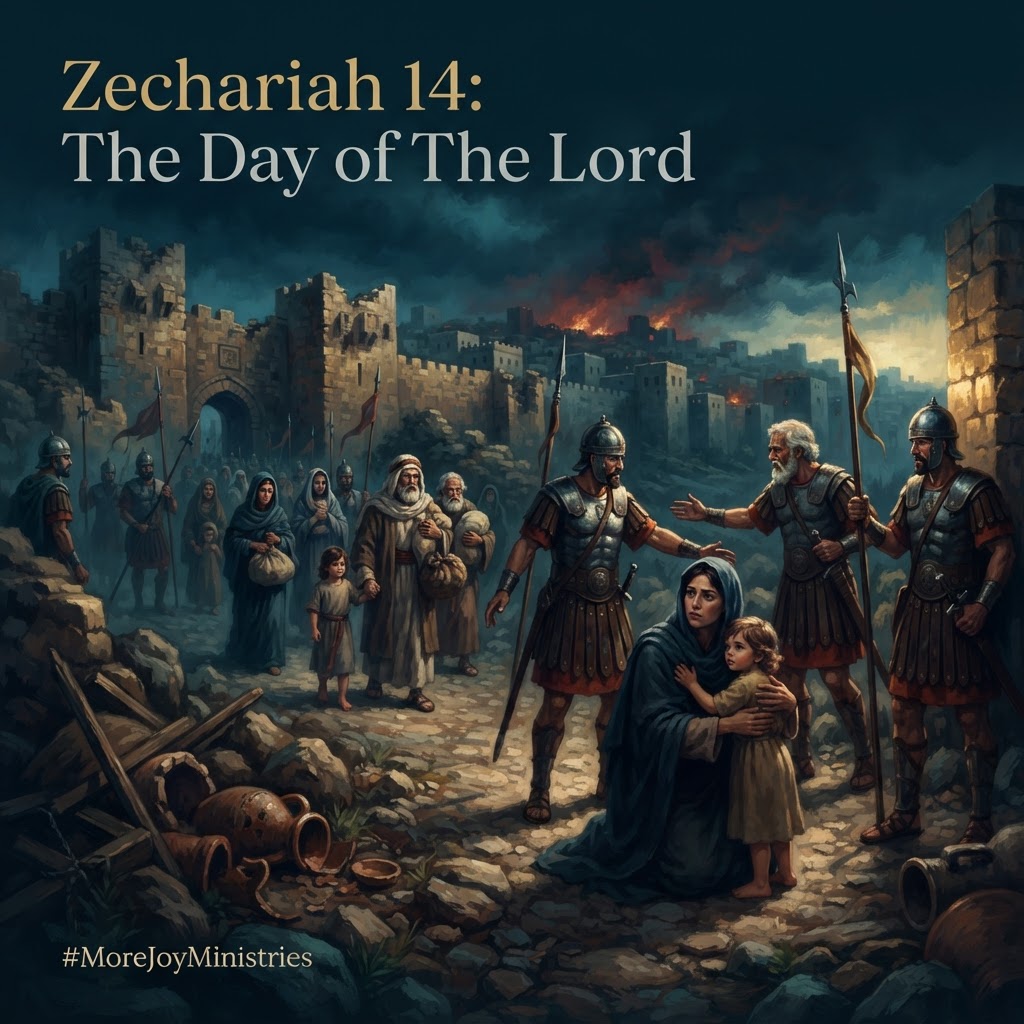
"For I will gather all the nations against Jerusalem to battle, and the city will be captured, the houses plundered, the women ravished and half of the city exiled, but the rest of the people will not be cut off from the city." (Zechariah 14:2)
In the first ten chapters of his book, we find Zechariah the prophet, exhorting the nation of Israel to repent of their sin and to learn a lesson from the mistakes of their forefathers. Along with the prophet Haggai, Zechariah exhorted the people to get to work on rebuilding the temple of God which had remained in ruins, despite the edict of Cyrus many years earlier, and a further decree from Darius who succeeded him.
As his ministry continued, Zechariah prophesied about the first advent of their Messiah, but from chapter 12 to the end his focus is on the Second Coming of our Lord, where he contrasts God's righteous judgments on Israel with their ultimate rescue, restoration, and blessing.
In this section, Zechariah gives many insights into God's judgement on apostate Israel, His punishment of the Gentile nations, and the return of the Lord Jesus to set up His kingdom. He describes how the holy city of Jerusalem would become a 'cup of trembling' and a 'burdensome stone' to all the nations of the world, but that the Lord their God would fight for His people and utterly destroy their enemies.
He also explains that in the end times, two-thirds of the nation of Israel would be killed, but that a remnant would return to the Lord and be saved by faith in Him. This would be the time the Lord would pour out His Spirit of grace upon His chosen nation. Their blinded eyes would be opened to the truth and they would recognise that Jesus, the One Whom they crucified, was indeed their promised Messiah sent from God.
He explains how the faithful remnant will mourn deeply over rejecting their Messiah when they realise their sin. He also tells us that, in His grace, the Lord has made provision for their sin to be forgiven, the nation to be restored, and their land to be cleansed.
It is at the beginning of this final chapter that Zechariah describes the last, great battle over Jerusalem which will occur immediately prior to His awesome return to set up His kingdom, when every eye will see Him. The fury of the Gentile nations will have caused Israel's enemies to come against Jerusalem and His chosen people: "For I will gather all the nations against Jerusalem to battle. The city will be captured, the houses plundered, the women ravished and half of the city exiled, but the rest of the people will not be cut off from the city."
The nations that have raged against Jerusalem for so long and plundered their land over multiple centuries, will once more come against the city in a final attempt to exterminate God's chosen people and wipe them off the face of the earth. The invading armies will capture half of the city and greedily divide up the spoils of war. They will also carry out some terrible atrocities, forcing half the citizens into slavery and raping the women.
But the evil they will perpetrate against the God of Israel and His chosen people will receive the full force of God's wrath, for at the height of their evil deeds, as Zechariah prophesied, the Lord Himself will go forth and fight against those nations. Christ's feet will stand on the Mount of Olives which will be split in two, enabling the rest of His people to flee, just as they fled before the earthquake in the days of Uzziah, king of Judah.
"Then," Zechariah concludes, "the LORD, my God, will come, and all the holy ones with Him," to set up His Millennial Kingdom, as promised to Abraham through David and his seed.
Time is short, and every day is a day when the gospel of grace can be shared with Jew and Gentile alike. May we be increasingly aware of the days in which we live and take every opportunity to tell others that salvation is by grace through faith in Christ before this terrible time of Tribulation.
Zechariah 13-14, Clean and Holy
A. Israel attacked, but defended by the returning Messiah.
1. (1-2) Jerusalem under siege from the nations.
Behold, the day of the LORD is coming,
And your spoil will be divided in your midst.
For I will gather all the nations to battle against Jerusalem;
The city shall be taken,
The houses rifled,
And the women ravished.
Half of the city shall go into captivity,
But the remnant of the people shall not be cut off from the city.
a. I will gather all the nations to battle against Jerusalem: Zechariah seems to have the very end times in view, when Jerusalem will be surrounded and attacked by some type of international force. When the Romans came against Jerusalem in A.D. 70 they came with a multinational army and brought terrible destruction on the city and its people. Yet there was none of the deliverance that Zechariah will describe in the following verses, so it is difficult to say that this was fulfilled in the Roman attack upon Jerusalem in A.D. 70.
b. Half the city shall go into captivity: This attack against Jerusalem will be severe, but the city itself will not be overthrown (the remnant of the people shall not be cut off from the city).
2. (3-5) The Messiah intervenes for His people.
Then the LORD will go forth
And fight against those nations,
As He fights in the day of battle.
And in that day His feet will stand on the Mount of Olives,
Which faces Jerusalem on the east.
And the Mount of Olives shall be split in two,
From east to west,
Making a very large valley;
Half of the mountain shall move toward the north
And half of it toward the south.
Then you shall flee through My mountain valley,
For the mountain valley shall reach to Azal.
Yes, you shall flee
As you fled from the earthquake
In the days of Uzziah king of Judah.
Thus the LORD my God will come,
And all the saints with You.
a. Then the LORD will go forth and fight: Just when it seems that all hope will be gone for Jerusalem and the people of Israel, then the LORD will fight for His people.
i. “God is said to go forth when he manifests his power by delivering his people and punishing their enemies.”
b. His feet will stand on the Mount of Olives.… And the Mount of Olives shall be split in two, from east to west: This speaks of the LORD, Jesus, as God the Son, materially returning to a material earth and setting His feet on the Mount of Olives. At that time a great split will cut the Mount of Olives in two, and the persecuted people of Jerusalem will flee through the valley made by the split.
c. Thus the LORD my God will come, and all the saints with You: Jesus will touch His feet on the Mount of Olives when He returns in glory with all the saints, the armies of heaven described in Revelation 19:14.
i. This was the type of arrival the Jews in Jesus’ day hoped for. Indeed, when the Roman armies surrounded Jerusalem in A.D. 70, a mistaken assurance from prophecies like this made the Jews utterly confident that the Messiah would return from heaven and wipe out the Roman armies surrounding Jerusalem. They could not see that the Messiah must first be rejected, and the nation brought to repentance as Zechariah mentioned in Zechariah 11:12 through 13, 12:10.
B. The kingdom of the Messiah.
1. (6-11) The Messiah’s rule changes the earth.
It shall come to pass in that day
That there will be no light;
The lights will diminish.
It shall be one day
Which is known to the LORD;
Neither day nor night.
But at evening time it shall happen
That it will be light.
And in that day it shall be,
That living waters shall flow from Jerusalem,
Half of them toward the eastern sea
And half of them toward the western sea;
In both summer and winter it shall occur.
And the LORD shall be King over all the earth.
In that day it shall be
“The LORD is one,”
And His name one.
All the land shall be turned into a plain from Geba to Rimmon south of Jerusalem. Jerusalem shall be raised up and inhabited in her place from Benjamin’s Gate to the place of the First Gate and the Corner Gate, and from the Tower of Hananel to the king’s winepresses.
The people shall dwell in it;
And no longer shall there be utter destruction,
But Jerusalem shall be safely inhabited.
a. At evening time it shall happen that it will be light: Now Zechariah looked forward to the glory of Jerusalem in the Messiah’s kingdom. The lights we guide our lives by will diminish, but God will establish His own light.
b. Living waters shall flow from Jerusalem: Jerusalem will no longer be a dry city, but a glorious river will flow from the city and branch off both east and west, and it will be a never-ending flow (in both summer and winter it shall occur).
i. All over the world people want to know what will happen to Jerusalem. Zechariah knows the answer, God will gloriously save and restore Jerusalem, making it the capital city of the millennial earth.
ii. Ezekiel 47 records a vision that may describe this scene. Ezekiel saw a river flowing from the throne of God and down to the Dead Sea, bringing life and vitality everywhere.
c. All the land shall be turned into a plain from Geba to Rimmon south of Jerusalem: Since the mountains around Jerusalem would no longer be needed as a defense, they could be flattened into a plain.
d. Jerusalem shall be safely inhabited: This will be the first time in a long time that Jerusalem will be a safe place to live.
2. (12-15) Enemies are forever plagued.
And this shall be the plague with which the LORD will strike all the people who fought against Jerusalem:
Their flesh shall dissolve while they stand on their feet,
Their eyes shall dissolve in their sockets,
And their tongues shall dissolve in their mouths.
It shall come to pass in that day
That a great panic from the LORD will be among them.
Everyone will seize the hand of his neighbor,
And raise his hand against his neighbor’s hand;
Judah also will fight at Jerusalem.
And the wealth of all the surrounding nations
Shall be gathered together:
Gold, silver, and apparel in great abundance.
Such also shall be the plague
On the horse and the mule,
On the camel and the donkey,
And on all the cattle that will be in those camps.
So shall this plague be.
a. Their flesh shall dissolve while they stand on their feet: In the glorious deliverance the Messiah brings, the enemies of God and His people will be destroyed by plague, mutual slaughter, and by the sword of Judah (Judah also will fight at Jerusalem).
i. The description of flesh dissolving makes some think that Zechariah is describing the effects of a neutron or nuclear bomb.
b. The wealth of all the surrounding nations shall be gathered together: In the glorious deliverance the Messiah brings, Jerusalem will become a wealthy and influential city again.
3. (16-19) All the nations come to Jerusalem to worship the LORD.
And it shall come to pass that everyone who is left of all the nations which came against Jerusalem shall go up from year to year to worship the King, the LORD of hosts, and to keep the Feast of Tabernacles. And it shall be that whichever of the families of the earth do not come up to Jerusalem to worship the King, the LORD of hosts, on them there will be no rain. If the family of Egypt will not come up and enter in, they shall have no rain; they shall receive the plague with which the LORD strikes the nations who do not come up to keep the Feast of Tabernacles. This shall be the punishment of Egypt and the punishment of all the nations that do not come up to keep the Feast of Tabernacles.
a. Shall go up from year to year to worship the King: Instead of coming to Jerusalem for battle, now the nations come to honor God and to remember His faithfulness to Israel in the wilderness by keeping the Feast of Tabernacles.
i. Jesus told us to go to the ends of the earth with the gospel but in the millennium the earth will come to Jerusalem to worship and honor God.
b. Whichever of the families of the earth do not come up to Jerusalem…on them there will be no rain: God won’t make people worship Him during the millennium, but the advantages of worshipping and honoring God will be more evident than ever.
c. If the family of Egypt will not come up and enter in, they shall have no rain: Egypt is specifically mentioned because they were a nation not especially dependent on rain, yet they too would be punished if they were disobedient.
4. (20-21) The common is made holy.
In that day “HOLINESS TO THE LORD” shall be engraved on the bells of the horses. The pots in the Lord’s house shall be like the bowls before the altar. Yes, every pot in Jerusalem and Judah shall be holiness to the LORD of hosts. Everyone who sacrifices shall come and take them and cook in them. In that day there shall no longer be a Canaanite in the house of the LORD of hosts.
a. In that day “HOLINESS TO THE LORD” shall be engraved on the bells of the horses: This was the great inscription on the metal band around the high priest’s headpiece (Exodus 28:36). In the glory of the Messiah’s kingdom horses won’t be needed for war any longer, then even they can wear the emblems of HOLINESS TO THE LORD.
b. The pots in the LORD’s house: These were the cooking utensils used by worshipers to cook the sacrificial meat intended for them from the peace offerings. The bowls before the altar were used to gather and sprinkle sacrificial blood on the altar. This shows that animal sacrifice will continue in the millennium, but not as atonement for sin, which was perfectly satisfied by the atoning work of Jesus. Sacrifice in the millennium will look back to the perfect work of Jesus.
c. Every pot in Jerusalem and Judah shall be holiness to the LORD of hosts: In the glory of the Messiah’s kingdom, what was previously common is made holy; the holy is made holier and the irreclaimably profane is forever shut out. At the end of it all, there is no longer any distinction between the holy and the profane. All is set apart to God and His purposes.
i. “The point is that the people and the city will be so holy that even these insignificant things will be fully dedicated to the Lord.”
ii. There is a right way and a wrong way to eliminate the line between the holy and the profane: you can make everything holy (set apart to the LORD), or you can make everything profane (set apart to sin and self). Zechariah ends his prophecy making it clear that God’s way is to make everything that was once common or profane holy instead.