More Joy Ministries
Full Bible Study
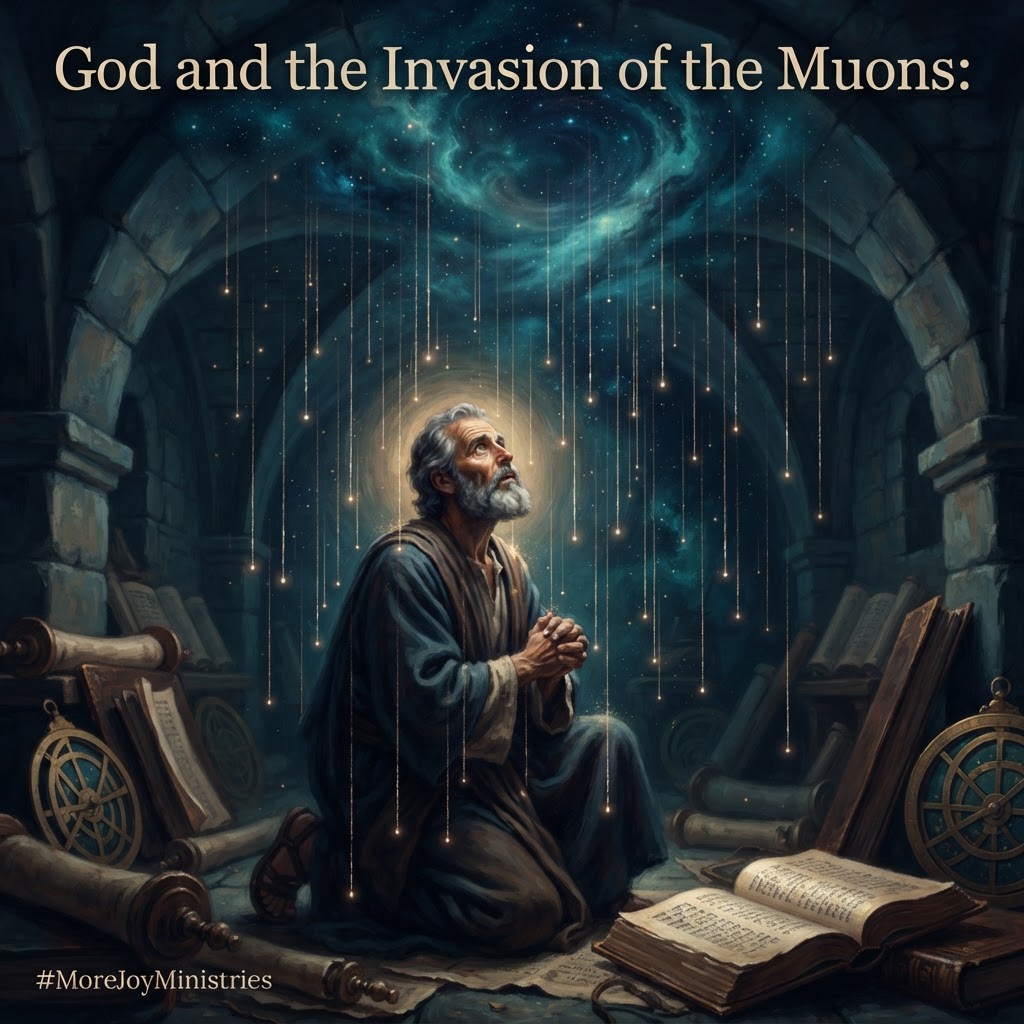
God and the Invasion of the Muons:
Most people are not familiar with little particles called “muons“, but they are not rare things. It’s been demonstrated that about 600 of them pass through your body every minute. You can’t feel them, and you certainly can’t see them.
Particle Physics places the muons along with electrons and four other particles in a class called “leptons”. Along with electrons, the muons have a negative electrical charge but they are about 200 times heavier. There are also anti-particle muons which (like anti-particle electrons) have a positive electrical charge.
Muons are produced in the high parts of Earth’s atmosphere. As cosmic rays interact with the atmosphere showers of tiny sub-atomic particles are produced. Muons are one of the things generated as the shower of particles begins to decay. Muons have a very high energy level so they outlive the other particles produced making them the only ones that make it down to the Earth’s surface where we live.
When muons pass through matter they don’t disturb things very much at all. As they pass through the electrical fields surrounding the atoms in our bodies, they often jar some electrons loose causing some minor ionizing. Since this is happening to everybody all the time we know that these ionizations have no meaningful effect on us as far as we know.
Of course, behind all this is the sustaining and directing power of the Creator of everything. There is no cosmic ray, no neutrino, no hurricane, child, or adult that is not upheld and under the control of the Almighty God. Every interaction of sub-atomic particles and of nations and of those who live in them is part of an eternal plan. Muons are truly amazing little parts of God’s creation. They silently declare the Creator’s glory, and God has only recently in the long history of the human race enabled us to find a way of knowing they are there.
Our Creator made everything for a purpose. All of creation is there to display God’s nature and glory.
Psalms 19:1 through 2, “The heavens declare the glory of God; And the firmament shows His handiwork. Day unto day utters speech, And night unto night reveals knowledge.”
Romans 1:20, “For since the creation of the world His invisible attributes are clearly seen, being understood by the things that are made, even His eternal power and Godhead, so that they are without excuse”
Revelation 4:11, “You are worthy, O Lord, To receive glory and honor and power; For You created all things, And by Your will they exist and were created”
Colossians 1:16 through 17, “For by Him all things were created that are in heaven and that are on earth, visible and invisible, whether thrones or dominions or principalities or powers. All things were created through Him and for Him.”
Without question the little muon is there as part of the universe God made, and it fulfills the purpose shared by all parts of creation. It reminds us of God’s power and presence all around us even though we can’t see these things with our eyes. There is also a comforting contrast. While the muons move through us without any meaningful effect, the Creator’s presence is always busy moving things and people to conform to his wise, loving, and eternal plan.
Psalm 135:6, “Whatever the Lord pleases He does, In heaven and in earth, in the seas and in all deep places.”
Job 42:2, “I know that You can do everything, And that no purpose of Yours can be withheld from You.”
Jesus said in John 6:39, “This is the will of the Father who sent Me, that of all He has given Me I should lose nothing, but should raise it up at the last day.”
More About Muons:
The muon is an elementary particle similar to the electron with a unitary negative electric charge and a spin of ½. It is an unstable subatomic particle with a mean lifetime of 2.2 µs, compared to that of a free neutron (~15 minutes), a free proton (greater than 6.6×1033 years, possibly infinite), and that of an electron, also possibly infinite.
Muons have a mass of 105.7 MeV/c2, which is about 200 times the mass of an electron. Since the muon's interactions are very similar to those of the electron, a muon can be thought of as a much heavier version of the electron.
For materials studies, it is mainly the positive muon that is used. When implanted into materials, positive muons can be thought of as acting a bit like light protons (they have the same charge as the proton, and are about 1/9 the mass of a proton).
In the same way that protons can pick up an electron to form a hydrogen atom, implanted muons can also pick up an electron to form ‘muonium’. Muonium behaves chemically just like hydrogen (the ionization potential and radius of muonium are very close to those of a hydrogen atom), and so we can use muonium to study what isolated hydrogen atoms do inside substances.
How are muons produced?
Muons are produced from the interactions between an energetic proton beam and a light-element target. The proton collisions produce pions, which decay into muons. The muon beam produced can be 100% spin polarised, i.e. all the muon spins are pointing in the same direction (the polarisation direction is anti-parallel to the muon's momentum direction). This is a key feature of the muon technique, as it is what happens to the muon polarisation which we observe in muon experiments.
The muons are implanted into the material under investigation, where they come to rest. Local magnetic fields, for example from near-by magnetic atoms, cause the spin of each muon to change direction. By watching what happens to the muon spins, we learn about the muons’ local environment and hence about how the atoms are behaving in the material.
The life of a muon:
After an average lifetime of 2.2µs, each muon decays and emits a positron. The decay positrons are preferentially emitted in the muon spin direction, they are detected, and tell us about how the muons' spins were behaving in the sample. This in turn tells us about the muons' environment, so we can learn about the atomic level magnetism.