More Joy Ministries
Full Bible Study
Boaz:
The Hebrew name Boaz, means "in him is strength" or "strength is within him".
Boaz, born 1283 BC, was a wealthy man from Bethlehem mentioned in the genealogy of Christ (Matthew 1:5). The son of Boaz and Ruth was Obed, King David’s grandfather. Everything we see about Boaz in Scripture is good. He shows himself to be a kind, generous, and honorable man of his word.
Boaz is first mentioned in the second chapter of the Book of Ruth, but his family background is detailed in 1 Chronicles, where he is listed as part of David's lineage, the future king of Israel. It states that his father was Salmon and his mother was Rahab. This Rahab is widely thought to be the same woman from Jericho who helped the Hebrew spies. She believed in the God of the Hebrews, and the Bible notes, “By faith Rahab the prostitute did not perish with those who were disobedient, because she had given a friendly welcome to the spies” (Hebrews 11:31). Thanks to her bravery and faith, she survived the Battle of Jericho, which also indicates that Boaz had mixed heritage and was not solely of Hebrew descent.
When Boaz first enters Ruth's story, it’s after she and Naomi returned to Israel from Moab, both having lost their husbands. Boaz was a wealthy and influential landowner, respected enough to interact with the local leaders at the city gates of Bethlehem. Some scholars debate whether he could have been one of those leaders himself, considering his mother's background. Nevertheless, Naomi vouches for Boaz's character, encouraging Ruth to glean in his fields because he was “a relative of her husband's, a worthy man of the clan of Elimelech” (Ruth 2:1). When Ruth visits his fields, she notices that he greets his workers in the name of the Lord, reflecting his commitment to God.
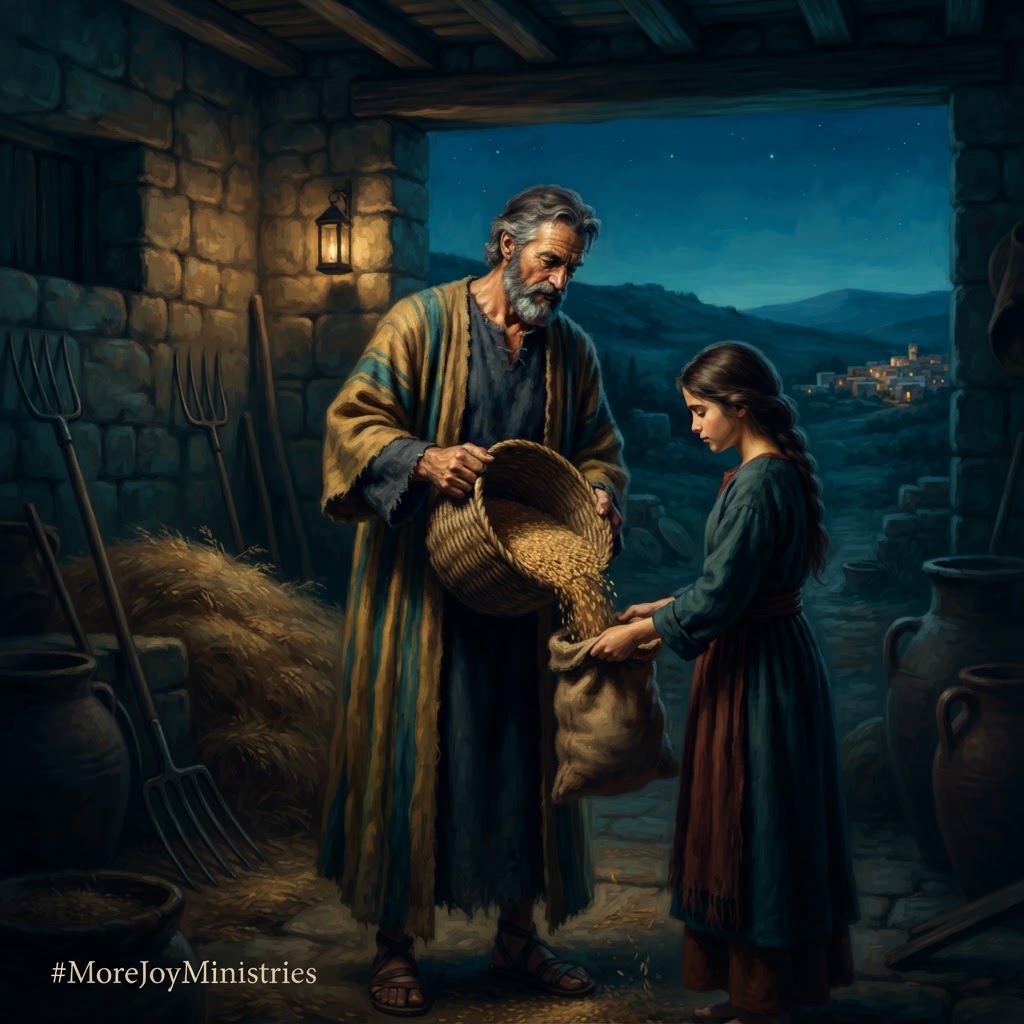
A significant moment that reveals Boaz's character is when he saw Ruth gathering leftover grain. Back then, it was common for the less fortunate to follow the workers in the fields of the rich to collect what was left behind. Boaz noticed that Ruth was a foreigner, which showed he was familiar with both his workers and the regular gleaners in his fields. Being a woman on her own, she could have faced threats or harm. Boaz took steps to ensure that this woman, who he recognized as a Moabite and thus an outsider, was kept safe.
As Naomi's relative by marriage, Boaz had the chance to step into the role of a kinsman redeemer. This is a male relative who can help a family member in distress or need. However, he wasn't the only one eligible; there was another man in Bethlehem who was more closely related to Elimelech, Naomi's late husband.
The Bible doesn't clearly explain why Boaz chose to become Ruth's kinsman redeemer. He wasn't required to do anything beyond letting them gather leftover grain from his fields. He could have easily supported the other potential redeemer in taking care of Ruth and Naomi. Encouraged by Naomi, Ruth approached Boaz and reminded him that he was a relative who could help them. This seemed to please Boaz.
He had already shown admiration for Ruth's loyalty to Naomi, but when she approached him, he responded:
"May you be blessed by the Lord, my daughter. You have made this last kindness greater than the first in that you have not gone after young men, whether poor or rich. And now, my daughter, do not fear. I will do for you all that you ask, for all my fellow townsmen know that you are a worthy woman. And now it is true that I am a redeemer. Yet there is a redeemer nearer than I. Remain tonight, and in the morning, if he will redeem you, good; let him do it. But if he is not willing to redeem you, then, as the Lord lives, I will redeem you. Lie down until the morning” (Ruth 3:10b-13).
This statement indicates that Boaz was an older man, and some scholars think it might have been challenging for him to marry a devoted Hebrew woman due to his background. He appeared to be quite pleased that this young widow wanted him to be her kinsman redeemer.
Part of the process of redeeming Elimelech’s property involved taking care of the women in his family. However, the closer kinsman redeemer was reluctant to do this because their first child would inherit Elimelech's estate, which would complicate things for his own children. Boaz, on the other hand, accepted this responsibility and married Ruth. It's likely that Ruth and Boaz had developed feelings for each other, and with Naomi's support, Boaz decided to pursue marriage with Ruth.
What Connection Does Boaz Have to the Lineage of Jesus?
Boaz was a key figure in the lineage of Judah, which eventually led to King David. The genealogy goes like this: “Salmon fathered Boaz, Boaz fathered Obed, Obed fathered Jesse, and Jesse fathered David” (Ruth 4:21 through 22). God made a promise through David to create a kingdom that would last forever and to send the Messiah.
When Jesus arrived on Earth, He fulfilled many promises made over centuries, sacrificing Himself on the cross to offer redemption to everyone from their sins. He is expected to return as a king, ruling during the millennium and eternally in the New Heaven and New Earth, as foretold in the Book of Revelation. Although Boaz was a Hebrew by lineage, Jesus also had gentile ancestry, making Him the Messiah for all people, not just the Jews.
One of the most significant yet often overlooked blessings that God gave to Boaz is quite touching. In the Hebrew customs of his time, if a widow remarried and had no children with her first husband, the first son born to the new couple would inherit the deceased husband’s estate. This means that their first child, Obed, could be regarded as the son of Ruth’s late husband, Mahlon, and Naomi’s son. This is why the community exclaimed, “A son has been born to Naomi” (Ruth 4:17). Essentially, their first child was viewed as a way for Mahlon and Naomi to keep their family name alive, even though Mahlon had no biological children.
Without the guidance of the Holy Spirit, Boaz’s name could have been lost to history. God chose to honor Boaz as the father of Obed in the Book of Ruth, probably written by the prophet Samuel, in the Chronicles, and in the Gospel of Matthew.
Boaz represents a truly righteous man who consistently aimed to do what was right. Exploring the details of his life can teach us how God can work through individuals to fulfill His plans. Many people in ancient Israel might not have anticipated that the Messiah would come from a family line that included a non-Jewish former prostitute, but Boaz’s mother exemplifies the incredible redemptive power of God’s love. Thanks to her commitment to living a life that honored God, she raised a man of integrity who helped redeem a young woman and her mother-in-law, ultimately becoming an ancestor of the Messiah.
The theme of redemption is central to the stories of Boaz and Ruth, and it serves as a precursor to the redeeming love of Jesus Christ.