More Joy Ministries
Full Bible Study
THE DISPENSATION OF PROMISE:
(Genesis 11:10, Exodus 19:4)
God’s Covenant Faithfulness to Abraham and His Descendants
Each dispensation in Scripture reveals a distinct way God administers His relationship with mankind. In every one, we see the same pattern: God gives a responsibility, appoints stewards, man fails, judgment follows, and yet God’s grace still prevails.
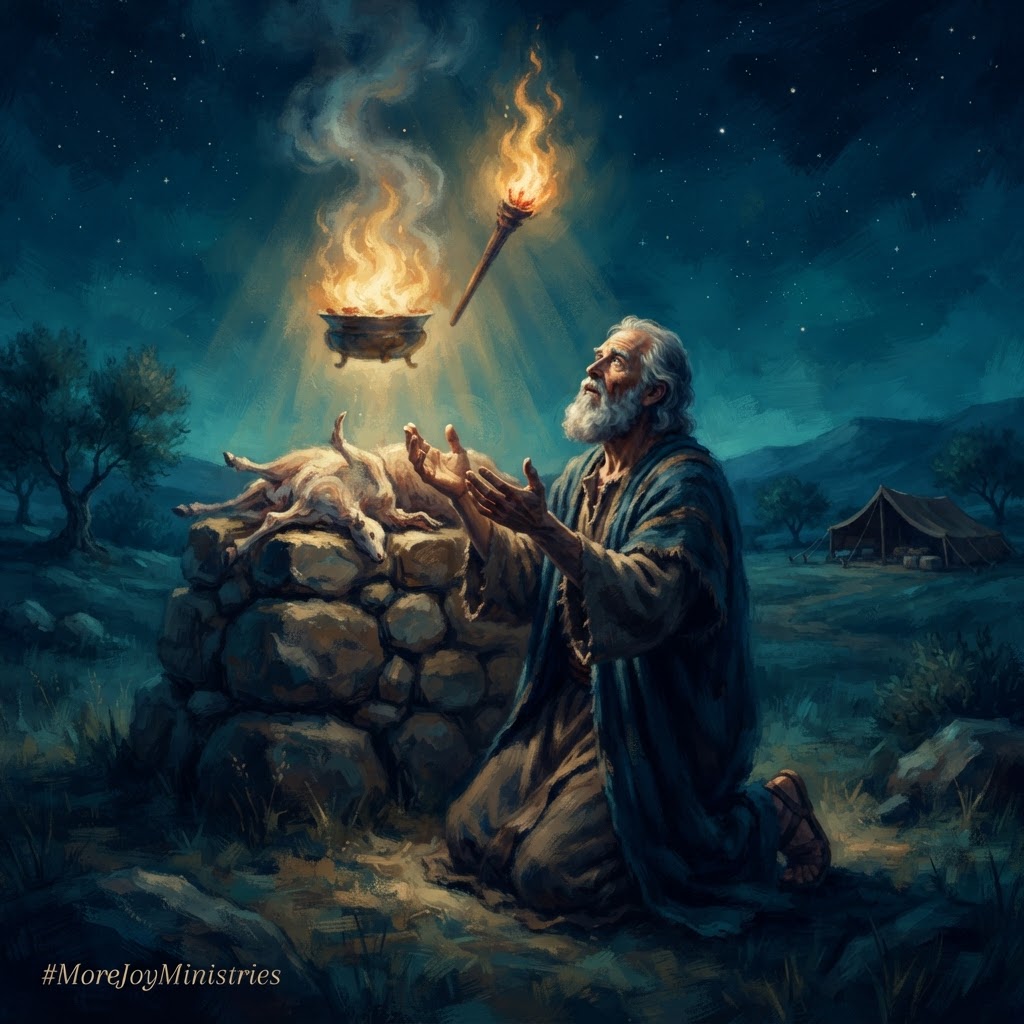
The fourth dispensation is known as the Dispensation of Promise, and it begins with the call of Abraham. It is called “Promise” because God entered into an unconditional covenant with Abraham and his descendants, a covenant that rested not on human performance, but on God’s faithfulness alone.
God promised Abraham that he would become the father of a great nation, that God would bless him and his descendants, and that through his seed all the families of the earth would be blessed. These promises were both physical and spiritual in nature. God guaranteed land, descendants, protection, blessing, and ultimately redemption through the coming Messiah. Scripture tells us that Abraham lived in the “land of promise,” dwelling there by faith while trusting God to fulfill what He had sworn by His own name.
The stewards of this dispensation were the patriarchs: Abraham, Isaac, and Jacob. The period stretches from Abraham’s call in Genesis 12 to Israel’s arrival at Mount Sinai in Exodus 19..a span of about 430 years.
Their God-given responsibility was simple: to dwell in the land of Canaan and trust the promises of God. But instead of remaining in the land of promise, they repeatedly left it. Abraham went down to Egypt during a famine. Jacob and his sons later settled permanently in Egypt. Rather than trusting God’s provision and protection, they relied on human solutions.
The patriarchs themselves also failed personally. Abraham fathered Ishmael through Hagar instead of waiting for God’s promise through Sarah. He twice deceived foreign rulers by claiming Sarah was his sister. Isaac repeated the same deception. Jacob lived much of his early life as a deceiver and manipulator. Yet despite their failures, God never withdrew His covenant.
Eventually, their descendants became enslaved in Egypt. What began as refuge became bondage. The failure to remain in the land of promise led to judgment in the form of Egyptian oppression, where Israel suffered harsh labor and affliction for generations.
And yet, once again, God’s grace intervened.
God raised up Moses as a deliverer, sending him to confront Pharaoh and lead His people out of bondage. God protected Israel through the Passover, judged Egypt through mighty plagues, parted the Red Sea, and miraculously provided food and water in the wilderness. In Exodus 19:4, God reminded Israel of His covenant mercy:
“You yourselves have seen what I did to Egypt, and how I carried you on eagles’ wings and brought you to myself.”
This dispensation powerfully demonstrates that God’s promises are not canceled by human weakness. Though Abraham, Isaac, Jacob, and Israel all failed, God remained faithful to His covenant.
The Dispensation of Promise ended at Mount Sinai, where God introduced a new administration, the Dispensation of Law. Israel would now be governed by commandments rather than promises alone. Yet even under the Law, the covenant with Abraham was never revoked.
The great lesson of this dispensation is this:
God’s promises are unconditional.
God’s faithfulness is unbreakable.
And God’s grace always triumphs over human failure.
Through Abraham’s seed, Jesus Christ would one day come, fulfilling the ultimate promise, that all nations would be blessed through Him.
More Joy Ministries, Tony Campbell