More Joy Ministries
Full Bible Study
REPLACEMENT THEOLOGY: DID THE CHURCH REPLACE ISRAEL?
This topic matters because it changes how you read almost every major prophecy passage in the Bible. It affects how you interpret Daniel, Zechariah, Matthew 24, Romans 11, Revelation, and the very meaning of covenant faithfulness. If you get Israel wrong, you will almost always get the end times wrong.
Replacement theology is often called supersessionism. The core claim is simple: national Israel no longer has a distinct covenant future because the Church has taken Israel’s place. In other words, Israel’s promises are either canceled, transferred, or reinterpreted spiritually so that the Church becomes “the true Israel” in every sense.
This is not the question of whether Gentiles can be saved. They absolutely can. This is not the question of whether there is one way of salvation. There is only one: by grace through faith in Jesus Christ. This is not the question of whether the Church shares in spiritual blessings. It does.
The real question is this: did God revoke His national covenant promises to Israel, or do those promises still stand and will be fulfilled as written?
If Scripture teaches that God permanently cast off Israel as a nation, then replacement theology is correct. But if Scripture teaches that Israel’s hardening is temporary and that God’s covenant promises remain intact, then replacement theology collapses.
So let Scripture speak.
THE FOUNDATION: GOD’S COVENANTS ARE NOT A SMALL DETAIL
To understand this issue, you have to understand how the Bible treats covenant. God does not speak casually when He makes covenant. He binds His name to His word. If God makes unconditional promises to Israel, then the only way replacement theology can be true is if God breaks His covenant word or redefines it after the fact.
Now watch how the Old Testament sets this up.
THE ABRAHAMIC COVENANT: WHO WALKED THROUGH THE PIECES?
Genesis 12 begins the promises. Genesis 15 seals them.
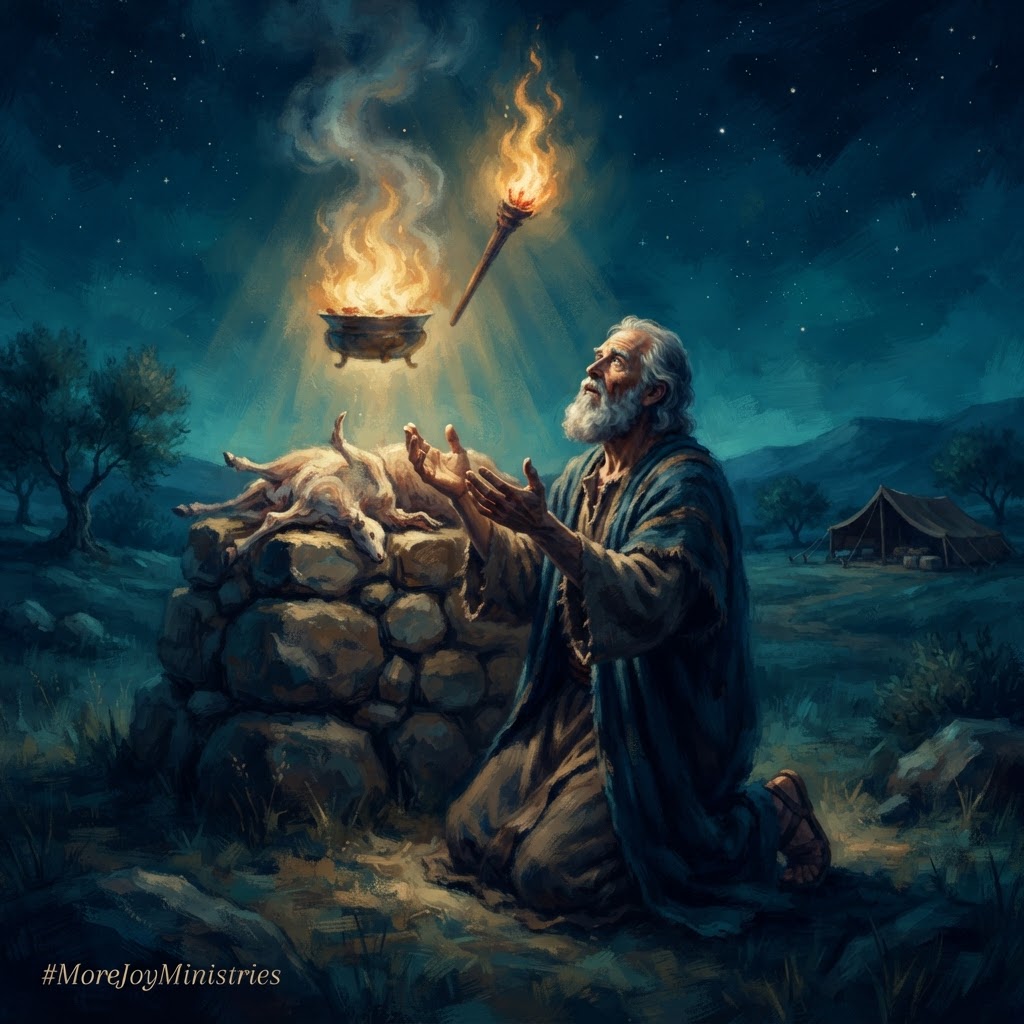
In Genesis 15, God tells Abram to prepare animals, cut them, and lay the pieces opposite one another. In the ancient world, this was covenant language. The idea was: may I become like these slain animals if I break this covenant.
But here is the key: Abram does not walk through the pieces. God does.
Genesis 15 describes a smoking furnace and a burning lamp passing between the pieces. Abram is in a deep sleep. God is the One who binds Himself to fulfill the covenant.
That means the Abrahamic covenant is not dependent on Israel’s performance for its ultimate fulfillment. It is rooted in God’s faithfulness.
And what exactly is promised?
A specific land with boundaries. A literal nation from Abraham’s seed. A global blessing through Abraham’s seed.
So immediately we learn something. The Bible does not treat Israel as a vague symbol. It treats Israel as a real people group with real promises anchored in covenant.
THE LAND PROMISE DOES NOT DISAPPEAR AFTER DISOBEDIENCE:
One of the strongest passages is Deuteronomy 30.
Moses predicts Israel’s future failure, scattering, and exile. Then God says He will restore them.
Deuteronomy 30:1 through 5 teaches regathering language from the nations back into the land. This is national language. It is geographic language. It is not describing “going to heaven.” It is describing God bringing Israel back.
So even after God predicts their disobedience, He still speaks of future restoration.
THE DAVIDIC COVENANT: A THRONE, A KINGDOM, A FOREVER PROMISE
In 2 Samuel 7:12 through 16, God promises David a dynasty and an eternal throne.
This covenant is not just “a spiritual reign in hearts.” The language is kingship, throne, kingdom, and duration.
And the New Testament explicitly connects Jesus to this promise.
Luke 1:32 through 33 says Jesus will receive “the throne of His father David” and will reign over “the house of Jacob” forever. That is covenant language. That is Israel language. That is kingdom language.
THE NEW COVENANT: “WITH THE HOUSE OF ISRAEL AND THE HOUSE OF JUDAH”
Jeremiah 31:31 through 37 is the knockout passage that replacement theology struggles to survive.
God says He will make a new covenant “with the house of Israel and with the house of Judah.” He then describes national forgiveness, internal transformation, and covenant permanence.
Then God makes this argument: only if the fixed order of the sun, moon, and stars can be removed will Israel cease from being a nation before Him.
That is not ambiguous. God anchors Israel’s continued national identity to the stability of creation.
If replacement theology says Israel is no longer a nation before God in covenant terms, then Jeremiah 31 has to be reinterpreted away from its plain meaning.
Now let’s move into the New Testament because this is where the whole debate gets decided.
THE KEY NEW TESTAMENT PASSAGE: ROMANS 9 through 11
Romans 9 through 11 is not an optional side discussion. It is Paul’s direct answer to the question: If Israel rejected Messiah, did God’s word fail? Did God cast them off? Are the promises dead?
Paul’s answer is clear.
Romans 11:1 says: “Has God cast away His people?”
Then Paul responds: “God forbid.”
In Greek that phrase is μὴ γένοιτο (mē genoito).
That is the strongest possible denial. It means: absolutely not. May it never be. No way.
Paul then proves his point by giving multiple arguments.
First, he points to himself: he is an Israelite, yet saved.
Second, he teaches that there is a remnant. God has not eliminated Israel. He has preserved a believing remnant, just like in Elijah’s day.
Third, he explains Israel’s present condition in a way that destroys replacement theology.
Romans 11:25 says Israel has experienced blindness “in part.”
Not total. Not permanent. In part.
Then Paul uses a time word: “until.”
Blindness “until the fullness of the Gentiles be come in.”
That means Israel’s hardening is temporary and has an endpoint.
Then Paul says: “and so all Israel shall be saved” (Romans 11:26).
That is not a statement that every individual Jew who has ever lived gets saved automatically. Paul is talking about national restoration at the end, when Israel turns to Messiah.
He even supports it with Old Testament citations, tying Israel’s future salvation to God’s covenant commitments.
Then Paul seals it with a sentence that replacement theology cannot honestly harmonize with a permanent casting off.
Romans 11:29 says: “For the gifts and calling of God are without repentance.”
The Greek idea is that God does not regret or revoke. His calling is not withdrawn. His gifts are not taken back.
So Paul’s framework is this.
Israel stumbled. Israel is hardened. Gentiles are being gathered. Israel will be provoked to jealousy. Israel will be restored. God’s covenant faithfulness stands.
That is not replacement. That is a temporary setting aside of national blessing while God gathers the nations, followed by a future restoration.
THE OLIVE TREE: GENTILES ARE GRAFTED IN, NOT SWAPPING ROOTS
Romans 11 also uses the olive tree picture.
Israel is pictured as the natural branches. Gentiles are the wild branches. Gentiles are grafted into a covenant root.
Paul warns Gentiles not to boast against the natural branches.
That warning only makes sense if Israel still has a future in God’s plan. If Israel was replaced permanently, there would be nothing to boast against. Paul’s warning assumes the natural branches matter and can be grafted back in again.
He explicitly says God is able to graft them in again.
That is restoration.
WHAT ABOUT THE VERSES PEOPLE USE TO ARGUE REPLACEMENT?
Let’s deal with the most common ones without dodging.
Galatians 3:28 through 29 says that in Christ, believers are Abraham’s seed and heirs according to promise.
Yes. Absolutely.
But that does not require the cancellation of Israel. It teaches that Gentiles share in spiritual blessing through faith, not that God revoked the national covenants He swore to Israel.
Sharing blessing is not the same thing as stealing identity.
Romans 2:28 through 29 says a Jew is one inwardly and circumcision is of the heart.
Yes. Paul is attacking hypocrisy and external religion.
But Paul never uses Romans 2 to redefine Israel out of existence, because in Romans 9 through 11 he still speaks of Israel as Israel with a future restoration.
Matthew 21:43 says the kingdom will be taken from you and given to a nation producing the fruits thereof.
Jesus is rebuking the leaders of Israel and announcing judgment.
But judgment does not equal covenant cancellation. Israel was judged many times in the Old Testament without God revoking His covenants. The exile did not cancel Abraham. The Babylonian captivity did not cancel David. Discipline is not divorce.
Also, Matthew 23 ends with Jesus saying Israel will not see Him again “until” they say, “Blessed is He that cometh in the name of the Lord.” That is future national recognition.
The same time word again. Until.
1 Peter 2:9 calls the Church a chosen generation, royal priesthood, holy nation.
Yes. The Church inherits spiritual identity language because we are in Christ.
But again, that does not prove Israel is erased. It proves believers share covenant blessings through Messiah. The New Testament constantly teaches inclusion without teaching replacement.
THE REAL PROBLEM WITH REPLACEMENT THEOLOGY:
It creates a massive theological issue.
If God can revoke unconditional promises made to Israel, then what guarantees the promises made to you?
If God can redefine land promises into spiritual metaphors after the fact, what prevents someone from redefining eternal life promises into metaphors?
Covenant faithfulness is not a minor issue. It is the foundation of trust.
God is not faithful because we are faithful. God is faithful because He is God.
And that is exactly Paul’s point in Romans 11. Israel’s failure magnifies God’s mercy, but it does not cancel His calling.
SO WHAT IS THE BIBLICAL VIEW?
The biblical view is balanced and it holds two truths without flattening either.
There is one body in Christ. One gospel. One salvation. Jew and Gentile are saved the same way. The Church is not a parenthesis in God’s plan; it is central to His present work.
And Israel still has national covenant promises that will be fulfilled as written. A future repentance. A future restoration. A future kingdom. A future fulfillment of the covenants in Messiah.
This is why end time prophecy keeps Israel at the center.
Daniel’s 70 weeks are “determined upon thy people and upon thy holy city” (Daniel 9:24). That is Israel. That is Jerusalem.
Zechariah 12 speaks of Jerusalem and the house of David and the inhabitants of Jerusalem looking upon Him whom they pierced, and mourning.
That is national repentance.
Jesus in Matthew 24 speaks directly to Israel’s prophetic context and Judea realities.
Revelation speaks of tribes, Jerusalem, and Israel-centered final events.
Israel isn’t a theological prop you can remove. It is woven into the covenant structure of Scripture.
Replacement theology often sounds spiritual and humble, but the fruit of it is usually this: it forces you to allegorize the plain promises of God.
When Scripture speaks clearly, we don’t upgrade it into symbolism to make it fit a system.
God meant what He said. God will do what He promised. And God is not finished with Israel.
Romans 11:33 through 36 ends this section with worship for a reason. When you realize God’s plan is bigger than human failure, the right response is awe, not arrogance.
More Joy Ministries, Tony Campbell
#MoreJoyMinistries